

6.3 Solutions
355
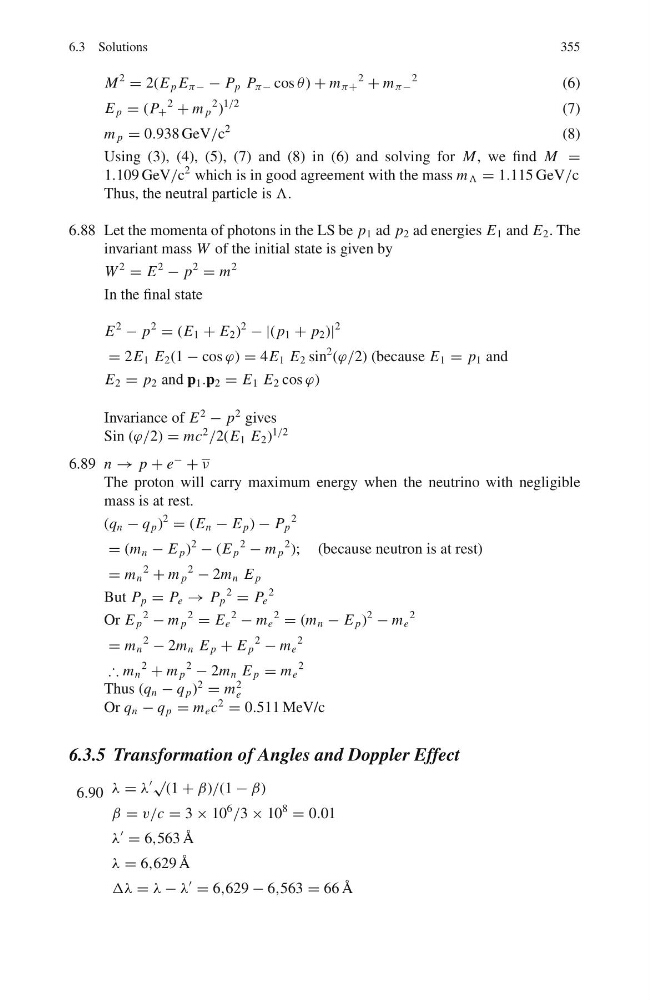
M
2
= 2(E p E π− − P p P π− cos θ) + m π+
2
+ m π −
2
(6)
E p = (P +
2
+ m p
2 )
1/2
(7)
m p = 0.938 GeV/c
2
(8)
Using (3), (4), (5), (7) and (8) in (6) and solving for M, we find M =
1.109 GeV/c
2 which is in good agreement with the mass m Λ = 1.115 GeV/c
Thus, the neutral particle is Λ.
6.88 Let the momenta of photons in the LS be p 1 ad p 2 ad energies E 1 and E 2 . The
invariant mass W of the initial state is given by
W
2
= E
2
− p
2
= m
2
In the final state
E
2
− p
2
= (E 1 + E 2 )
2
− |( p 1 + p 2 )|
2
= 2E 1 E 2 (1 − cos ϕ) = 4E 1 E 2 sin
2 (ϕ/2) (because E 1 = p 1 and
E 2 = p 2 and p 1 .p 2 = E 1 E 2 cos ϕ)
Invariance of E
2
− p
2 gives
Sin (ϕ/2) = mc
2
/2(E 1 E 2 )
1/2
6.89 n → p + e
−
+ ν
The proton will carry maximum energy when the neutrino with negligible
mass is at rest.
(q n − q p )
2
= (E n − E p ) − P p
2
= (m n − E p )
2
− (E p
2
− m p
2 ); (because neutron is at rest)
= m n
2
+ m p
2
− 2m n E p
But P p = P e → P p
2
= P e
2
Or E p
2
− m p
2
= E e
2
− m e
2
= (m n − E p )
2
− m e
2
= m n
2
− 2m n E p + E p
2
− m e
2
∴ m n
2
+ m p
2
− 2m n E p = m e
2
Thus (q n − q p )
2
= m
2
e
Or q n − q p = m e c
2
= 0.511 MeV/c
6.3.5 Transformation of Angles and Doppler Effect
6.90 λ = λ
√
(1 + β)/(1 − β)
β = v/c = 3 × 10
6
/3 × 10
8
= 0.01
λ
= 6,563 ˚
A
λ = 6,629 ˚
A
Δλ = λ − λ
= 6,629 − 6,563 = 66 ˚
A
355
M
2
= 2(E p E π− − P p P π− cos θ) + m π+
2
+ m π −
2
(6)
E p = (P +
2
+ m p
2 )
1/2
(7)
m p = 0.938 GeV/c
2
(8)
Using (3), (4), (5), (7) and (8) in (6) and solving for M, we find M =
1.109 GeV/c
2 which is in good agreement with the mass m Λ = 1.115 GeV/c
Thus, the neutral particle is Λ.
6.88 Let the momenta of photons in the LS be p 1 ad p 2 ad energies E 1 and E 2 . The
invariant mass W of the initial state is given by
W
2
= E
2
− p
2
= m
2
In the final state
E
2
− p
2
= (E 1 + E 2 )
2
− |( p 1 + p 2 )|
2
= 2E 1 E 2 (1 − cos ϕ) = 4E 1 E 2 sin
2 (ϕ/2) (because E 1 = p 1 and
E 2 = p 2 and p 1 .p 2 = E 1 E 2 cos ϕ)
Invariance of E
2
− p
2 gives
Sin (ϕ/2) = mc
2
/2(E 1 E 2 )
1/2
6.89 n → p + e
−
+ ν
The proton will carry maximum energy when the neutrino with negligible
mass is at rest.
(q n − q p )
2
= (E n − E p ) − P p
2
= (m n − E p )
2
− (E p
2
− m p
2 ); (because neutron is at rest)
= m n
2
+ m p
2
− 2m n E p
But P p = P e → P p
2
= P e
2
Or E p
2
− m p
2
= E e
2
− m e
2
= (m n − E p )
2
− m e
2
= m n
2
− 2m n E p + E p
2
− m e
2
∴ m n
2
+ m p
2
− 2m n E p = m e
2
Thus (q n − q p )
2
= m
2
e
Or q n − q p = m e c
2
= 0.511 MeV/c
6.3.5 Transformation of Angles and Doppler Effect
6.90 λ = λ
√
(1 + β)/(1 − β)
β = v/c = 3 × 10
6
/3 × 10
8
= 0.01
λ
= 6,563 ˚
A
λ = 6,629 ˚
A
Δλ = λ − λ
= 6,629 − 6,563 = 66 ˚
A