

4.3 Solutions
273
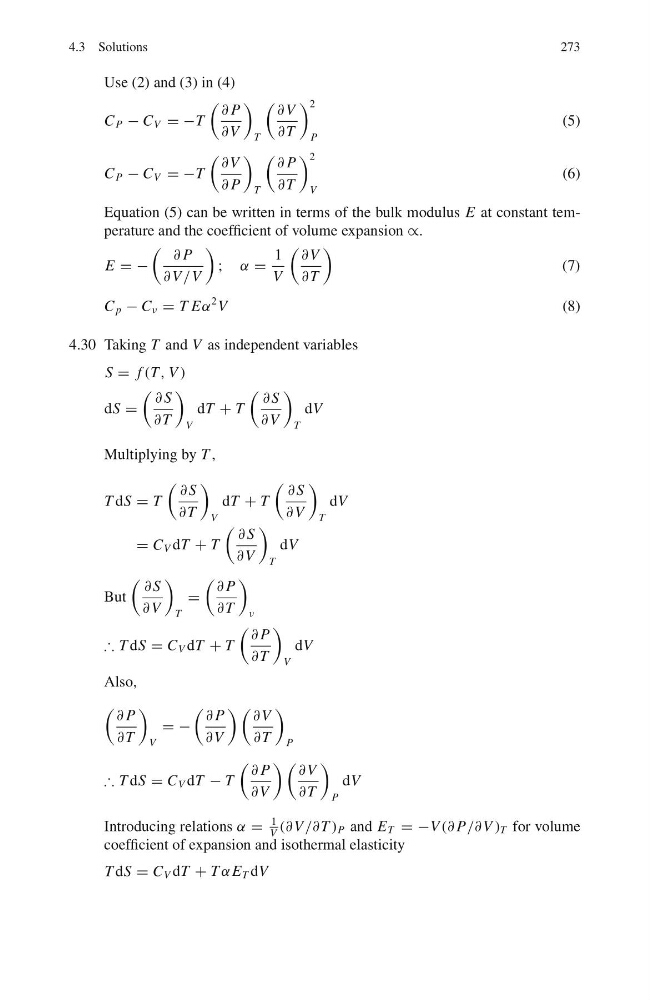
Use (2) and (3) in (4)
C P − C V = −T
∂ P
∂ V
T
∂ V
∂ T
2
P
(5)
C P − C V = −T
∂ V
∂ P
T
∂ P
∂ T
2
V
(6)
Equation (5) can be written in terms of the bulk modulus E at constant temperature and the coefficient of volume expansion ∝.
E = −
∂ P
∂ V /V
; α =
1
V
∂ V
∂ T
(7)
C p − C ν = T Eα
2 V
(8)
4.30 Taking T and V as independent variables
S = f (T, V )
dS =
∂ S
∂ T
V
dT + T
∂ S
∂ V
T
dV
Multiplying by T ,
T dS = T
∂ S
∂ T
V
dT + T
∂ S
∂ V
T
dV
= C V dT + T
∂ S
∂ V
T
dV
But
∂ S
∂ V
T
=
∂ P
∂ T
ν
∴ T dS = C V dT + T
∂ P
∂ T
V
dV
Also,
∂ P
∂ T
V
= −
∂ P
∂ V
∂ V
∂ T
P
∴ T dS = C V dT − T
∂ P
∂ V
∂ V
∂ T
P
dV
Introducing relations α =
1
V
(∂ V /∂ T ) P and E T = −V (∂ P/∂ V ) T for volume
coefficient of expansion and isothermal elasticity
T dS = C V dT + T α E T dV
273
Use (2) and (3) in (4)
C P − C V = −T
∂ P
∂ V
T
∂ V
∂ T
2
P
(5)
C P − C V = −T
∂ V
∂ P
T
∂ P
∂ T
2
V
(6)
Equation (5) can be written in terms of the bulk modulus E at constant temperature and the coefficient of volume expansion ∝.
E = −
∂ P
∂ V /V
; α =
1
V
∂ V
∂ T
(7)
C p − C ν = T Eα
2 V
(8)
4.30 Taking T and V as independent variables
S = f (T, V )
dS =
∂ S
∂ T
V
dT + T
∂ S
∂ V
T
dV
Multiplying by T ,
T dS = T
∂ S
∂ T
V
dT + T
∂ S
∂ V
T
dV
= C V dT + T
∂ S
∂ V
T
dV
But
∂ S
∂ V
T
=
∂ P
∂ T
ν
∴ T dS = C V dT + T
∂ P
∂ T
V
dV
Also,
∂ P
∂ T
V
= −
∂ P
∂ V
∂ V
∂ T
P
∴ T dS = C V dT − T
∂ P
∂ V
∂ V
∂ T
P
dV
Introducing relations α =
1
V
(∂ V /∂ T ) P and E T = −V (∂ P/∂ V ) T for volume
coefficient of expansion and isothermal elasticity
T dS = C V dT + T α E T dV