

274
4 Thermodynamics and Statistical Physics
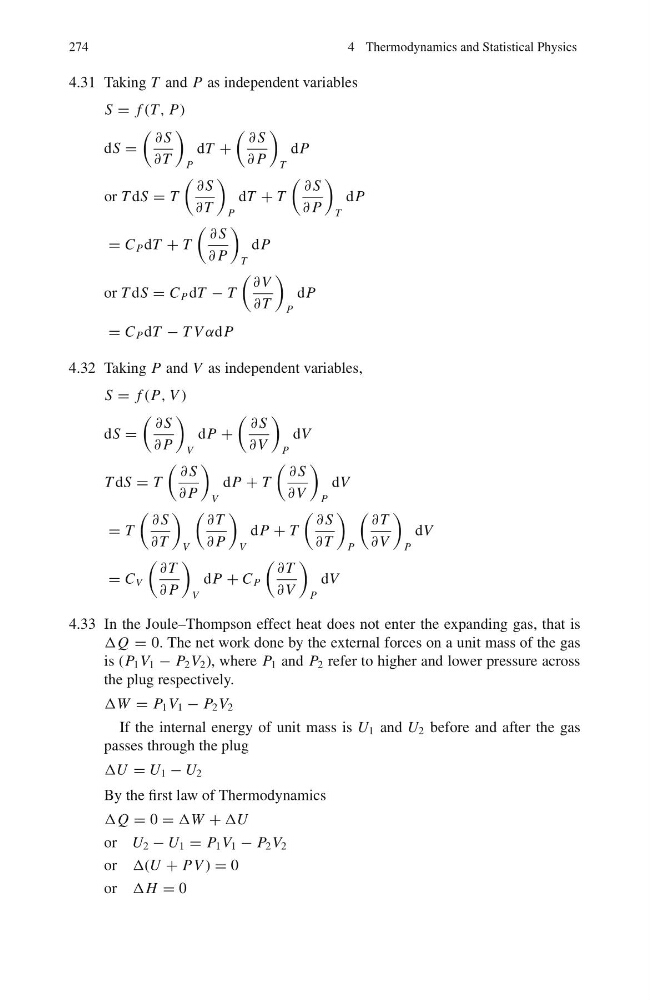
4.31 Taking T and P as independent variables
S = f (T, P)
dS =
∂ S
∂ T
P
dT +
∂ S
∂ P
T
dP
or T dS = T
∂ S
∂ T
P
dT + T
∂ S
∂ P
T
dP
= C P dT + T
∂ S
∂ P
T
dP
or T dS = C P dT − T
∂ V
∂ T
P
dP
= C P dT − T V αdP
4.32 Taking P and V as independent variables,
S = f (P, V )
dS =
∂ S
∂ P
V
dP +
∂ S
∂ V
P
dV
T dS = T
∂ S
∂ P
V
dP + T
∂ S
∂ V
P
dV
= T
∂ S
∂ T
V
∂ T
∂ P
V
dP + T
∂ S
∂ T
P
∂ T
∂ V
P
dV
= C V
∂ T
∂ P
V
dP + C P
∂ T
∂ V
P
dV
4.33 In the Joule–Thompson effect heat does not enter the expanding gas, that is
ΔQ = 0. The net work done by the external forces on a unit mass of the gas
is (P 1 V 1 − P 2 V 2 ), where P 1 and P 2 refer to higher and lower pressure across
the plug respectively.
ΔW = P 1 V 1 − P 2 V 2
If the internal energy of unit mass is U 1 and U 2 before and after the gas
passes through the plug
ΔU = U 1 − U 2
By the first law of Thermodynamics
ΔQ = 0 = ΔW + ΔU
or U 2 − U 1 = P 1 V 1 − P 2 V 2
or Δ(U + PV ) = 0
or ΔH = 0
4 Thermodynamics and Statistical Physics
4.31 Taking T and P as independent variables
S = f (T, P)
dS =
∂ S
∂ T
P
dT +
∂ S
∂ P
T
dP
or T dS = T
∂ S
∂ T
P
dT + T
∂ S
∂ P
T
dP
= C P dT + T
∂ S
∂ P
T
dP
or T dS = C P dT − T
∂ V
∂ T
P
dP
= C P dT − T V αdP
4.32 Taking P and V as independent variables,
S = f (P, V )
dS =
∂ S
∂ P
V
dP +
∂ S
∂ V
P
dV
T dS = T
∂ S
∂ P
V
dP + T
∂ S
∂ V
P
dV
= T
∂ S
∂ T
V
∂ T
∂ P
V
dP + T
∂ S
∂ T
P
∂ T
∂ V
P
dV
= C V
∂ T
∂ P
V
dP + C P
∂ T
∂ V
P
dV
4.33 In the Joule–Thompson effect heat does not enter the expanding gas, that is
ΔQ = 0. The net work done by the external forces on a unit mass of the gas
is (P 1 V 1 − P 2 V 2 ), where P 1 and P 2 refer to higher and lower pressure across
the plug respectively.
ΔW = P 1 V 1 − P 2 V 2
If the internal energy of unit mass is U 1 and U 2 before and after the gas
passes through the plug
ΔU = U 1 − U 2
By the first law of Thermodynamics
ΔQ = 0 = ΔW + ΔU
or U 2 − U 1 = P 1 V 1 − P 2 V 2
or Δ(U + PV ) = 0
or ΔH = 0