

272
4 Thermodynamics and Statistical Physics
∂ P
∂ T
V
=
R
V
(3)
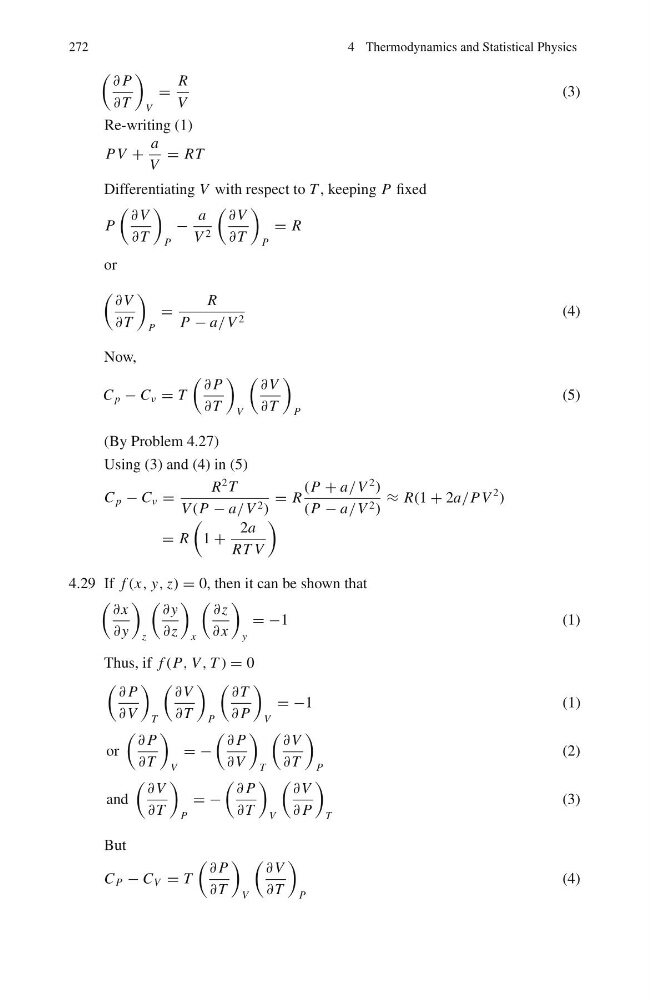
Re-writing (1)
PV +
a
V
= RT
Differentiating V with respect to T , keeping P fixed
P
∂ V
∂ T
P
−
a
V 2
∂ V
∂ T
P
= R
or
∂ V
∂ T
P
=
R
P − a/V 2
(4)
Now,
C p − C ν = T
∂ P
∂ T
V
∂ V
∂ T
P
(5)
(By Problem 4.27)
Using (3) and (4) in (5)
C p − C ν =
R
2 T
V (P − a/V 2 )
= R
(P + a/V
2 )
(P − a/V 2 )
≈ R(1 + 2a/PV
2 )
= R
1 +
2a
RT V
4.29 If f (x, y, z) = 0, then it can be shown that
∂ x
∂ y
z
∂ y
∂z
x
∂z
∂ x
y
= −1
( 1 )
Thus, if f (P, V, T ) = 0
∂ P
∂ V
T
∂ V
∂ T
P
∂ T
∂ P
V
= −1
( 1 )
or
∂ P
∂ T
V
= −
∂ P
∂ V
T
∂ V
∂ T
P
(2)
and
∂ V
∂ T
P
= −
∂ P
∂ T
V
∂ V
∂ P
T
(3)
But
C P − C V = T
∂ P
∂ T
V
∂ V
∂ T
P
(4)
4 Thermodynamics and Statistical Physics
∂ P
∂ T
V
=
R
V
(3)
Re-writing (1)
PV +
a
V
= RT
Differentiating V with respect to T , keeping P fixed
P
∂ V
∂ T
P
−
a
V 2
∂ V
∂ T
P
= R
or
∂ V
∂ T
P
=
R
P − a/V 2
(4)
Now,
C p − C ν = T
∂ P
∂ T
V
∂ V
∂ T
P
(5)
(By Problem 4.27)
Using (3) and (4) in (5)
C p − C ν =
R
2 T
V (P − a/V 2 )
= R
(P + a/V
2 )
(P − a/V 2 )
≈ R(1 + 2a/PV
2 )
= R
1 +
2a
RT V
4.29 If f (x, y, z) = 0, then it can be shown that
∂ x
∂ y
z
∂ y
∂z
x
∂z
∂ x
y
= −1
( 1 )
Thus, if f (P, V, T ) = 0
∂ P
∂ V
T
∂ V
∂ T
P
∂ T
∂ P
V
= −1
( 1 )
or
∂ P
∂ T
V
= −
∂ P
∂ V
T
∂ V
∂ T
P
(2)
and
∂ V
∂ T
P
= −
∂ P
∂ T
V
∂ V
∂ P
T
(3)
But
C P − C V = T
∂ P
∂ T
V
∂ V
∂ T
P
(4)