

3.3 Solutions
243
and minima are smeared out, just as in the case of optical diffraction from a
diffuse boundary of objects characterized by a slow varying refractive index.
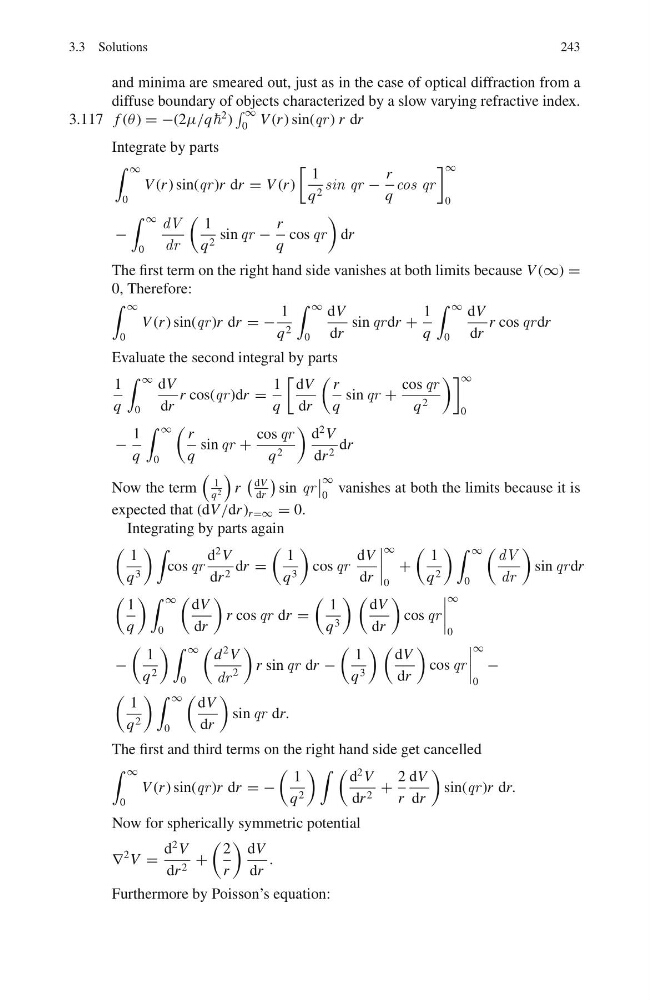
3.117 f (θ ) = −(2μ/q
2 )
∞
0 V (r ) sin(qr ) r dr
Integrate by parts
∞
0
V (r ) sin(qr )r dr = V (r )
1
q 2 sin qr −
r
q
cos qr
∞
0
−
∞
0
dV
dr
1
q 2 sin qr −
r
q
cos qr
dr
The first term on the right hand side vanishes at both limits because V (∞) =
0, Therefore:
∞
0
V (r ) sin(qr )r dr = −
1
q 2
∞
0
dV
dr
sin qr dr +
1
q
∞
0
dV
dr
r cos qr dr
Evaluate the second integral by parts
1
q
∞
0
dV
dr
r cos(qr )dr =
1
q
dV
dr
r
q
sin qr +
cos qr
q 2
∞
0
−
1
q
∞
0
r
q
sin qr +
cos qr
q 2
d
2 V
dr 2 dr
Now the term
1
q 2
r
dV
dr
sin qr
∞
0
vanishes at both the limits because it is
expected that (dV /dr ) r =∞ = 0.
Integrating by parts again
1
q 3
cos qr
d
2 V
dr 2 dr =
1
q 3
cos qr
dV
dr
∞
0
+
1
q 2
∞
0
dV
dr
sin qr dr
1
q
∞
0
dV
dr
r cos qr dr =
1
q 3
dV
dr
cos qr
∞
0
−
1
q 2
∞
0
d
2 V
dr
2
r sin qr dr −
1
q 3
dV
dr
cos qr
∞
0
−
1
q 2
∞
0
dV
dr
sin qr dr.
The first and third terms on the right hand side get cancelled
∞
0
V (r ) sin(qr )r dr = −
1
q 2
d
2 V
dr 2 +
2
r
dV
dr
sin(qr )r dr.
Now for spherically symmetric potential
∇
2 V =
d
2 V
dr 2 +
2
r
dV
dr
.
Furthermore by Poisson’s equation:
243
and minima are smeared out, just as in the case of optical diffraction from a
diffuse boundary of objects characterized by a slow varying refractive index.
3.117 f (θ ) = −(2μ/q
2 )
∞
0 V (r ) sin(qr ) r dr
Integrate by parts
∞
0
V (r ) sin(qr )r dr = V (r )
1
q 2 sin qr −
r
q
cos qr
∞
0
−
∞
0
dV
dr
1
q 2 sin qr −
r
q
cos qr
dr
The first term on the right hand side vanishes at both limits because V (∞) =
0, Therefore:
∞
0
V (r ) sin(qr )r dr = −
1
q 2
∞
0
dV
dr
sin qr dr +
1
q
∞
0
dV
dr
r cos qr dr
Evaluate the second integral by parts
1
q
∞
0
dV
dr
r cos(qr )dr =
1
q
dV
dr
r
q
sin qr +
cos qr
q 2
∞
0
−
1
q
∞
0
r
q
sin qr +
cos qr
q 2
d
2 V
dr 2 dr
Now the term
1
q 2
r
dV
dr
sin qr
∞
0
vanishes at both the limits because it is
expected that (dV /dr ) r =∞ = 0.
Integrating by parts again
1
q 3
cos qr
d
2 V
dr 2 dr =
1
q 3
cos qr
dV
dr
∞
0
+
1
q 2
∞
0
dV
dr
sin qr dr
1
q
∞
0
dV
dr
r cos qr dr =
1
q 3
dV
dr
cos qr
∞
0
−
1
q 2
∞
0
d
2 V
dr
2
r sin qr dr −
1
q 3
dV
dr
cos qr
∞
0
−
1
q 2
∞
0
dV
dr
sin qr dr.
The first and third terms on the right hand side get cancelled
∞
0
V (r ) sin(qr )r dr = −
1
q 2
d
2 V
dr 2 +
2
r
dV
dr
sin(qr )r dr.
Now for spherically symmetric potential
∇
2 V =
d
2 V
dr 2 +
2
r
dV
dr
.
Furthermore by Poisson’s equation: