

244
3 Quantum Mechanics – II
∇
2 V = −4π Ze
2
ρ
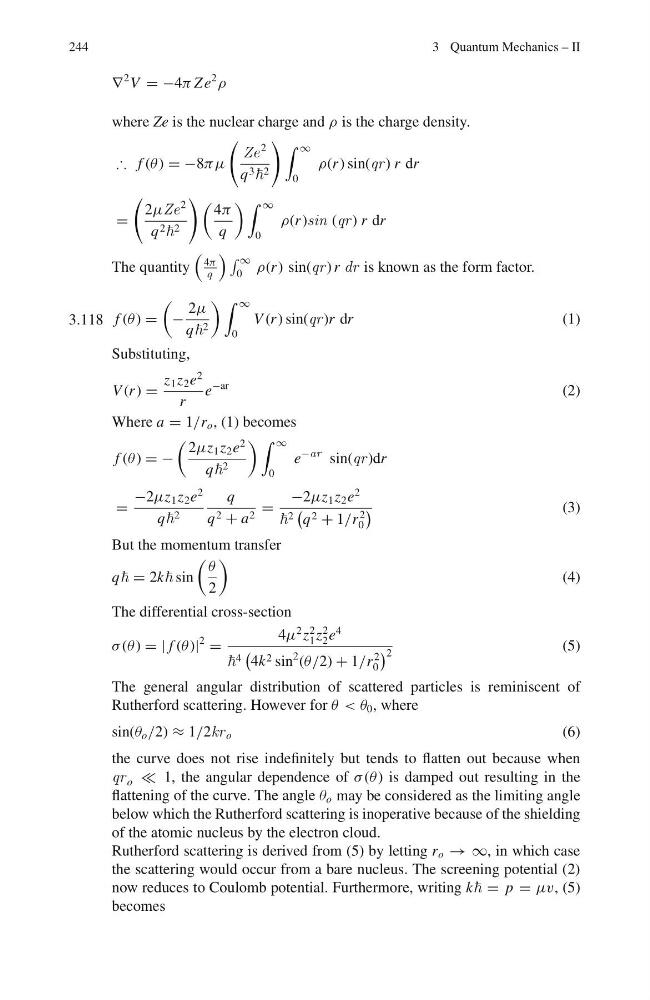
where Ze is the nuclear charge and ρ is the charge density.
∴ f (θ ) = −8πμ
Ze
2
q 3 2
∞
0
ρ(r ) sin(qr ) r dr
=
2μZe
2
q 2 2
4π
q
∞
0
ρ(r )sin (qr ) r dr
The quantity
4π
q
∞
0 ρ(r ) sin(qr ) r dr is known as the form factor.
3.118 f (θ ) =
−
2μ
q 2
∞
0
V (r ) sin(qr )r dr
(1)
Substituting,
V (r ) =
z 1 z 2 e
2
r
e
−ar
(2)
Where a = 1/r o , (1) becomes
f (θ ) = −
2μz 1 z 2 e
2
q 2
∞
0
e
−ar sin(qr )dr
=
−2μz 1 z 2 e
2
q 2
q
q 2 + a 2 =
−2μz 1 z 2 e
2
2
q 2 + 1/r
2
0
(3)
But the momentum transfer
q = 2k sin
θ
2
(4)
The differential cross-section
σ (θ ) = | f (θ )|
2
=
4μ
2 z
2
1 z
2
2 e
4
4
4k 2 sin
2 (θ/2) + 1/r
2
0
2
(5)
The general angular distribution of scattered particles is reminiscent of
Rutherford scattering. However for θ < θ 0 , where
sin(θ o /2) ≈ 1/2kr o
(6)
the curve does not rise indefinitely but tends to flatten out because when
qr o 1, the angular dependence of σ (θ ) is damped out resulting in the
flattening of the curve. The angle θ o may be considered as the limiting angle
below which the Rutherford scattering is inoperative because of the shielding
of the atomic nucleus by the electron cloud.
Rutherford scattering is derived from (5) by letting r o → ∞, in which case
the scattering would occur from a bare nucleus. The screening potential (2)
now reduces to Coulomb potential. Furthermore, writing k = p = μv, (5)
becomes
3 Quantum Mechanics – II
∇
2 V = −4π Ze
2
ρ
where Ze is the nuclear charge and ρ is the charge density.
∴ f (θ ) = −8πμ
Ze
2
q 3 2
∞
0
ρ(r ) sin(qr ) r dr
=
2μZe
2
q 2 2
4π
q
∞
0
ρ(r )sin (qr ) r dr
The quantity
4π
q
∞
0 ρ(r ) sin(qr ) r dr is known as the form factor.
3.118 f (θ ) =
−
2μ
q 2
∞
0
V (r ) sin(qr )r dr
(1)
Substituting,
V (r ) =
z 1 z 2 e
2
r
e
−ar
(2)
Where a = 1/r o , (1) becomes
f (θ ) = −
2μz 1 z 2 e
2
q 2
∞
0
e
−ar sin(qr )dr
=
−2μz 1 z 2 e
2
q 2
q
q 2 + a 2 =
−2μz 1 z 2 e
2
2
q 2 + 1/r
2
0
(3)
But the momentum transfer
q = 2k sin
θ
2
(4)
The differential cross-section
σ (θ ) = | f (θ )|
2
=
4μ
2 z
2
1 z
2
2 e
4
4
4k 2 sin
2 (θ/2) + 1/r
2
0
2
(5)
The general angular distribution of scattered particles is reminiscent of
Rutherford scattering. However for θ < θ 0 , where
sin(θ o /2) ≈ 1/2kr o
(6)
the curve does not rise indefinitely but tends to flatten out because when
qr o 1, the angular dependence of σ (θ ) is damped out resulting in the
flattening of the curve. The angle θ o may be considered as the limiting angle
below which the Rutherford scattering is inoperative because of the shielding
of the atomic nucleus by the electron cloud.
Rutherford scattering is derived from (5) by letting r o → ∞, in which case
the scattering would occur from a bare nucleus. The screening potential (2)
now reduces to Coulomb potential. Furthermore, writing k = p = μv, (5)
becomes