

234
3 Quantum Mechanics – II
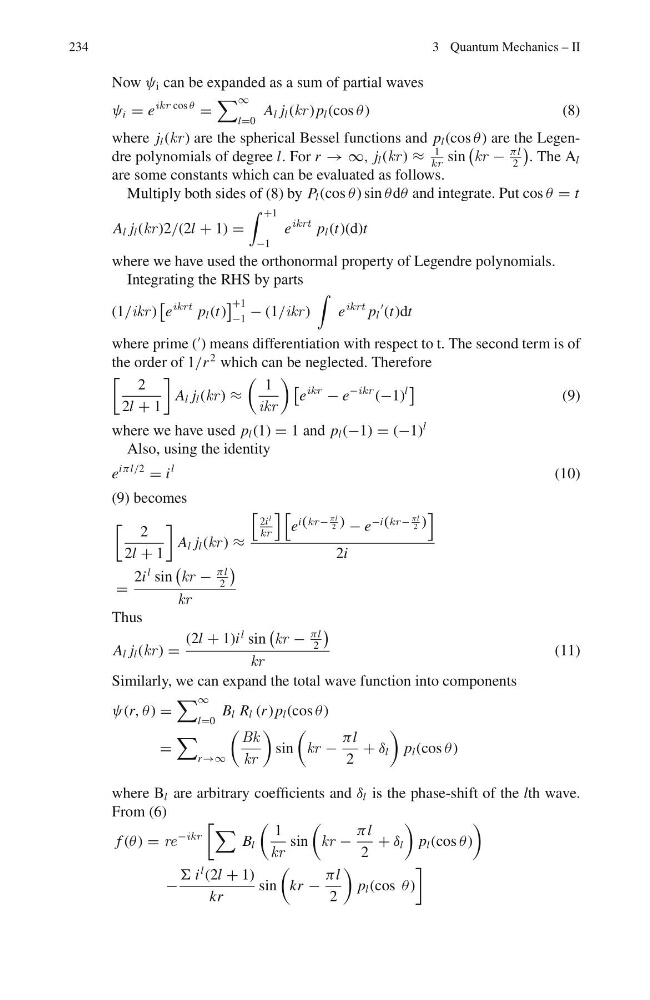
Now ψ i can be expanded as a sum of partial waves
ψ i = e
ikr cos θ
=
∞
l=0
A l j l (kr ) p l (cos θ)
( 8 )
where j l (kr ) are the spherical Bessel functions and p l (cos θ ) are the Legendre polynomials of degree l. For r → ∞, j l (kr ) ≈
1
kr
sin
kr −
πl
2
. The A l
are some constants which can be evaluated as follows.
Multiply both sides of (8) by P l (cos θ) sin θ dθ and integrate. Put cos θ = t
A l j l (kr )2/(2l + 1) =
+1
−1
e
ikrt p l (t)(d)t
where we have used the orthonormal property of Legendre polynomials.
Integrating the RHS by parts
(1/ikr )
e
ikrt p l (t)
+1
−1
− (1/ikr )
e
ikrt p l
(t)dt
where prime (
) means differentiation with respect to t. The second term is of
the order of 1/r
2 which can be neglected. Therefore
2
2l + 1
A l j l (kr ) ≈
1
ikr
e
ikr
− e
−ikr (−1)
l
(9)
where we have used p l (1) = 1 and p l (−1) = (−1)
l
Also, using the identity
e
iπl/2
= i
l
(10)
(9) becomes
2
2l + 1
A l j l (kr ) ≈
2i
l
kr
e
i(kr −
πl
2 ) − e
−i(kr −
πl
2 )
2i
=
2i
l sin
kr −
πl
2
kr
Thus
A l j l (kr ) =
(2l + 1)i
l sin
kr −
πl
2
kr
(11)
Similarly, we can expand the total wave function into components
ψ(r, θ) =
∞
l=0
B l R l (r ) p l (cos θ)
=
r →∞
Bk
kr
sin
kr −
πl
2
+ δ l
p l (cos θ )
where B l are arbitrary coefficients and δ l is the phase-shift of the lth wave.
From (6)
f (θ ) = re
−ikr
B l
1
kr
sin
kr −
πl
2
+ δ l
p l (cos θ )
−
Σ i
l (2l + 1)
kr
sin
kr −
πl
2
p l (cos θ )
3 Quantum Mechanics – II
Now ψ i can be expanded as a sum of partial waves
ψ i = e
ikr cos θ
=
∞
l=0
A l j l (kr ) p l (cos θ)
( 8 )
where j l (kr ) are the spherical Bessel functions and p l (cos θ ) are the Legendre polynomials of degree l. For r → ∞, j l (kr ) ≈
1
kr
sin
kr −
πl
2
. The A l
are some constants which can be evaluated as follows.
Multiply both sides of (8) by P l (cos θ) sin θ dθ and integrate. Put cos θ = t
A l j l (kr )2/(2l + 1) =
+1
−1
e
ikrt p l (t)(d)t
where we have used the orthonormal property of Legendre polynomials.
Integrating the RHS by parts
(1/ikr )
e
ikrt p l (t)
+1
−1
− (1/ikr )
e
ikrt p l
(t)dt
where prime (
) means differentiation with respect to t. The second term is of
the order of 1/r
2 which can be neglected. Therefore
2
2l + 1
A l j l (kr ) ≈
1
ikr
e
ikr
− e
−ikr (−1)
l
(9)
where we have used p l (1) = 1 and p l (−1) = (−1)
l
Also, using the identity
e
iπl/2
= i
l
(10)
(9) becomes
2
2l + 1
A l j l (kr ) ≈
2i
l
kr
e
i(kr −
πl
2 ) − e
−i(kr −
πl
2 )
2i
=
2i
l sin
kr −
πl
2
kr
Thus
A l j l (kr ) =
(2l + 1)i
l sin
kr −
πl
2
kr
(11)
Similarly, we can expand the total wave function into components
ψ(r, θ) =
∞
l=0
B l R l (r ) p l (cos θ)
=
r →∞
Bk
kr
sin
kr −
πl
2
+ δ l
p l (cos θ )
where B l are arbitrary coefficients and δ l is the phase-shift of the lth wave.
From (6)
f (θ ) = re
−ikr
B l
1
kr
sin
kr −
πl
2
+ δ l
p l (cos θ )
−
Σ i
l (2l + 1)
kr
sin
kr −
πl
2
p l (cos θ )