

3.3 Solutions
235
or e
ikr f (θ ) =
B l p l (cos θ)
e
i (kr−
πl
2
+δ l ) − e
−i(kr −
πl
2
+δ l )
2ik
−
i
l (2l + 1) p l (cos θ)
e
i(kr −
πl
2 ) − e
−i(kr −
πl
2 )
2ik
Equating coefficients of e
−ikr
0 = −
1
2ik
B l p l (cos θ)
e
−i(−πl/2+δ l )
+
i
l (2l + 1)P l (cos θ )
2ik
e
iπl/2
Therefore
B l = i
l (2l + 1)e
iδ l
(12)
Equating coefficients of e
ikr , and using the value of B l
f (θ ) =
1
2ik
i
l (2l + 1)e
iδ l p l (cos θ)e
i(−
πl
2
+δ l )
−
i
l (2l + 1) p l (cos θ)e
−
πl
2
=
1
2ik
i
l (2l + 1)P l (cos θ)e
−iπl/2
e
2iδ l − 1
(13)
Using (10), formula (12) becomes
f (θ ) =
1
2ik
(2l + 1)(e
2iδ l − 1)P l (cos θ)
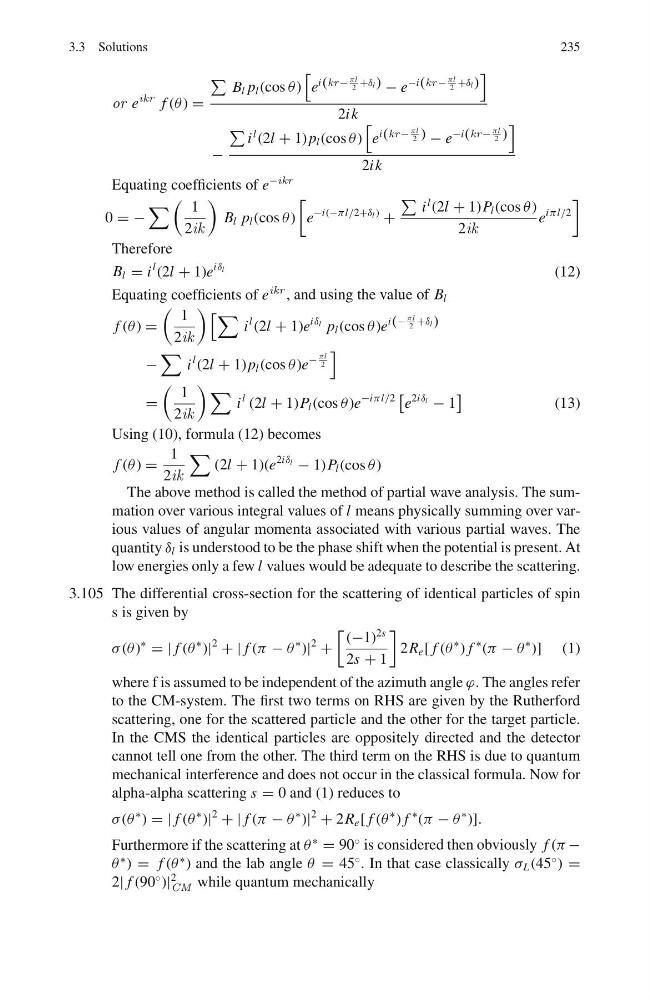
The above method is called the method of partial wave analysis. The summation over various integral values of l means physically summing over various values of angular momenta associated with various partial waves. The
quantity δ l is understood to be the phase shift when the potential is present. At
low energies only a few l values would be adequate to describe the scattering.
3.105 The differential cross-section for the scattering of identical particles of spin
s is given by
σ (θ )
∗
= | f (θ
∗ )|
2
+ | f (π − θ
∗ )|
2
+
(−1)
2s
2s + 1
2R e [ f (θ
∗ ) f
∗ (π − θ
∗ )] (1)
where f is assumed to be independent of the azimuth angle ϕ. The angles refer
to the CM-system. The first two terms on RHS are given by the Rutherford
scattering, one for the scattered particle and the other for the target particle.
In the CMS the identical particles are oppositely directed and the detector
cannot tell one from the other. The third term on the RHS is due to quantum
mechanical interference and does not occur in the classical formula. Now for
alpha-alpha scattering s = 0 and (1) reduces to
σ (θ
∗ ) = | f (θ
∗ )|
2
+ | f (π − θ
∗ )|
2
+ 2R e [ f (θ
∗ ) f
∗ (π − θ
∗ )].
Furthermore if the scattering at θ
∗
= 90
◦ is considered then obviously f (π −
θ
∗ ) = f (θ
∗ ) and the lab angle θ = 45
◦ . In that case classically σ L (45
◦ ) =
2| f (90
◦ )|
2
CM while quantum mechanically
235
or e
ikr f (θ ) =
B l p l (cos θ)
e
i (kr−
πl
2
+δ l ) − e
−i(kr −
πl
2
+δ l )
2ik
−
i
l (2l + 1) p l (cos θ)
e
i(kr −
πl
2 ) − e
−i(kr −
πl
2 )
2ik
Equating coefficients of e
−ikr
0 = −
1
2ik
B l p l (cos θ)
e
−i(−πl/2+δ l )
+
i
l (2l + 1)P l (cos θ )
2ik
e
iπl/2
Therefore
B l = i
l (2l + 1)e
iδ l
(12)
Equating coefficients of e
ikr , and using the value of B l
f (θ ) =
1
2ik
i
l (2l + 1)e
iδ l p l (cos θ)e
i(−
πl
2
+δ l )
−
i
l (2l + 1) p l (cos θ)e
−
πl
2
=
1
2ik
i
l (2l + 1)P l (cos θ)e
−iπl/2
e
2iδ l − 1
(13)
Using (10), formula (12) becomes
f (θ ) =
1
2ik
(2l + 1)(e
2iδ l − 1)P l (cos θ)
The above method is called the method of partial wave analysis. The summation over various integral values of l means physically summing over various values of angular momenta associated with various partial waves. The
quantity δ l is understood to be the phase shift when the potential is present. At
low energies only a few l values would be adequate to describe the scattering.
3.105 The differential cross-section for the scattering of identical particles of spin
s is given by
σ (θ )
∗
= | f (θ
∗ )|
2
+ | f (π − θ
∗ )|
2
+
(−1)
2s
2s + 1
2R e [ f (θ
∗ ) f
∗ (π − θ
∗ )] (1)
where f is assumed to be independent of the azimuth angle ϕ. The angles refer
to the CM-system. The first two terms on RHS are given by the Rutherford
scattering, one for the scattered particle and the other for the target particle.
In the CMS the identical particles are oppositely directed and the detector
cannot tell one from the other. The third term on the RHS is due to quantum
mechanical interference and does not occur in the classical formula. Now for
alpha-alpha scattering s = 0 and (1) reduces to
σ (θ
∗ ) = | f (θ
∗ )|
2
+ | f (π − θ
∗ )|
2
+ 2R e [ f (θ
∗ ) f
∗ (π − θ
∗ )].
Furthermore if the scattering at θ
∗
= 90
◦ is considered then obviously f (π −
θ
∗ ) = f (θ
∗ ) and the lab angle θ = 45
◦ . In that case classically σ L (45
◦ ) =
2| f (90
◦ )|
2
CM while quantum mechanically