

3.3 Solutions
233
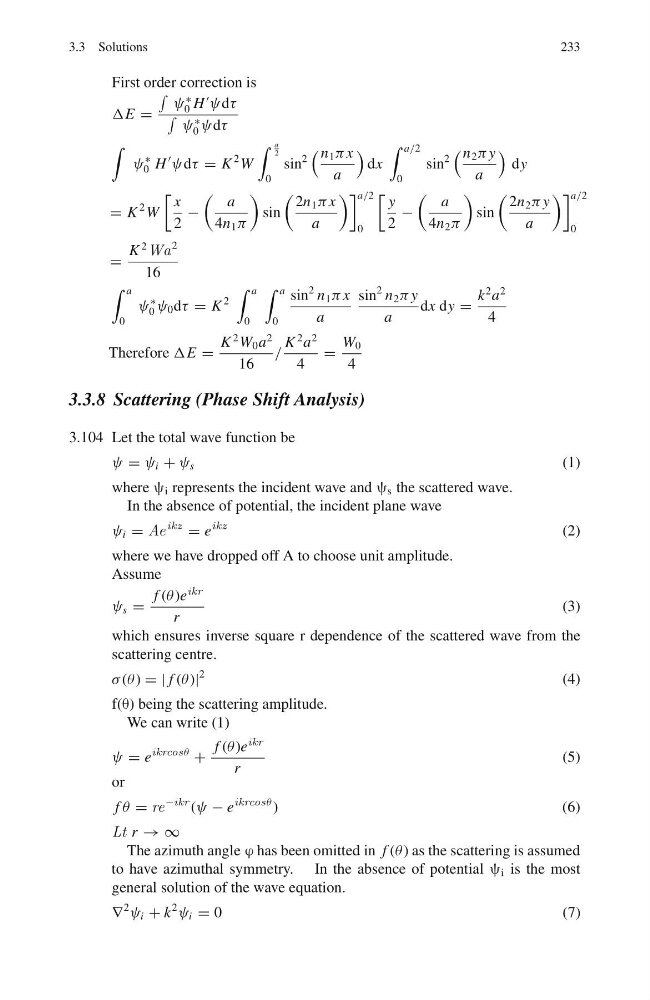
First order correction is
ΔE =
ψ
∗
0 H
ψdτ
ψ
∗
0 ψdτ
ψ
∗
0 H
ψdτ = K
2 W
a
2
0
sin
2
n 1 π x
a
dx
a/2
0
sin
2
n 2 π y
a
dy
= K
2 W
x
2
−
a
4n 1 π
sin
2n 1 π x
a
a/2
0
y
2
−
a
4n 2 π
sin
2n 2 π y
a
a/2
0
=
K
2 Wa
2
16
a
0
ψ
∗
0 ψ 0 dτ = K
2
a
0
a
0
sin
2 n 1 π x
a
sin
2 n 2 π y
a
dx dy =
k
2 a
2
4
Therefore ΔE =
K
2 W 0 a
2
16
/
K
2 a
2
4
=
W 0
4
3.3.8 Scattering (Phase Shift Analysis)
3.104 Let the total wave function be
ψ = ψ i + ψ s
(1)
where ψ i represents the incident wave and ψ s the scattered wave.
In the absence of potential, the incident plane wave
ψ i = Ae
ikz
= e
ikz
(2)
where we have dropped off A to choose unit amplitude.
Assume
ψ s =
f (θ )e
ikr
r
(3)
which ensures inverse square r dependence of the scattered wave from the
scattering centre.
σ (θ ) = | f (θ )|
2
(4)
f(θ) being the scattering amplitude.
We can write (1)
ψ = e
ikrcosθ
+
f (θ )e
ikr
r
(5)
or
f θ = re
−ikr (ψ − e
ikrcosθ )
( 6 )
Lt r → ∞
The azimuth angle ϕ has been omitted in f (θ ) as the scattering is assumed
to have azimuthal symmetry. In the absence of potential ψ i is the most
general solution of the wave equation.
∇
2
ψ i + k
2
ψ i = 0
( 7 )
233
First order correction is
ΔE =
ψ
∗
0 H
ψdτ
ψ
∗
0 ψdτ
ψ
∗
0 H
ψdτ = K
2 W
a
2
0
sin
2
n 1 π x
a
dx
a/2
0
sin
2
n 2 π y
a
dy
= K
2 W
x
2
−
a
4n 1 π
sin
2n 1 π x
a
a/2
0
y
2
−
a
4n 2 π
sin
2n 2 π y
a
a/2
0
=
K
2 Wa
2
16
a
0
ψ
∗
0 ψ 0 dτ = K
2
a
0
a
0
sin
2 n 1 π x
a
sin
2 n 2 π y
a
dx dy =
k
2 a
2
4
Therefore ΔE =
K
2 W 0 a
2
16
/
K
2 a
2
4
=
W 0
4
3.3.8 Scattering (Phase Shift Analysis)
3.104 Let the total wave function be
ψ = ψ i + ψ s
(1)
where ψ i represents the incident wave and ψ s the scattered wave.
In the absence of potential, the incident plane wave
ψ i = Ae
ikz
= e
ikz
(2)
where we have dropped off A to choose unit amplitude.
Assume
ψ s =
f (θ )e
ikr
r
(3)
which ensures inverse square r dependence of the scattered wave from the
scattering centre.
σ (θ ) = | f (θ )|
2
(4)
f(θ) being the scattering amplitude.
We can write (1)
ψ = e
ikrcosθ
+
f (θ )e
ikr
r
(5)
or
f θ = re
−ikr (ψ − e
ikrcosθ )
( 6 )
Lt r → ∞
The azimuth angle ϕ has been omitted in f (θ ) as the scattering is assumed
to have azimuthal symmetry. In the absence of potential ψ i is the most
general solution of the wave equation.
∇
2
ψ i + k
2
ψ i = 0
( 7 )