

232
3 Quantum Mechanics – II
2S(m = 0); ψ 2s (0) = (4π)
−
1
2
1
2a
3
2
2 −
r
a
exp
−
r
a
2P(m = 0); ψ 2 p (0) = (4π)
−
1
2
1
2a
3
2 r
a
exp
−
r
2a
cos θ
We can calculate
< 2, 0, 0|z|2, 1, 0 >=< 2, 0, 0|r cos θ|2, 1, 0 >
=
1
4π
1
2a
3
1
a
∞
0
r
4
2 −
r
a
exp
−
r
a
dr
π
0
cos
2
θ sin θdθ
2π
0
dϕ
= −3a
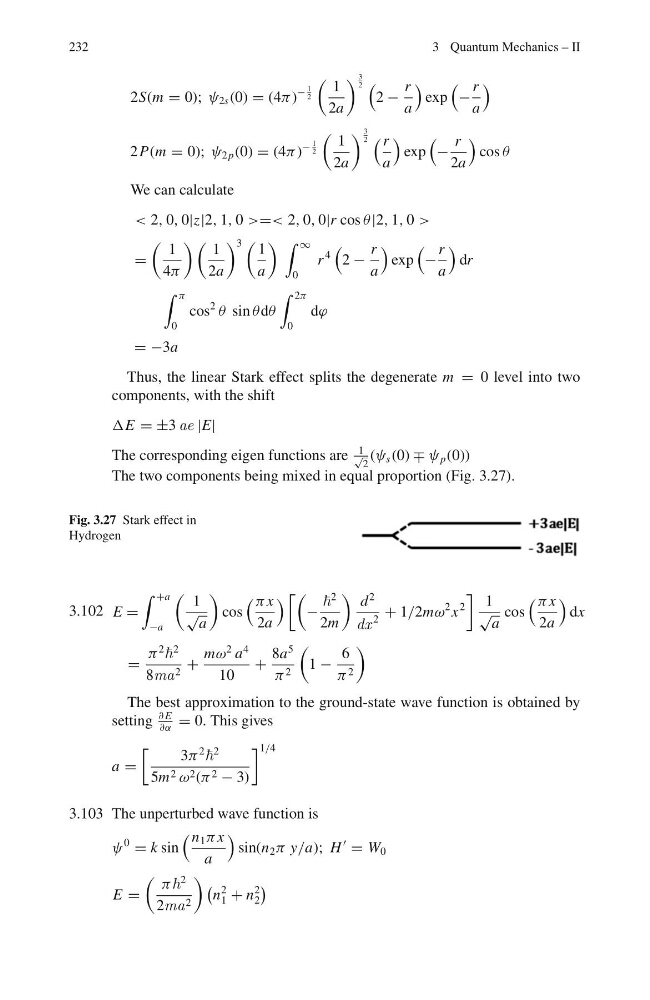
Thus, the linear Stark effect splits the degenerate m = 0 level into two
components, with the shift
ΔE = ±3 ae |E|
The corresponding eigen functions are
1
√
2
(ψ s (0) ∓ ψ p (0))
The two components being mixed in equal proportion (Fig. 3.27).
Fig. 3.27 Stark effect in
Hydrogen
3.102 E =
+a
−a
1
√
a
cos
π x
2a
−
2
2m
d
2
dx
2
+ 1/2mω
2 x
2
1
√
a
cos
π x
2a
dx
=
π
2
2
8ma 2 +
mω
2 a
4
10
+
8a
5
π 2
1 −
6
π 2
The best approximation to the ground-state wave function is obtained by
setting
∂ E
∂α
= 0. This gives
a =
3π
2
2
5m 2 ω 2 (π 2 − 3)
1/4
3.103 The unperturbed wave function is
ψ
0
= k sin
n 1 π x
a
sin(n 2 π y/a); H
= W 0
E =
π
2
2ma 2
n
2
1 + n
2
2
3 Quantum Mechanics – II
2S(m = 0); ψ 2s (0) = (4π)
−
1
2
1
2a
3
2
2 −
r
a
exp
−
r
a
2P(m = 0); ψ 2 p (0) = (4π)
−
1
2
1
2a
3
2 r
a
exp
−
r
2a
cos θ
We can calculate
< 2, 0, 0|z|2, 1, 0 >=< 2, 0, 0|r cos θ|2, 1, 0 >
=
1
4π
1
2a
3
1
a
∞
0
r
4
2 −
r
a
exp
−
r
a
dr
π
0
cos
2
θ sin θdθ
2π
0
dϕ
= −3a
Thus, the linear Stark effect splits the degenerate m = 0 level into two
components, with the shift
ΔE = ±3 ae |E|
The corresponding eigen functions are
1
√
2
(ψ s (0) ∓ ψ p (0))
The two components being mixed in equal proportion (Fig. 3.27).
Fig. 3.27 Stark effect in
Hydrogen
3.102 E =
+a
−a
1
√
a
cos
π x
2a
−
2
2m
d
2
dx
2
+ 1/2mω
2 x
2
1
√
a
cos
π x
2a
dx
=
π
2
2
8ma 2 +
mω
2 a
4
10
+
8a
5
π 2
1 −
6
π 2
The best approximation to the ground-state wave function is obtained by
setting
∂ E
∂α
= 0. This gives
a =
3π
2
2
5m 2 ω 2 (π 2 − 3)
1/4
3.103 The unperturbed wave function is
ψ
0
= k sin
n 1 π x
a
sin(n 2 π y/a); H
= W 0
E =
π
2
2ma 2
n
2
1 + n
2
2