

3.3 Solutions
203
Similarly < Δ p x >
2
=< p
2
>
1
/ 2 mω
2
< x
2
> ·
1
2m
< p x >
2
≤
1
4
ω
2
2
< x
2
>< p
2
x >
1/2 ≤
2
or Δx.Δ p x ≤
2
Now compare this result with the uncertainty principle
Δx · Δ p x ≤
2
We conclude that Δx.Δ p x ≥
2
. Obviously the zero point energy could not
have been lower than
ω
2
without violating the uncertainty principle.
3.55 The probability distribution for the quantum mechanical simple harmonic
oscillator (S.H.O) is
P(x) = |ψ n |
2
=
α exp(−ξ
2 )H
2
n (ξ )
√ π2 n n!
(1)
ξ = αx; α
4
= mk/
2
Stirling approximation gives
n! → (2nπ )
1/2 n
n e
−n
(2)
Furthermore the asymptotic expression for Hermite function is
H n (ξ )(for n → ∞) → 2
n+1 (n/2e)
n
2
√
2 cos β
exp(nβ
2 ) cos
(2n +
1
/ 2 )β −
nπ
2
(3)
where sin β = ξ/
√
2n
(4)
Using (2) and (3) in (1)
P(x) → 2α exp(−ξ
2 ) exp(2nβ
2 )
cos
2
2n +
1
2
β −
nπ
2
π
√
2n cos β
But < cos
2
2n +
1
2
β −
nπ
2
>=
1
2
Therefore P(x) =
α exp(−ξ
2 ) exp(2nβ
2 )
π
√
2n cos β
(5)
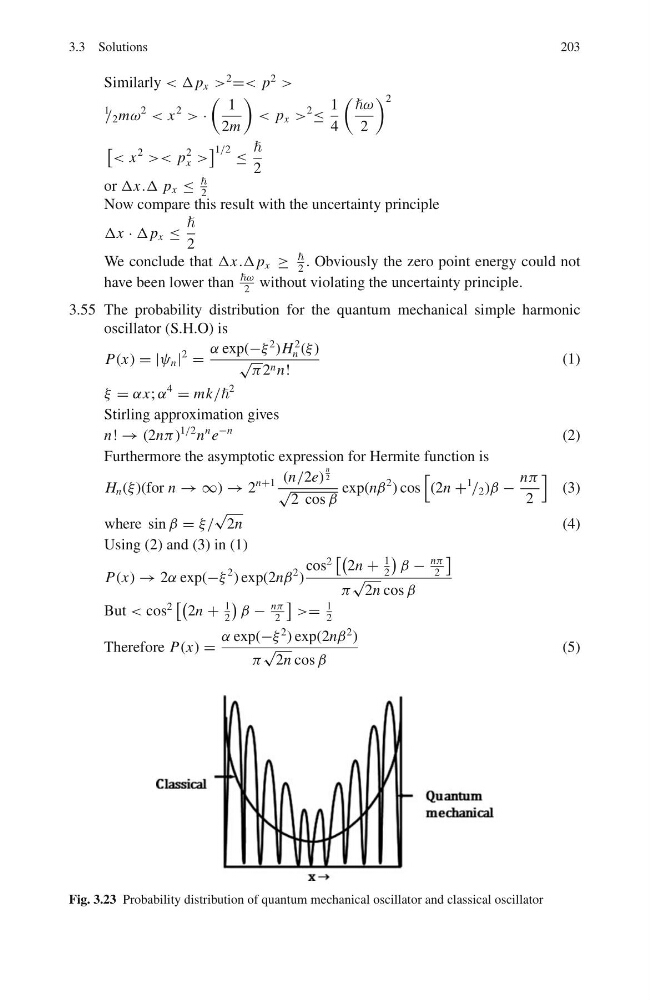
Fig. 3.23 Probability distribution of quantum mechanical oscillator and classical oscillator
203
Similarly < Δ p x >
2
=< p
2
>
1
/ 2 mω
2
< x
2
> ·
1
2m
< p x >
2
≤
1
4
ω
2
2
< x
2
>< p
2
x >
1/2 ≤
2
or Δx.Δ p x ≤
2
Now compare this result with the uncertainty principle
Δx · Δ p x ≤
2
We conclude that Δx.Δ p x ≥
2
. Obviously the zero point energy could not
have been lower than
ω
2
without violating the uncertainty principle.
3.55 The probability distribution for the quantum mechanical simple harmonic
oscillator (S.H.O) is
P(x) = |ψ n |
2
=
α exp(−ξ
2 )H
2
n (ξ )
√ π2 n n!
(1)
ξ = αx; α
4
= mk/
2
Stirling approximation gives
n! → (2nπ )
1/2 n
n e
−n
(2)
Furthermore the asymptotic expression for Hermite function is
H n (ξ )(for n → ∞) → 2
n+1 (n/2e)
n
2
√
2 cos β
exp(nβ
2 ) cos
(2n +
1
/ 2 )β −
nπ
2
(3)
where sin β = ξ/
√
2n
(4)
Using (2) and (3) in (1)
P(x) → 2α exp(−ξ
2 ) exp(2nβ
2 )
cos
2
2n +
1
2
β −
nπ
2
π
√
2n cos β
But < cos
2
2n +
1
2
β −
nπ
2
>=
1
2
Therefore P(x) =
α exp(−ξ
2 ) exp(2nβ
2 )
π
√
2n cos β
(5)
Fig. 3.23 Probability distribution of quantum mechanical oscillator and classical oscillator