

202
3 Quantum Mechanics – II
Br
2
= x
(8)
Substitute (8) in (7) and simplify, to obtain
xd
2
v
dx 2 +
dv
dx
(C − x) − Av = 0
( 9 )
which is the familiar confluent hyper geometric equation whose solution
which is regular at x = 0 is;
V (A, C, x) = α 0
1 +
Ax
C
+
A(A + 1)x
2
C(C + 1)2!
+
A(A + 1)( A + 2)x
3
C(C + 1)(C + 2)3!
+ · · · .
V ( A, C, Br
2 ) = α 0
1 +
ABr
2
C
+
A( A + 1)B
2 r
4
C(C + 1)2!
+
A( A + 1)( A + 2)B
3 r
6
C(C + 1)(C + 2)3!
+ · · ·
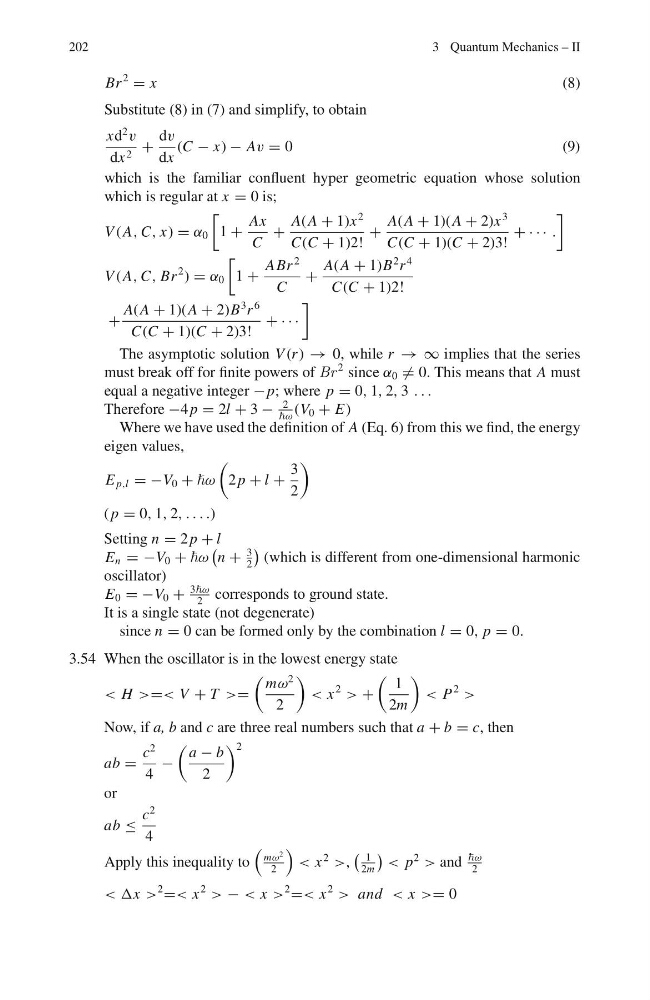
The asymptotic solution V (r ) → 0, while r → ∞ implies that the series
must break off for finite powers of Br
2 since α 0 = 0. This means that A must
equal a negative integer − p; where p = 0, 1, 2, 3 . . .
Therefore −4 p = 2l + 3 −
2
ω
(V 0 + E)
Where we have used the definition of A (Eq. 6) from this we find, the energy
eigen values,
E p,l = −V 0 + ω
2 p + l +
3
2
( p = 0, 1, 2, . . . .)
Setting n = 2 p + l
E n = −V 0 + ω
n +
3
2
(which is different from one-dimensional harmonic
oscillator)
E 0 = −V 0 +
3ω
2
corresponds to ground state.
It is a single state (not degenerate)
since n = 0 can be formed only by the combination l = 0, p = 0.
3.54 When the oscillator is in the lowest energy state
< H >=< V + T >=
mω
2
2
< x
2
> +
1
2m
< P
2
>
Now, if a, b and c are three real numbers such that a + b = c, then
ab =
c
2
4
−
a − b
2
2
or
ab ≤
c
2
4
Apply this inequality to
mω
2
2
< x
2
>,
1
2m
< p
2
> and
ω
2
< Δx >
2
=< x
2
> − < x >
2
=< x
2
> and < x >= 0
3 Quantum Mechanics – II
Br
2
= x
(8)
Substitute (8) in (7) and simplify, to obtain
xd
2
v
dx 2 +
dv
dx
(C − x) − Av = 0
( 9 )
which is the familiar confluent hyper geometric equation whose solution
which is regular at x = 0 is;
V (A, C, x) = α 0
1 +
Ax
C
+
A(A + 1)x
2
C(C + 1)2!
+
A(A + 1)( A + 2)x
3
C(C + 1)(C + 2)3!
+ · · · .
V ( A, C, Br
2 ) = α 0
1 +
ABr
2
C
+
A( A + 1)B
2 r
4
C(C + 1)2!
+
A( A + 1)( A + 2)B
3 r
6
C(C + 1)(C + 2)3!
+ · · ·
The asymptotic solution V (r ) → 0, while r → ∞ implies that the series
must break off for finite powers of Br
2 since α 0 = 0. This means that A must
equal a negative integer − p; where p = 0, 1, 2, 3 . . .
Therefore −4 p = 2l + 3 −
2
ω
(V 0 + E)
Where we have used the definition of A (Eq. 6) from this we find, the energy
eigen values,
E p,l = −V 0 + ω
2 p + l +
3
2
( p = 0, 1, 2, . . . .)
Setting n = 2 p + l
E n = −V 0 + ω
n +
3
2
(which is different from one-dimensional harmonic
oscillator)
E 0 = −V 0 +
3ω
2
corresponds to ground state.
It is a single state (not degenerate)
since n = 0 can be formed only by the combination l = 0, p = 0.
3.54 When the oscillator is in the lowest energy state
< H >=< V + T >=
mω
2
2
< x
2
> +
1
2m
< P
2
>
Now, if a, b and c are three real numbers such that a + b = c, then
ab =
c
2
4
−
a − b
2
2
or
ab ≤
c
2
4
Apply this inequality to
mω
2
2
< x
2
>,
1
2m
< p
2
> and
ω
2
< Δx >
2
=< x
2
> − < x >
2
=< x
2
> and < x >= 0