

3.3 Solutions
201
The boundary condition that u/r be finite at r = 0 demands that b = 0.
Thus, ψ is proportional to r
l . The probability that a particle be in a spherical
shell of radii r and r + dr for small r , is proportional to r
2l+2 dr . The larger l
is, the smaller is the probability that the particle be in the vicinity of the origin.
For the case of collision problems, there is a classical analogy: the larger the
orbital angular momentum the larger the impact parameter.
Thus u(r ) ∼ r
l+1 (r → 0)
For → ∞, we obtain, as an approximation to differential equation (3), as
d
2 u
dr 2 −
2μγ
2 r
2 u
2
= 0
If we try a solution of the form,
u(r ) = u 0 e
−Br
2 /2
the asymptotically valid solution is satisfied provided we change
B =
γ (2μ)
1
2
=
μω
Inorder to solve (3) for all r , we may first separate the asymptotic behaviour
by writing
u(r ) = r
l+1 e
Br
2 /2 V (r )
( 5 )
Insert (5) in (3), and dividing by r
l+1 e
−Bν
2 /2
We get
d
2
ν
dr 2 +
2dv
dr
l + 1
r
− Br
− Bv
2l + 3 −
2
ω
(V 0 + E)
Define C = l +
3
2
4A = 2l + 3 −
2
ω
(V 0 + E)
( 6 )
d
2
v
dr 2 +
dv
dr
2C − 1
r
− 2Br
− 4ABv = 0
( 7 )
Set
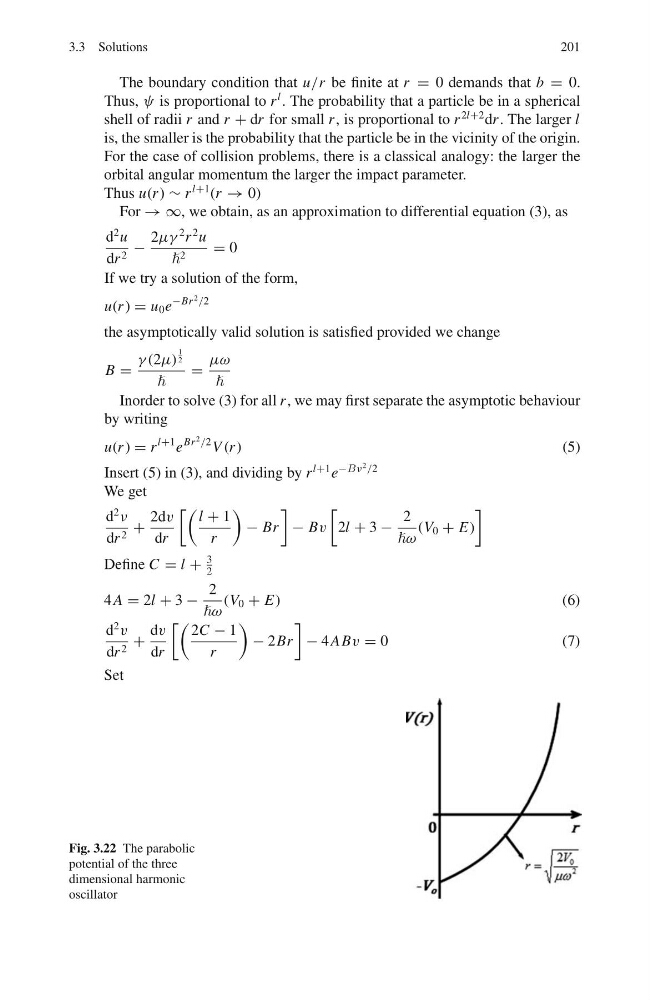
Fig. 3.22 The parabolic
potential of the three
dimensional harmonic
oscillator
201
The boundary condition that u/r be finite at r = 0 demands that b = 0.
Thus, ψ is proportional to r
l . The probability that a particle be in a spherical
shell of radii r and r + dr for small r , is proportional to r
2l+2 dr . The larger l
is, the smaller is the probability that the particle be in the vicinity of the origin.
For the case of collision problems, there is a classical analogy: the larger the
orbital angular momentum the larger the impact parameter.
Thus u(r ) ∼ r
l+1 (r → 0)
For → ∞, we obtain, as an approximation to differential equation (3), as
d
2 u
dr 2 −
2μγ
2 r
2 u
2
= 0
If we try a solution of the form,
u(r ) = u 0 e
−Br
2 /2
the asymptotically valid solution is satisfied provided we change
B =
γ (2μ)
1
2
=
μω
Inorder to solve (3) for all r , we may first separate the asymptotic behaviour
by writing
u(r ) = r
l+1 e
Br
2 /2 V (r )
( 5 )
Insert (5) in (3), and dividing by r
l+1 e
−Bν
2 /2
We get
d
2
ν
dr 2 +
2dv
dr
l + 1
r
− Br
− Bv
2l + 3 −
2
ω
(V 0 + E)
Define C = l +
3
2
4A = 2l + 3 −
2
ω
(V 0 + E)
( 6 )
d
2
v
dr 2 +
dv
dr
2C − 1
r
− 2Br
− 4ABv = 0
( 7 )
Set
Fig. 3.22 The parabolic
potential of the three
dimensional harmonic
oscillator