

204
3 Quantum Mechanics – II
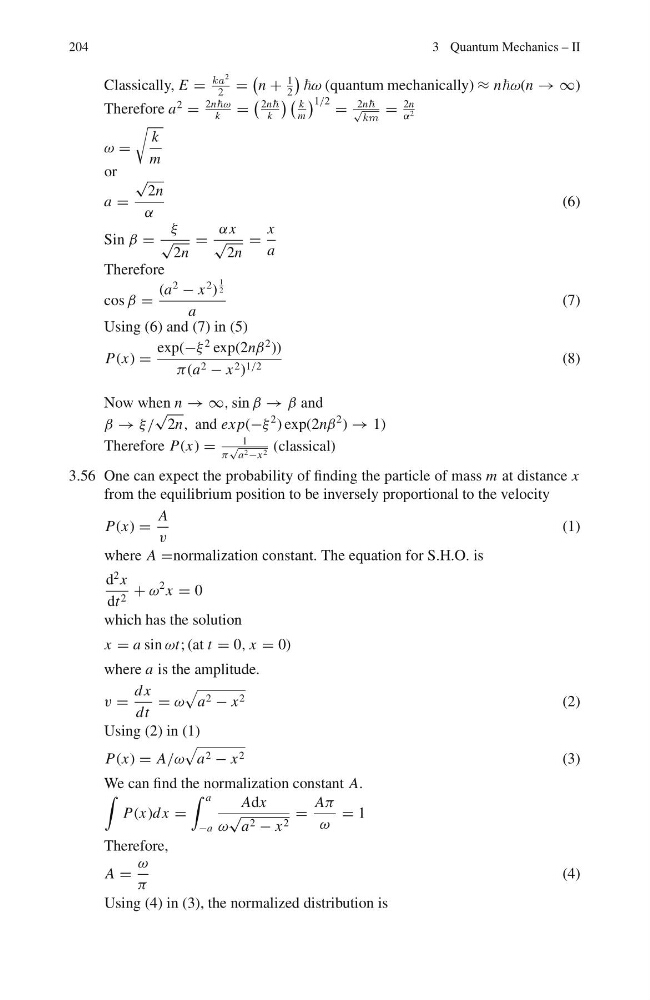
Classically, E =
ka
2
2
=
n +
1
2
ω (quantum mechanically) ≈ nω(n → ∞)
Therefore a
2
=
2nω
k
=
2n
k
k
m
1/2 =
2n
√
km
=
2n
α 2
ω =
k
m
or
a =
√
2n
α
(6)
Sin β =
ξ
√
2n
=
αx
√
2n
=
x
a
Therefore
cos β =
(a
2
− x
2 )
1
2
a
(7)
Using (6) and (7) in (5)
P(x) =
exp(−ξ
2 exp(2nβ
2 ))
π(a 2 − x 2 ) 1/2
(8)
Now when n → ∞, sin β → β and
β → ξ/
√
2n, and ex p(−ξ
2 ) exp(2nβ
2 ) → 1)
Therefore P(x) =
1
π
√
a 2 −x 2 (classical)
3.56 One can expect the probability of finding the particle of mass m at distance x
from the equilibrium position to be inversely proportional to the velocity
P(x) =
A
v
(1)
where A =normalization constant. The equation for S.H.O. is
d
2 x
dt 2 + ω
2 x = 0
which has the solution
x = a sin ωt; (at t = 0, x = 0)
where a is the amplitude.
v =
dx
dt
= ω
a 2 − x 2
(2)
Using (2) in (1)
P(x) = A/ω
a 2 − x 2
(3)
We can find the normalization constant A.
P(x)dx =
a
−a
Adx
ω
√
a 2 − x 2
=
Aπ
ω
= 1
Therefore,
A =
ω
π
(4)
Using (4) in (3), the normalized distribution is
3 Quantum Mechanics – II
Classically, E =
ka
2
2
=
n +
1
2
ω (quantum mechanically) ≈ nω(n → ∞)
Therefore a
2
=
2nω
k
=
2n
k
k
m
1/2 =
2n
√
km
=
2n
α 2
ω =
k
m
or
a =
√
2n
α
(6)
Sin β =
ξ
√
2n
=
αx
√
2n
=
x
a
Therefore
cos β =
(a
2
− x
2 )
1
2
a
(7)
Using (6) and (7) in (5)
P(x) =
exp(−ξ
2 exp(2nβ
2 ))
π(a 2 − x 2 ) 1/2
(8)
Now when n → ∞, sin β → β and
β → ξ/
√
2n, and ex p(−ξ
2 ) exp(2nβ
2 ) → 1)
Therefore P(x) =
1
π
√
a 2 −x 2 (classical)
3.56 One can expect the probability of finding the particle of mass m at distance x
from the equilibrium position to be inversely proportional to the velocity
P(x) =
A
v
(1)
where A =normalization constant. The equation for S.H.O. is
d
2 x
dt 2 + ω
2 x = 0
which has the solution
x = a sin ωt; (at t = 0, x = 0)
where a is the amplitude.
v =
dx
dt
= ω
a 2 − x 2
(2)
Using (2) in (1)
P(x) = A/ω
a 2 − x 2
(3)
We can find the normalization constant A.
P(x)dx =
a
−a
Adx
ω
√
a 2 − x 2
=
Aπ
ω
= 1
Therefore,
A =
ω
π
(4)
Using (4) in (3), the normalized distribution is