

© Dunod – La photocopie non autorisée est un délit
SOLUTIONS
Solutions
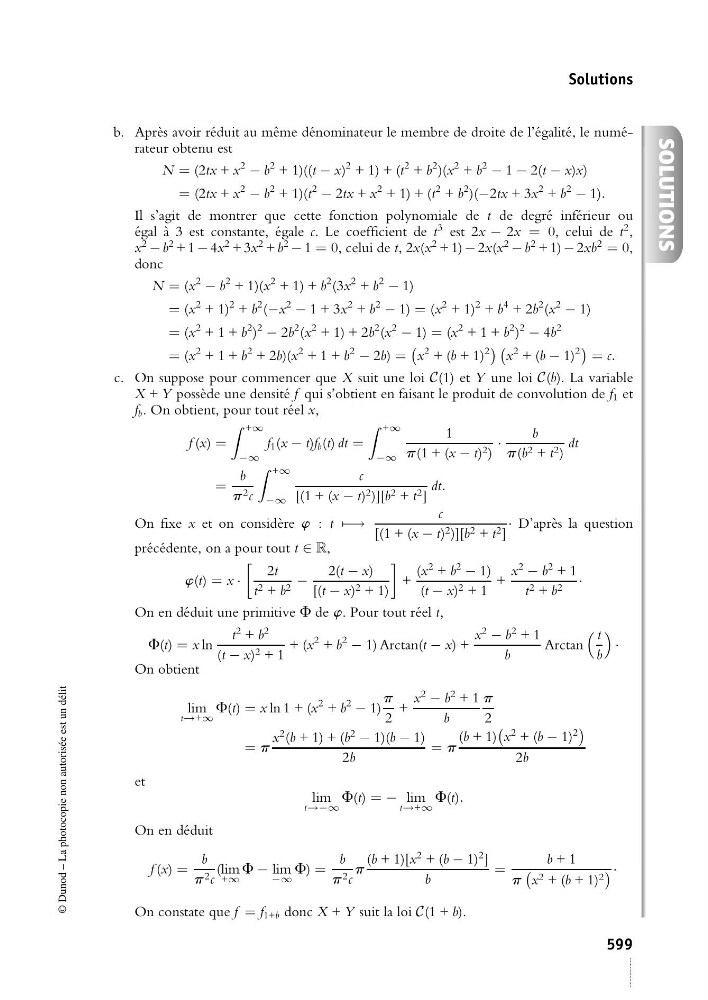
b. Après avoir réduit au même dénominateur le membre de droite de l’égalité, le numérateur obtenu est
N = (2tx + x
2
− b
2 + 1)((t − x)
2 + 1) + (t
2 + b
2 )(x
2 + b
2
− 1 − 2(t − x)x)
= (2tx + x
2
− b
2 + 1)(t
2
− 2tx + x
2 + 1) + (t
2 + b
2 )(−2tx + 3x
2 + b
2
− 1).
Il s’agit de montrer que cette fonction polynomiale de t de degré inférieur ou
égal à 3 est constante, égale c. Le coefficient de t
3 est 2x − 2x = 0, celui de t
2 ,
x
2
− b
2 + 1 − 4x
2 + 3x
2 + b
2
− 1 = 0, celui de t, 2x(x
2 + 1) − 2x(x
2
− b
2 + 1) − 2xb
2 = 0,
donc
N = (x
2
− b
2 + 1)(x
2 + 1) + b
2 (3x
2 + b
2
− 1)
= (x
2 + 1)
2 + b
2 (−x
2
− 1 + 3x
2 + b
2
− 1) = (x
2 + 1)
2 + b
4 + 2b
2 (x
2
− 1)
= (x
2 + 1 + b
2 )
2
− 2b
2 (x
2 + 1) + 2b
2 (x
2
− 1) = (x
2 + 1 + b
2 )
2
− 4b
2
= (x
2 + 1 + b
2 + 2b)(x
2 + 1 + b
2
− 2b) =
x
2 + (b + 1)
2
x
2 + (b − 1)
2
= c.
c. On suppose pour commencer que X suit une loi C(1) et Y une loi C(b). La variable
X + Y possède une densité f qui s’obtient en faisant le produit de convolution de f 1 et
f b . On obtient, pour tout réel x,
f (x) =
+∞
−∞
f 1 (x − t)f b (t) dt =
+∞
−∞
1
p(1 + (x − t) 2 )
·
b
p(b 2 + t 2 )
dt
=
b
p 2 c
+∞
−∞
c
[(1 + (x − t) 2 )][b 2 + t 2 ]
dt.
On fixe x et on considère w : t −→
c
[(1 + (x − t) 2 )][b 2 + t 2 ]
· D’après la question
précédente, on a pour tout t ∈ R,
w(t) = x ·
2t
t 2 + b 2 −
2(t − x)
[(t − x) 2 + 1)
+
(x
2 + b
2
− 1)
(t − x) 2 + 1
+
x
2
− b
2 + 1
t 2 + b 2 ·
On en déduit une primitive F de w. Pour tout réel t,
F(t) = x ln
t
2 + b
2
(t − x) 2 + 1
+ (x
2 + b
2
− 1) Arctan(t − x) +
x
2
− b
2 + 1
b
Arctan
t
b
·
On obtient
lim
t→+∞
F(t) = x ln 1 + (x
2 + b
2
− 1)
p
2
+
x
2
− b
2 + 1
b
p
2
= p
x
2 (b + 1) + (b
2
− 1)(b − 1)
2b
= p
(b + 1)
x
2 + (b − 1)
2
2b
et
lim
t→−∞
F(t) = − lim
t→+∞
F(t).
On en déduit
f (x) =
b
p 2 c
(lim
+∞
F − lim
−∞
F) =
b
p 2 c
p
(b + 1)[x
2 + (b − 1)
2 ]
b
=
b + 1
p
x 2 + (b + 1) 2
·
On constate que f = f 1+b donc X + Y suit la loi C(1 + b).
599