

© Dunod – La photocopie non autorisée est un délit
SOLUTIONS
Solutions
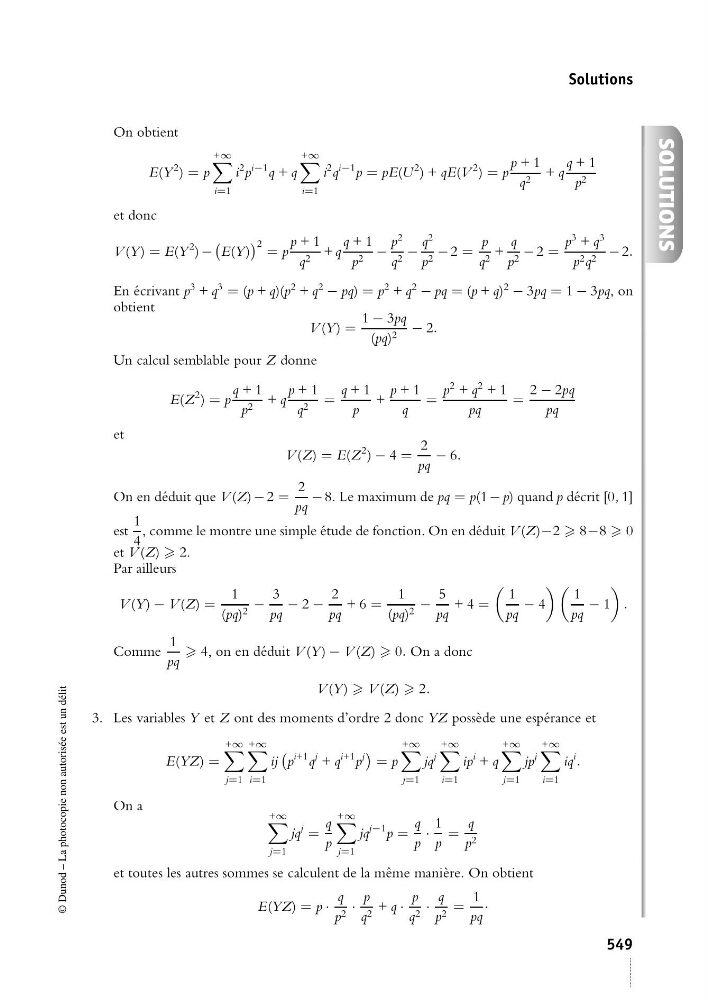
On obtient
E(Y
2 ) = p
+∞
i=1
i
2 p
i−1 q + q
+∞
i=1
i
2 q
i−1 p = pE(U
2 ) + qE(V
2 ) = p
p + 1
q 2 + q
q + 1
p 2
et donc
V (Y ) = E(Y
2 ) −
E(Y )
2 = p
p + 1
q 2 + q
q + 1
p 2 −
p
2
q 2 −
q
2
p 2 − 2 =
p
q 2 +
q
p 2 − 2 =
p
3 + q
3
p 2 q 2 − 2.
En écrivant p
3 + q
3 = (p + q)(p
2 + q
2
− pq) = p
2 + q
2
− pq = (p + q)
2
− 3pq = 1 − 3pq, on
obtient
V (Y ) =
1 − 3pq
(pq) 2 − 2.
Un calcul semblable pour Z donne
E(Z
2 ) = p
q + 1
p 2 + q
p + 1
q 2 =
q + 1
p
+
p + 1
q
=
p
2 + q
2 + 1
pq
=
2 − 2pq
pq
et
V (Z) = E(Z
2 ) − 4 =
2
pq
− 6.
On en déduit que V (Z) − 2 =
2
pq
− 8. Le maximum de pq = p(1 − p) quand p décrit [0, 1]
est
1
4
, comme le montre une simple étude de fonction. On en déduit V (Z)−2 8−8 0
et V (Z) 2.
Par ailleurs
V (Y ) − V (Z) =
1
(pq) 2 −
3
pq
− 2 −
2
pq
+ 6 =
1
(pq) 2 −
5
pq
+ 4 =
1
pq
− 4
1
pq
− 1
.
Comme
1
pq
4, on en déduit V (Y ) − V (Z) 0. On a donc
V (Y ) V (Z) 2.
3. Les variables Y et Z ont des moments d’ordre 2 donc YZ possède une espérance et
E(YZ) =
+∞
j=1
+∞
i=1
ij
p
i+1 q
j + q
i+1 p
j
= p
+∞
j=1
jq
j
+∞
i=1
ip
i + q
+∞
j=1
jp
j
+∞
i=1
iq
i .
On a
+∞
j=1
jq
j =
q
p
+∞
j=1
jq
j−1 p =
q
p
·
1
p
=
q
p 2
et toutes les autres sommes se calculent de la même manière. On obtient
E(YZ) = p ·
q
p 2 ·
p
q 2 + q ·
p
q 2 ·
q
p 2 =
1
pq
·
549
SOLUTIONS
Solutions
On obtient
E(Y
2 ) = p
+∞
i=1
i
2 p
i−1 q + q
+∞
i=1
i
2 q
i−1 p = pE(U
2 ) + qE(V
2 ) = p
p + 1
q 2 + q
q + 1
p 2
et donc
V (Y ) = E(Y
2 ) −
E(Y )
2 = p
p + 1
q 2 + q
q + 1
p 2 −
p
2
q 2 −
q
2
p 2 − 2 =
p
q 2 +
q
p 2 − 2 =
p
3 + q
3
p 2 q 2 − 2.
En écrivant p
3 + q
3 = (p + q)(p
2 + q
2
− pq) = p
2 + q
2
− pq = (p + q)
2
− 3pq = 1 − 3pq, on
obtient
V (Y ) =
1 − 3pq
(pq) 2 − 2.
Un calcul semblable pour Z donne
E(Z
2 ) = p
q + 1
p 2 + q
p + 1
q 2 =
q + 1
p
+
p + 1
q
=
p
2 + q
2 + 1
pq
=
2 − 2pq
pq
et
V (Z) = E(Z
2 ) − 4 =
2
pq
− 6.
On en déduit que V (Z) − 2 =
2
pq
− 8. Le maximum de pq = p(1 − p) quand p décrit [0, 1]
est
1
4
, comme le montre une simple étude de fonction. On en déduit V (Z)−2 8−8 0
et V (Z) 2.
Par ailleurs
V (Y ) − V (Z) =
1
(pq) 2 −
3
pq
− 2 −
2
pq
+ 6 =
1
(pq) 2 −
5
pq
+ 4 =
1
pq
− 4
1
pq
− 1
.
Comme
1
pq
4, on en déduit V (Y ) − V (Z) 0. On a donc
V (Y ) V (Z) 2.
3. Les variables Y et Z ont des moments d’ordre 2 donc YZ possède une espérance et
E(YZ) =
+∞
j=1
+∞
i=1
ij
p
i+1 q
j + q
i+1 p
j
= p
+∞
j=1
jq
j
+∞
i=1
ip
i + q
+∞
j=1
jp
j
+∞
i=1
iq
i .
On a
+∞
j=1
jq
j =
q
p
+∞
j=1
jq
j−1 p =
q
p
·
1
p
=
q
p 2
et toutes les autres sommes se calculent de la même manière. On obtient
E(YZ) = p ·
q
p 2 ·
p
q 2 + q ·
p
q 2 ·
q
p 2 =
1
pq
·
549