

52
2 • Différentielles d’ordre supérieur
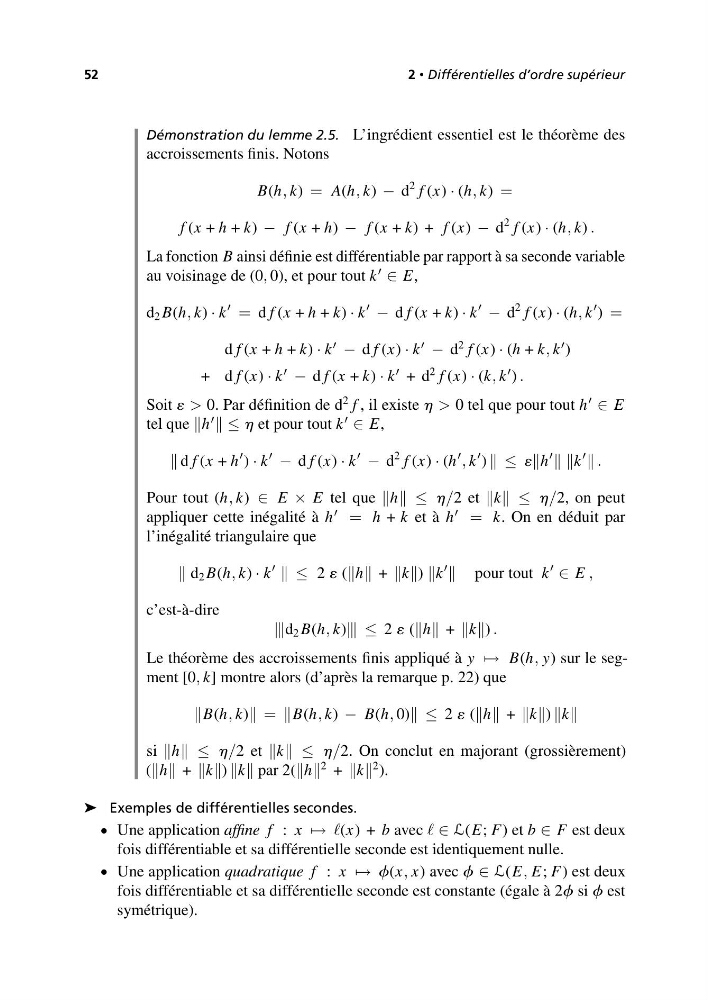
Démonstration du lemme 2.5. L’ingrédient essentiel est le théorème des
accroissements finis. Notons
B(h, k) = A(h, k) − d
2 f (x) · (h, k) =
f (x + h + k) − f (x + h) − f (x + k) + f (x) − d
2 f (x) · (h, k) .
La fonction B ainsi définie est différentiable par rapport à sa seconde variable
au voisinage de (0, 0), et pour tout k
∈ E,
d 2 B(h, k) · k
= d f (x + h + k) · k
− d f (x + k) · k
− d
2 f (x) · (h, k
) =
d f (x + h + k) · k
− d f (x) · k
− d
2 f (x) · (h + k, k
)
+ d f (x) · k
− d f (x + k) · k
+ d
2 f (x) · (k, k
) .
Soit ´ > 0. Par définition de d
2 f , il existe h > 0 tel que pour tout h
∈ E
tel que h
≤ h et pour tout k
∈ E,
d f (x + h
) · k
− d f (x) · k
− d
2 f (x) · (h
, k
) ≤ ´h
k
.
Pour tout (h, k) ∈ E × E tel que h ≤ h/2 et k ≤ h/2, on peut
appliquer cette inégalité à h
= h + k et à h
= k. On en déduit par
l’inégalité triangulaire que
d 2 B(h, k) · k
≤ 2 ´ (h + k) k
pour tout k
∈ E ,
c’est-à-dire
d 2 B(h, k) ≤ 2 ´ (h + k) .
Le théorème des accroissements finis appliqué à y → B(h, y) sur le segment [0, k] montre alors (d’après la remarque p. 22) que
B(h, k) = B(h, k) − B(h, 0) ≤ 2 ´ (h + k) k
si h ≤ h/2 et k ≤ h/2. On conclut en majorant (grossièrement)
(h + k) k par 2(h
2 + k
2 ).
➤ Exemples de différentielles secondes.
• Une application affine f : x → (x) + b avec ∈ L(E; F) et b ∈ F est deux
fois différentiable et sa différentielle seconde est identiquement nulle.
• Une application quadratique f : x → f(x, x) avec f ∈ L(E, E; F) est deux
fois différentiable et sa différentielle seconde est constante (égale à 2f si f est
symétrique).
2 • Différentielles d’ordre supérieur
Démonstration du lemme 2.5. L’ingrédient essentiel est le théorème des
accroissements finis. Notons
B(h, k) = A(h, k) − d
2 f (x) · (h, k) =
f (x + h + k) − f (x + h) − f (x + k) + f (x) − d
2 f (x) · (h, k) .
La fonction B ainsi définie est différentiable par rapport à sa seconde variable
au voisinage de (0, 0), et pour tout k
∈ E,
d 2 B(h, k) · k
= d f (x + h + k) · k
− d f (x + k) · k
− d
2 f (x) · (h, k
) =
d f (x + h + k) · k
− d f (x) · k
− d
2 f (x) · (h + k, k
)
+ d f (x) · k
− d f (x + k) · k
+ d
2 f (x) · (k, k
) .
Soit ´ > 0. Par définition de d
2 f , il existe h > 0 tel que pour tout h
∈ E
tel que h
≤ h et pour tout k
∈ E,
d f (x + h
) · k
− d f (x) · k
− d
2 f (x) · (h
, k
) ≤ ´h
k
.
Pour tout (h, k) ∈ E × E tel que h ≤ h/2 et k ≤ h/2, on peut
appliquer cette inégalité à h
= h + k et à h
= k. On en déduit par
l’inégalité triangulaire que
d 2 B(h, k) · k
≤ 2 ´ (h + k) k
pour tout k
∈ E ,
c’est-à-dire
d 2 B(h, k) ≤ 2 ´ (h + k) .
Le théorème des accroissements finis appliqué à y → B(h, y) sur le segment [0, k] montre alors (d’après la remarque p. 22) que
B(h, k) = B(h, k) − B(h, 0) ≤ 2 ´ (h + k) k
si h ≤ h/2 et k ≤ h/2. On conclut en majorant (grossièrement)
(h + k) k par 2(h
2 + k
2 ).
➤ Exemples de différentielles secondes.
• Une application affine f : x → (x) + b avec ∈ L(E; F) et b ∈ F est deux
fois différentiable et sa différentielle seconde est identiquement nulle.
• Une application quadratique f : x → f(x, x) avec f ∈ L(E, E; F) est deux
fois différentiable et sa différentielle seconde est constante (égale à 2f si f est
symétrique).