

2.1 Différentielle seconde
51
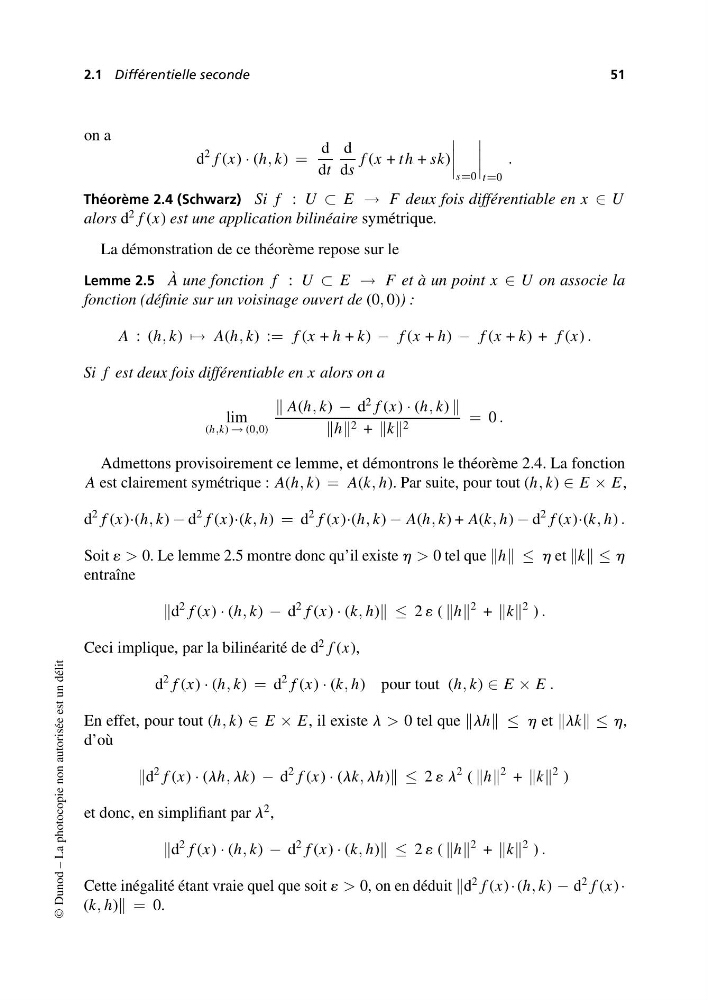
on a
d
2 f (x) · (h, k) =
d
dt
d
ds
f (x + th + sk)
s=0
t=0
.
Théorème 2.4 (Schwarz) Si f : U ⊂ E → F deux fois différentiable en x ∈ U
alors d
2 f (x) est une application bilinéaire symétrique.
La démonstration de ce théorème repose sur le
Lemme 2.5 À une fonction f : U ⊂ E → F et à un point x ∈ U on associe la
fonction (définie sur un voisinage ouvert de (0, 0)) :
A : (h, k) → A(h, k) := f (x + h + k) − f (x + h) − f (x + k) + f (x) .
Si f est deux fois différentiable en x alors on a
lim
(h,k) → (0,0)
A(h, k) − d
2 f (x) · (h, k)
h 2 + k 2
= 0 .
Admettons provisoirement ce lemme, et démontrons le théorème 2.4. La fonction
A est clairement symétrique : A(h, k) = A(k, h). Par suite, pour tout (h, k) ∈ E × E,
d
2 f (x)·(h, k) − d
2 f (x)·(k, h) = d
2 f (x)·(h, k) − A(h, k) + A(k, h) − d
2 f (x)·(k, h) .
Soit ´ > 0. Le lemme 2.5 montre donc qu’il existe h > 0 tel que h ≤ h et k ≤ h
entraîne
d
2 f (x) · (h, k) − d
2 f (x) · (k, h) ≤ 2 ´ ( h
2 + k
2 ) .
Ceci implique, par la bilinéarité de d
2 f (x),
d
2 f (x) · (h, k) = d
2 f (x) · (k, h) pour tout (h, k) ∈ E × E .
En effet, pour tout (h, k) ∈ E × E, il existe l > 0 tel que lh ≤ h et lk ≤ h,
d’où
d
2 f (x) · (lh, lk) − d
2 f (x) · (lk, lh) ≤ 2 ´ l
2 ( h
2 + k
2 )
et donc, en simplifiant par l
2 ,
d
2 f (x) · (h, k) − d
2 f (x) · (k, h) ≤ 2 ´ ( h
2 + k
2 ) .
Cette inégalité étant vraie quel que soit ´ > 0, on en déduit d
2 f (x) · (h, k) − d
2 f (x) ·
(k, h) = 0.
© Dunod – La photocopie non autorisée est un délit
51
on a
d
2 f (x) · (h, k) =
d
dt
d
ds
f (x + th + sk)
s=0
t=0
.
Théorème 2.4 (Schwarz) Si f : U ⊂ E → F deux fois différentiable en x ∈ U
alors d
2 f (x) est une application bilinéaire symétrique.
La démonstration de ce théorème repose sur le
Lemme 2.5 À une fonction f : U ⊂ E → F et à un point x ∈ U on associe la
fonction (définie sur un voisinage ouvert de (0, 0)) :
A : (h, k) → A(h, k) := f (x + h + k) − f (x + h) − f (x + k) + f (x) .
Si f est deux fois différentiable en x alors on a
lim
(h,k) → (0,0)
A(h, k) − d
2 f (x) · (h, k)
h 2 + k 2
= 0 .
Admettons provisoirement ce lemme, et démontrons le théorème 2.4. La fonction
A est clairement symétrique : A(h, k) = A(k, h). Par suite, pour tout (h, k) ∈ E × E,
d
2 f (x)·(h, k) − d
2 f (x)·(k, h) = d
2 f (x)·(h, k) − A(h, k) + A(k, h) − d
2 f (x)·(k, h) .
Soit ´ > 0. Le lemme 2.5 montre donc qu’il existe h > 0 tel que h ≤ h et k ≤ h
entraîne
d
2 f (x) · (h, k) − d
2 f (x) · (k, h) ≤ 2 ´ ( h
2 + k
2 ) .
Ceci implique, par la bilinéarité de d
2 f (x),
d
2 f (x) · (h, k) = d
2 f (x) · (k, h) pour tout (h, k) ∈ E × E .
En effet, pour tout (h, k) ∈ E × E, il existe l > 0 tel que lh ≤ h et lk ≤ h,
d’où
d
2 f (x) · (lh, lk) − d
2 f (x) · (lk, lh) ≤ 2 ´ l
2 ( h
2 + k
2 )
et donc, en simplifiant par l
2 ,
d
2 f (x) · (h, k) − d
2 f (x) · (k, h) ≤ 2 ´ ( h
2 + k
2 ) .
Cette inégalité étant vraie quel que soit ´ > 0, on en déduit d
2 f (x) · (h, k) − d
2 f (x) ·
(k, h) = 0.
© Dunod – La photocopie non autorisée est un délit