

82
STEREOCHEMISTRY
CO 2 H
NH 2
H
HS
R = CH 2 SH
CO 2 H
NH 2
HSH 2 C
priority 1
priority 2
priority 3
priorities:
NH 2 > CH 2 SH > CO 2 H> H
clockwise: R
(+)-(R)-cysteine
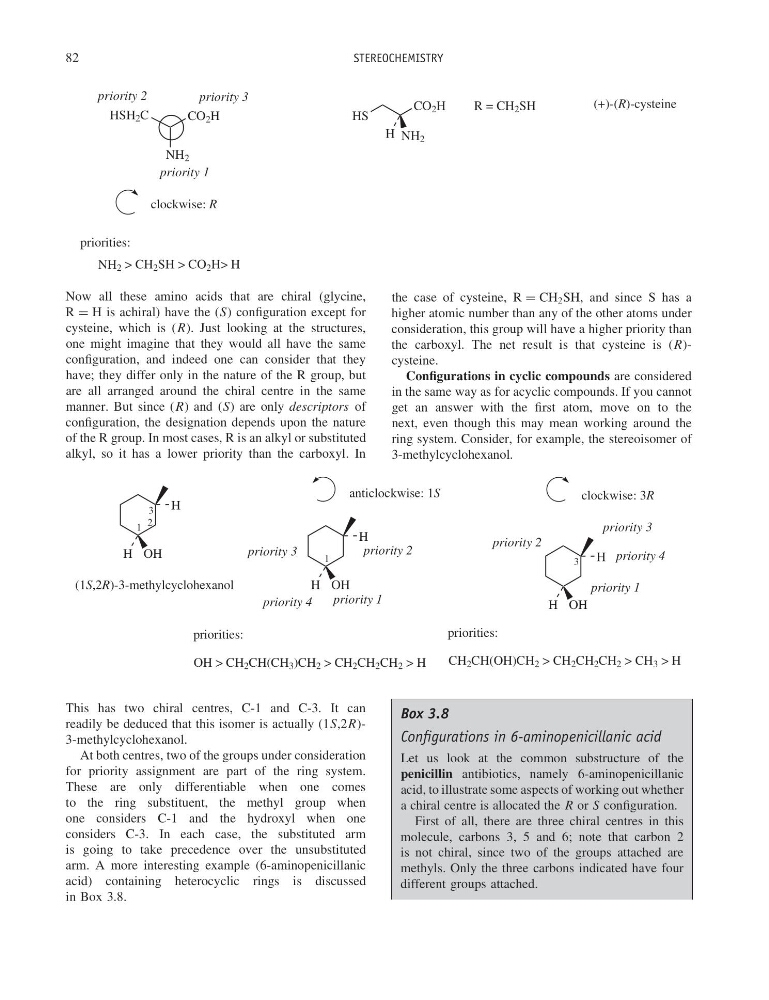
Now all these amino acids that are chiral (glycine,
R = H is achiral) have the (S) configuration except for
cysteine, which is (R). Just looking at the structures,
one might imagine that they would all have the same
configuration, and indeed one can consider that they
have; they differ only in the nature of the R group, but
are all arranged around the chiral centre in the same
manner. But since (R) and (S) are only descriptors of
configuration, the designation depends upon the nature
of the R group. In most cases, R is an alkyl or substituted
alkyl, so it has a lower priority than the carboxyl. In
the case of cysteine, R = CH 2 SH, and since S has a
higher atomic number than any of the other atoms under
consideration, this group will have a higher priority than
the carboxyl. The net result is that cysteine is (R)cysteine.
Configurations in cyclic compounds are considered
in the same way as for acyclic compounds. If you cannot
get an answer with the first atom, move on to the
next, even though this may mean working around the
ring system. Consider, for example, the stereoisomer of
3-methylcyclohexanol.
H
1
2
OH
H
3
priority 1
priority 3
priority 2
anticlockwise: 1S
H
1
OH
H
H
OH
H
3
priority 1
priority 4
priority 2
priority 3
priorities:
OH > CH 2 CH(CH 3 )CH 2 > CH 2 CH 2 CH 2 > H
priority 4
priorities:
CH 2 CH(OH)CH 2 > CH 2 CH 2 CH 2 > CH 3 > H
clockwise: 3R
(1S,2R)-3-methylcyclohexanol
This has two chiral centres, C-1 and C-3. It can
readily be deduced that this isomer is actually (1S,2R)3-methylcyclohexanol.
At both centres, two of the groups under consideration
for priority assignment are part of the ring system.
These are only differentiable when one comes
to the ring substituent, the methyl group when
one considers C-1 and the hydroxyl when one
considers C-3. In each case, the substituted arm
is going to take precedence over the unsubstituted
arm. A more interesting example (6-aminopenicillanic
acid) containing heterocyclic rings is discussed
in Box 3.8.
Box 3.8
Configurations in 6-aminopenicillanic acid
Let us look at the common substructure of the
penicillin antibiotics, namely 6-aminopenicillanic
acid, to illustrate some aspects of working out whether
a chiral centre is allocated the R or S configuration.
First of all, there are three chiral centres in this
molecule, carbons 3, 5 and 6; note that carbon 2
is not chiral, since two of the groups attached are
methyls. Only the three carbons indicated have four
different groups attached.
STEREOCHEMISTRY
CO 2 H
NH 2
H
HS
R = CH 2 SH
CO 2 H
NH 2
HSH 2 C
priority 1
priority 2
priority 3
priorities:
NH 2 > CH 2 SH > CO 2 H> H
clockwise: R
(+)-(R)-cysteine
Now all these amino acids that are chiral (glycine,
R = H is achiral) have the (S) configuration except for
cysteine, which is (R). Just looking at the structures,
one might imagine that they would all have the same
configuration, and indeed one can consider that they
have; they differ only in the nature of the R group, but
are all arranged around the chiral centre in the same
manner. But since (R) and (S) are only descriptors of
configuration, the designation depends upon the nature
of the R group. In most cases, R is an alkyl or substituted
alkyl, so it has a lower priority than the carboxyl. In
the case of cysteine, R = CH 2 SH, and since S has a
higher atomic number than any of the other atoms under
consideration, this group will have a higher priority than
the carboxyl. The net result is that cysteine is (R)cysteine.
Configurations in cyclic compounds are considered
in the same way as for acyclic compounds. If you cannot
get an answer with the first atom, move on to the
next, even though this may mean working around the
ring system. Consider, for example, the stereoisomer of
3-methylcyclohexanol.
H
1
2
OH
H
3
priority 1
priority 3
priority 2
anticlockwise: 1S
H
1
OH
H
H
OH
H
3
priority 1
priority 4
priority 2
priority 3
priorities:
OH > CH 2 CH(CH 3 )CH 2 > CH 2 CH 2 CH 2 > H
priority 4
priorities:
CH 2 CH(OH)CH 2 > CH 2 CH 2 CH 2 > CH 3 > H
clockwise: 3R
(1S,2R)-3-methylcyclohexanol
This has two chiral centres, C-1 and C-3. It can
readily be deduced that this isomer is actually (1S,2R)3-methylcyclohexanol.
At both centres, two of the groups under consideration
for priority assignment are part of the ring system.
These are only differentiable when one comes
to the ring substituent, the methyl group when
one considers C-1 and the hydroxyl when one
considers C-3. In each case, the substituted arm
is going to take precedence over the unsubstituted
arm. A more interesting example (6-aminopenicillanic
acid) containing heterocyclic rings is discussed
in Box 3.8.
Box 3.8
Configurations in 6-aminopenicillanic acid
Let us look at the common substructure of the
penicillin antibiotics, namely 6-aminopenicillanic
acid, to illustrate some aspects of working out whether
a chiral centre is allocated the R or S configuration.
First of all, there are three chiral centres in this
molecule, carbons 3, 5 and 6; note that carbon 2
is not chiral, since two of the groups attached are
methyls. Only the three carbons indicated have four
different groups attached.