

CONFIGURATIONAL ISOMERS
81
NH 2
H CO 2 H
CH 2 OH
(−)-serine
OH
H CH 2 CO 2 H
CO 2 H
(+)-malic acid
priorities
NH 2
O
C O
O
H
C O
H
H
>
>
>
highest
atomic
number
lowest atomic
number
same atomic number;
next atom then considered,
both have oxygen;
carbonyl double bond
considered to be duplicated;
three oxygens > one oxygen
NH 2
H CO 2 H
CH 2 OH
priority 1
priority 3
priority 2
priority 4
CH 2 OH
NH 2
HO 2 C
priority 1
priority 3
priority 2
anticlockwise: S
view from this
side
priorities
OH
O
C O
O
H
C C
H
H
>
>
>
highest
atomic
number
lowest atomic
number
same atomic number;
next atom then considerd O > C;
carbonyl double bond considered
to be duplicated
OH
H CH 2 CO 2 H
CO 2 H
priority 1
priority 2
priority 3
priority 4
CO 2 H
OH
HO 2 CH 2 C
priority 1
priority 2
priority 3
clockwise: R
view from
this side
(−)-(S)-serine
(+)-(R)-malic acid
nomenclature showing
optical activity and
configuration:
CO 2 H
C H 2 OH
CO 2 H
C H 2 CO 2 H
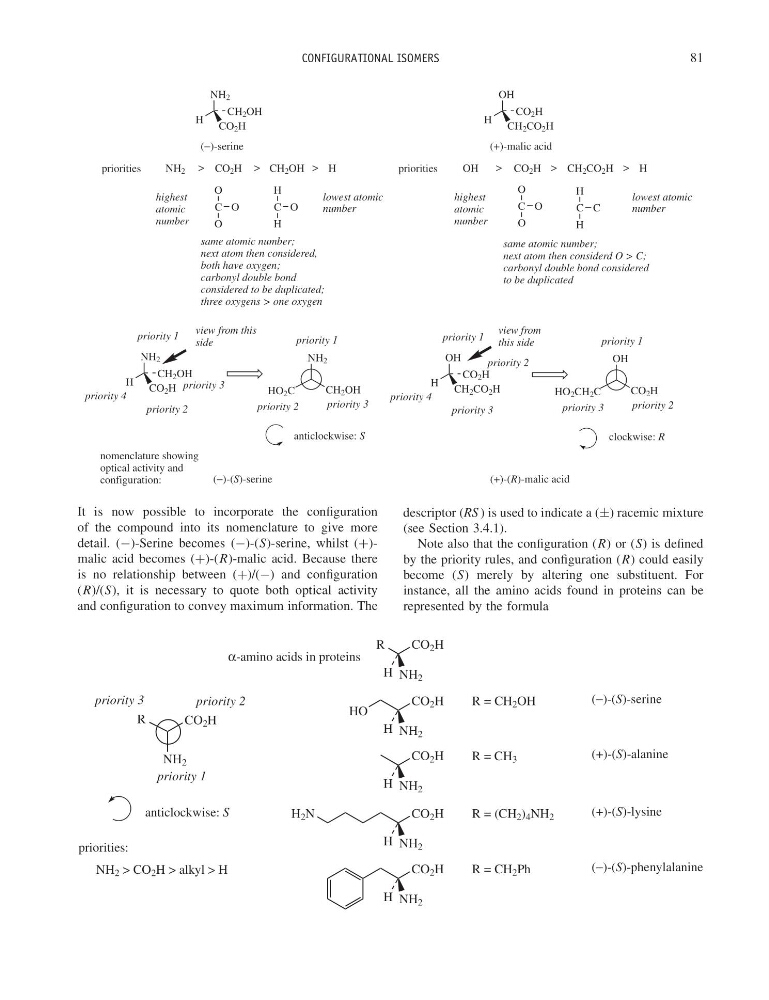
It is now possible to incorporate the configuration
of the compound into its nomenclature to give more
detail. (−)-Serine becomes (−)-(S)-serine, whilst (+)malic acid becomes (+)-(R)-malic acid. Because there
is no relationship between (+)/(−) and configuration
(R)/(S), it is necessary to quote both optical activity
and configuration to convey maximum information. The
descriptor (RS ) is used to indicate a (±) racemic mixture
(see Section 3.4.1).
Note also that the configuration (R) or (S) is defined
by the priority rules, and configuration (R) could easily
become (S) merely by altering one substituent. For
instance, all the amino acids found in proteins can be
represented by the formula
R
CO 2 H
NH 2
H
CO 2 H
NH 2
H
CO 2 H
NH 2
H
CO 2 H
NH 2
H
H 2 N
CO 2 H
NH 2
H
HO
CO 2 H
NH 2
R
priority 1
priority 3
priority 2
anticlockwise: S
R = CH 2 OH
R = CH 3
R = (CH 2 ) 4 NH 2
R = CH 2 Ph
priorities:
NH 2 > CO 2 H > alkyl > H
α-amino acids in proteins
(−)-(S)-serine
(+)-(S)-alanine
(+)-(S)-lysine
(−)-(S)-phenylalanine
81
NH 2
H CO 2 H
CH 2 OH
(−)-serine
OH
H CH 2 CO 2 H
CO 2 H
(+)-malic acid
priorities
NH 2
O
C O
O
H
C O
H
H
>
>
>
highest
atomic
number
lowest atomic
number
same atomic number;
next atom then considered,
both have oxygen;
carbonyl double bond
considered to be duplicated;
three oxygens > one oxygen
NH 2
H CO 2 H
CH 2 OH
priority 1
priority 3
priority 2
priority 4
CH 2 OH
NH 2
HO 2 C
priority 1
priority 3
priority 2
anticlockwise: S
view from this
side
priorities
OH
O
C O
O
H
C C
H
H
>
>
>
highest
atomic
number
lowest atomic
number
same atomic number;
next atom then considerd O > C;
carbonyl double bond considered
to be duplicated
OH
H CH 2 CO 2 H
CO 2 H
priority 1
priority 2
priority 3
priority 4
CO 2 H
OH
HO 2 CH 2 C
priority 1
priority 2
priority 3
clockwise: R
view from
this side
(−)-(S)-serine
(+)-(R)-malic acid
nomenclature showing
optical activity and
configuration:
CO 2 H
C H 2 OH
CO 2 H
C H 2 CO 2 H
It is now possible to incorporate the configuration
of the compound into its nomenclature to give more
detail. (−)-Serine becomes (−)-(S)-serine, whilst (+)malic acid becomes (+)-(R)-malic acid. Because there
is no relationship between (+)/(−) and configuration
(R)/(S), it is necessary to quote both optical activity
and configuration to convey maximum information. The
descriptor (RS ) is used to indicate a (±) racemic mixture
(see Section 3.4.1).
Note also that the configuration (R) or (S) is defined
by the priority rules, and configuration (R) could easily
become (S) merely by altering one substituent. For
instance, all the amino acids found in proteins can be
represented by the formula
R
CO 2 H
NH 2
H
CO 2 H
NH 2
H
CO 2 H
NH 2
H
CO 2 H
NH 2
H
H 2 N
CO 2 H
NH 2
H
HO
CO 2 H
NH 2
R
priority 1
priority 3
priority 2
anticlockwise: S
R = CH 2 OH
R = CH 3
R = (CH 2 ) 4 NH 2
R = CH 2 Ph
priorities:
NH 2 > CO 2 H > alkyl > H
α-amino acids in proteins
(−)-(S)-serine
(+)-(S)-alanine
(+)-(S)-lysine
(−)-(S)-phenylalanine