

80
STEREOCHEMISTRY
usually different and can be greater or less than
the melting point of the enantiomers. Most spectral
properties, e.g. NMR, mass spectrometry, etc., of (+)-,
(−)-, and (±)-forms are indistinguishable. However,
pharmacological properties are frequently different,
because they may depend upon the overall shape of the
compound and its interaction with a receptor.
3.4.2 Cahn–Ingold–Prelog system to
describe configuration at chiral centres
The arrangement of groups around a chiral atom is
called its configuration, and enantiomers have different
configurations. Therefore, it is necessary for us to have
a means of describing configuration so that we are in
no doubt about which enantiomer we are talking about.
Although enantiomers have equal and opposite optical
rotations, the sign of the optical rotation does not tell us
anything about the configuration. The system adopted
by IUPAC for describing configuration was devised by
Cahn, Ingold, and Prelog, and is often referred to as
the R,S convention.
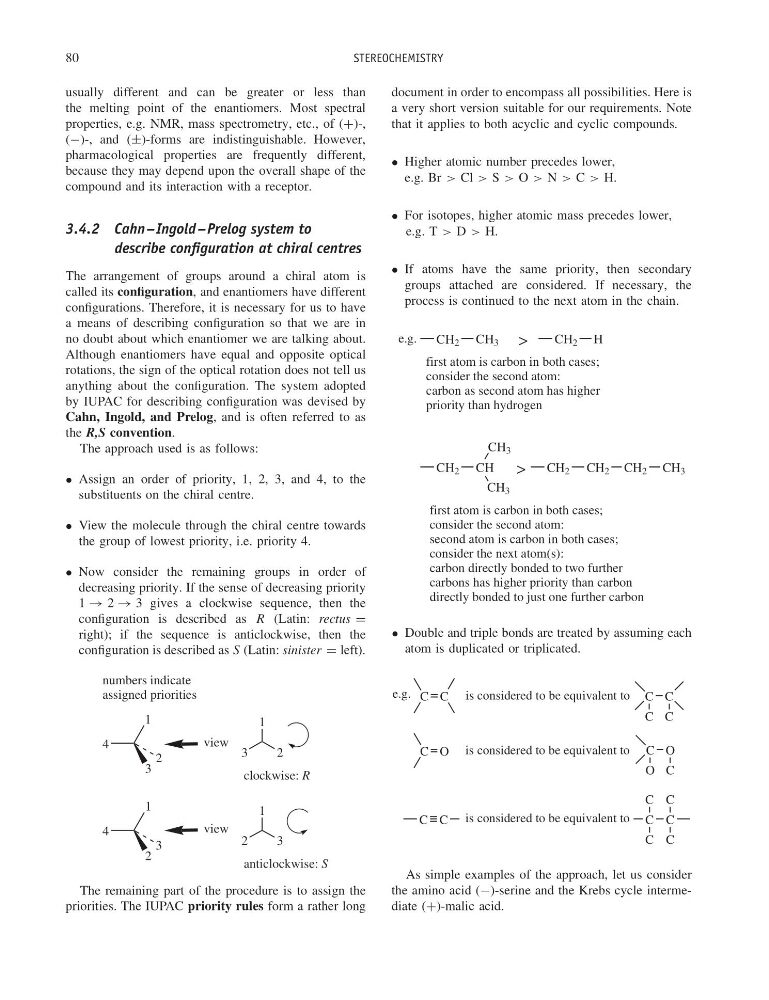
The approach used is as follows:
• Assign an order of priority, 1, 2, 3, and 4, to the
substituents on the chiral centre.
• View the molecule through the chiral centre towards
the group of lowest priority, i.e. priority 4.
• Now consider the remaining groups in order of
decreasing priority. If the sense of decreasing priority
1 → 2 → 3 gives a clockwise sequence, then the
configuration is described as R (Latin: rectus =
right); if the sequence is anticlockwise, then the
configuration is described as S (Latin: sinister = left).
4
1
3
2
1
3
2
4
1
2
3
1
2
3
view
view
anticlockwise: S
clockwise: R
numbers indicate
assigned priorities
The remaining part of the procedure is to assign the
priorities. The IUPAC priority rules form a rather long
document in order to encompass all possibilities. Here is
a very short version suitable for our requirements. Note
that it applies to both acyclic and cyclic compounds.
• Higher atomic number precedes lower,
e.g. Br > Cl > S > O > N > C > H.
• For isotopes, higher atomic mass precedes lower,
e.g. T > D > H.
• If atoms have the same priority, then secondary
groups attached are considered. If necessary, the
process is continued to the next atom in the chain.
>
>
e.g.
CH 2 CH 3
CH 2 H
CH 2 CH
CH 3
CH 3
CH 2 CH 2 CH 2
first atom is carbon in both cases;
consider the second atom:
carbon as second atom has higher
priority than hydrogen
first atom is carbon in both cases;
consider the second atom:
second atom is carbon in both cases;
consider the next atom(s):
carbon directly bonded to two further
carbons has higher priority than carbon
directly bonded to just one further carbon
CH 3
• Double and triple bonds are treated by assuming each
atom is duplicated or triplicated.
C O
C O
C
O
C C
C C
C
C
C C
C
C
C
C
C
C
e.g.
is considered to be equivalent to
is considered to be equivalent to
is considered to be equivalent to
As simple examples of the approach, let us consider
the amino acid (−)-serine and the Krebs cycle intermediate (+)-malic acid.
STEREOCHEMISTRY
usually different and can be greater or less than
the melting point of the enantiomers. Most spectral
properties, e.g. NMR, mass spectrometry, etc., of (+)-,
(−)-, and (±)-forms are indistinguishable. However,
pharmacological properties are frequently different,
because they may depend upon the overall shape of the
compound and its interaction with a receptor.
3.4.2 Cahn–Ingold–Prelog system to
describe configuration at chiral centres
The arrangement of groups around a chiral atom is
called its configuration, and enantiomers have different
configurations. Therefore, it is necessary for us to have
a means of describing configuration so that we are in
no doubt about which enantiomer we are talking about.
Although enantiomers have equal and opposite optical
rotations, the sign of the optical rotation does not tell us
anything about the configuration. The system adopted
by IUPAC for describing configuration was devised by
Cahn, Ingold, and Prelog, and is often referred to as
the R,S convention.
The approach used is as follows:
• Assign an order of priority, 1, 2, 3, and 4, to the
substituents on the chiral centre.
• View the molecule through the chiral centre towards
the group of lowest priority, i.e. priority 4.
• Now consider the remaining groups in order of
decreasing priority. If the sense of decreasing priority
1 → 2 → 3 gives a clockwise sequence, then the
configuration is described as R (Latin: rectus =
right); if the sequence is anticlockwise, then the
configuration is described as S (Latin: sinister = left).
4
1
3
2
1
3
2
4
1
2
3
1
2
3
view
view
anticlockwise: S
clockwise: R
numbers indicate
assigned priorities
The remaining part of the procedure is to assign the
priorities. The IUPAC priority rules form a rather long
document in order to encompass all possibilities. Here is
a very short version suitable for our requirements. Note
that it applies to both acyclic and cyclic compounds.
• Higher atomic number precedes lower,
e.g. Br > Cl > S > O > N > C > H.
• For isotopes, higher atomic mass precedes lower,
e.g. T > D > H.
• If atoms have the same priority, then secondary
groups attached are considered. If necessary, the
process is continued to the next atom in the chain.
>
>
e.g.
CH 2 CH 3
CH 2 H
CH 2 CH
CH 3
CH 3
CH 2 CH 2 CH 2
first atom is carbon in both cases;
consider the second atom:
carbon as second atom has higher
priority than hydrogen
first atom is carbon in both cases;
consider the second atom:
second atom is carbon in both cases;
consider the next atom(s):
carbon directly bonded to two further
carbons has higher priority than carbon
directly bonded to just one further carbon
CH 3
• Double and triple bonds are treated by assuming each
atom is duplicated or triplicated.
C O
C O
C
O
C C
C C
C
C
C C
C
C
C
C
C
C
e.g.
is considered to be equivalent to
is considered to be equivalent to
is considered to be equivalent to
As simple examples of the approach, let us consider
the amino acid (−)-serine and the Krebs cycle intermediate (+)-malic acid.