

CONFIGURATIONAL ISOMERS
79
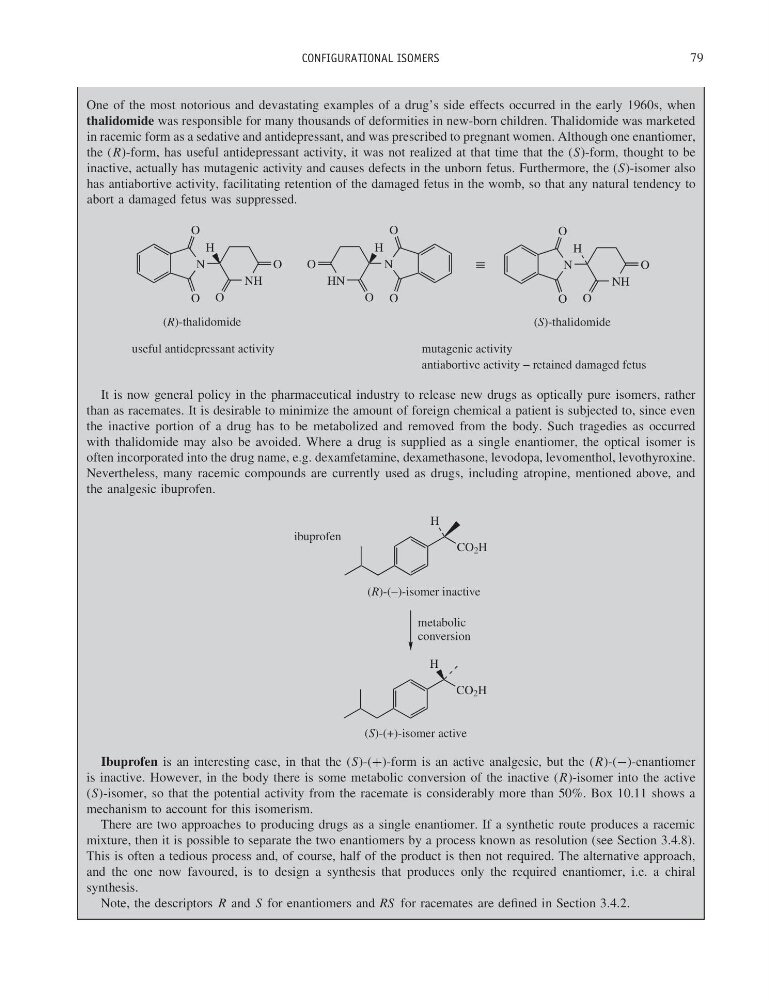
One of the most notorious and devastating examples of a drug’s side effects occurred in the early 1960s, when
thalidomide was responsible for many thousands of deformities in new-born children. Thalidomide was marketed
in racemic form as a sedative and antidepressant, and was prescribed to pregnant women. Although one enantiomer,
the (R)-form, has useful antidepressant activity, it was not realized at that time that the (S)-form, thought to be
inactive, actually has mutagenic activity and causes defects in the unborn fetus. Furthermore, the (S)-isomer also
has antiabortive activity, facilitating retention of the damaged fetus in the womb, so that any natural tendency to
abort a damaged fetus was suppressed.
N
NH
O
O
O
O
H
N
NH
O
O
O
O
H
N
HN
O
O
O
O
H
mutagenic activity
antiabortive activity − retained damaged fetus
(R)-thalidomide
(S)-thalidomide
useful antidepressant activity
≡
It is now general policy in the pharmaceutical industry to release new drugs as optically pure isomers, rather
than as racemates. It is desirable to minimize the amount of foreign chemical a patient is subjected to, since even
the inactive portion of a drug has to be metabolized and removed from the body. Such tragedies as occurred
with thalidomide may also be avoided. Where a drug is supplied as a single enantiomer, the optical isomer is
often incorporated into the drug name, e.g. dexamfetamine, dexamethasone, levodopa, levomenthol, levothyroxine.
Nevertheless, many racemic compounds are currently used as drugs, including atropine, mentioned above, and
the analgesic ibuprofen.
ibuprofen
CO 2 H
H
CO 2 H
H
(R)-(−)-isomer inactive
(S)-(+)-isomer active
metabolic
conversion
Ibuprofen is an interesting case, in that the (S)-(+)-form is an active analgesic, but the (R)-(−)-enantiomer
is inactive. However, in the body there is some metabolic conversion of the inactive (R)-isomer into the active
(S)-isomer, so that the potential activity from the racemate is considerably more than 50%. Box 10.11 shows a
mechanism to account for this isomerism.
There are two approaches to producing drugs as a single enantiomer. If a synthetic route produces a racemic
mixture, then it is possible to separate the two enantiomers by a process known as resolution (see Section 3.4.8).
This is often a tedious process and, of course, half of the product is then not required. The alternative approach,
and the one now favoured, is to design a synthesis that produces only the required enantiomer, i.e. a chiral
synthesis.
Note, the descriptors R and S for enantiomers and RS for racemates are defined in Section 3.4.2.
79
One of the most notorious and devastating examples of a drug’s side effects occurred in the early 1960s, when
thalidomide was responsible for many thousands of deformities in new-born children. Thalidomide was marketed
in racemic form as a sedative and antidepressant, and was prescribed to pregnant women. Although one enantiomer,
the (R)-form, has useful antidepressant activity, it was not realized at that time that the (S)-form, thought to be
inactive, actually has mutagenic activity and causes defects in the unborn fetus. Furthermore, the (S)-isomer also
has antiabortive activity, facilitating retention of the damaged fetus in the womb, so that any natural tendency to
abort a damaged fetus was suppressed.
N
NH
O
O
O
O
H
N
NH
O
O
O
O
H
N
HN
O
O
O
O
H
mutagenic activity
antiabortive activity − retained damaged fetus
(R)-thalidomide
(S)-thalidomide
useful antidepressant activity
≡
It is now general policy in the pharmaceutical industry to release new drugs as optically pure isomers, rather
than as racemates. It is desirable to minimize the amount of foreign chemical a patient is subjected to, since even
the inactive portion of a drug has to be metabolized and removed from the body. Such tragedies as occurred
with thalidomide may also be avoided. Where a drug is supplied as a single enantiomer, the optical isomer is
often incorporated into the drug name, e.g. dexamfetamine, dexamethasone, levodopa, levomenthol, levothyroxine.
Nevertheless, many racemic compounds are currently used as drugs, including atropine, mentioned above, and
the analgesic ibuprofen.
ibuprofen
CO 2 H
H
CO 2 H
H
(R)-(−)-isomer inactive
(S)-(+)-isomer active
metabolic
conversion
Ibuprofen is an interesting case, in that the (S)-(+)-form is an active analgesic, but the (R)-(−)-enantiomer
is inactive. However, in the body there is some metabolic conversion of the inactive (R)-isomer into the active
(S)-isomer, so that the potential activity from the racemate is considerably more than 50%. Box 10.11 shows a
mechanism to account for this isomerism.
There are two approaches to producing drugs as a single enantiomer. If a synthetic route produces a racemic
mixture, then it is possible to separate the two enantiomers by a process known as resolution (see Section 3.4.8).
This is often a tedious process and, of course, half of the product is then not required. The alternative approach,
and the one now favoured, is to design a synthesis that produces only the required enantiomer, i.e. a chiral
synthesis.
Note, the descriptors R and S for enantiomers and RS for racemates are defined in Section 3.4.2.