

CONFIGURATIONAL ISOMERS
83
N
S
O
H 2 N
CO 2 H
H
2
3
4
5
7
1
6
6-aminopenicillanic acid
N
C
S
H
5
priority 1
priority 2
priority 3
priority 4
clockwise: 5R
N
C
C
H
S
O
O O
C
3
priority 1
priority 2
priority 3
priority 4
viewed from the
front clockwise
therefore, if viewed
from rear, must be
anticlockwise: 3S
* chiral centre
*
*
*
C
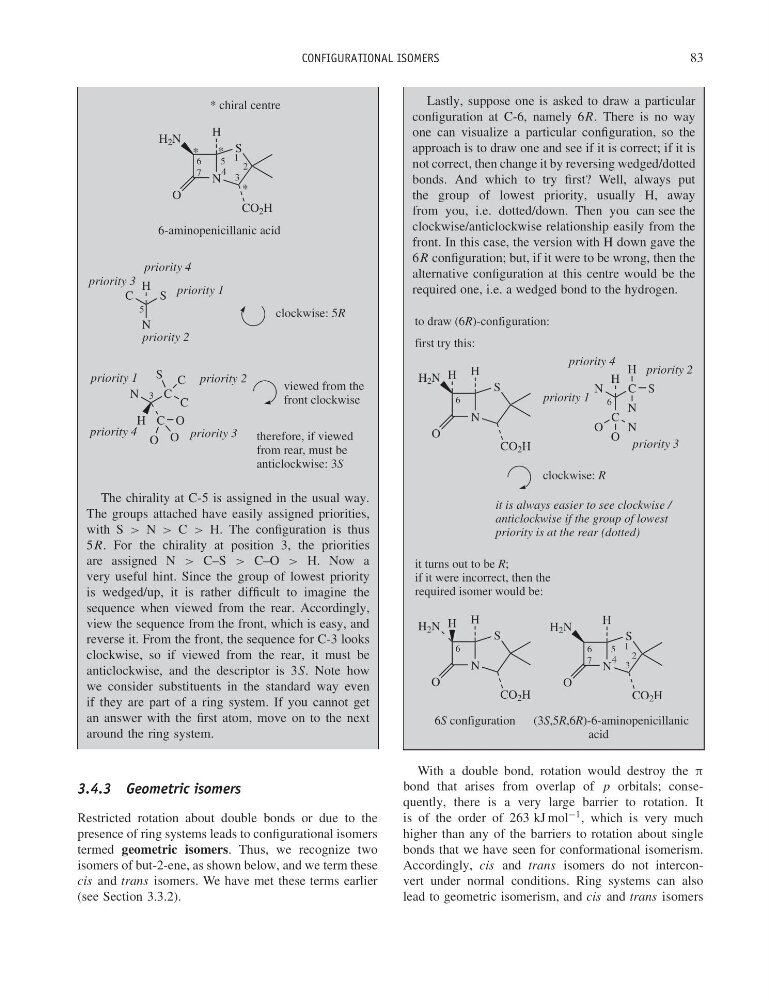
The chirality at C-5 is assigned in the usual way.
The groups attached have easily assigned priorities,
with S > N > C > H. The configuration is thus
5R. For the chirality at position 3, the priorities
are assigned N > C–S > C–O > H. Now a
very useful hint. Since the group of lowest priority
is wedged/up, it is rather difficult to imagine the
sequence when viewed from the rear. Accordingly,
view the sequence from the front, which is easy, and
reverse it. From the front, the sequence for C-3 looks
clockwise, so if viewed from the rear, it must be
anticlockwise, and the descriptor is 3S. Note how
we consider substituents in the standard way even
if they are part of a ring system. If you cannot get
an answer with the first atom, move on to the next
around the ring system.
3.4.3 Geometric isomers
Restricted rotation about double bonds or due to the
presence of ring systems leads to configurational isomers
termed geometric isomers. Thus, we recognize two
isomers of but-2-ene, as shown below, and we term these
cis and trans isomers. We have met these terms earlier
(see Section 3.3.2).
With a double bond, rotation would destroy the π
bond that arises from overlap of p orbitals; consequently, there is a very large barrier to rotation. It
is of the order of 263 kJ mol
−1 , which is very much
higher than any of the barriers to rotation about single
bonds that we have seen for conformational isomerism.
Accordingly, cis and trans isomers do not interconvert under normal conditions. Ring systems can also
lead to geometric isomerism, and cis and trans isomers
Lastly, suppose one is asked to draw a particular
configuration at C-6, namely 6R. There is no way
one can visualize a particular configuration, so the
approach is to draw one and see if it is correct; if it is
not correct, then change it by reversing wedged/dotted
bonds. And which to try first? Well, always put
the group of lowest priority, usually H, away
from you, i.e. dotted/down. Then you can see the
clockwise/anticlockwise relationship easily from the
front. In this case, the version with H down gave the
6R configuration; but, if it were to be wrong, then the
alternative configuration at this centre would be the
required one, i.e. a wedged bond to the hydrogen.
to draw (6R)-configuration:
N
S
O
H 2 N
CO 2 H
H
first try this:
H
6
C
N
C
H
S
N
H
N
O
O
priority 1
priority 2
priority 3
priority 4
clockwise: R
it turns out to be R;
if it were incorrect, then the
required isomer would be:
N
S
O
H 2 N
CO 2 H
H
H
6
it is always easier to see clockwise /
anticlockwise if the group of lowest
priority is at the rear (dotted)
6S configuration
N
S
O
H 2 N
CO 2 H
H
2
3
4
5
7
1
6
(3S,5R,6R)-6-aminopenicillanic
acid
6
83
N
S
O
H 2 N
CO 2 H
H
2
3
4
5
7
1
6
6-aminopenicillanic acid
N
C
S
H
5
priority 1
priority 2
priority 3
priority 4
clockwise: 5R
N
C
C
H
S
O
O O
C
3
priority 1
priority 2
priority 3
priority 4
viewed from the
front clockwise
therefore, if viewed
from rear, must be
anticlockwise: 3S
* chiral centre
*
*
*
C
The chirality at C-5 is assigned in the usual way.
The groups attached have easily assigned priorities,
with S > N > C > H. The configuration is thus
5R. For the chirality at position 3, the priorities
are assigned N > C–S > C–O > H. Now a
very useful hint. Since the group of lowest priority
is wedged/up, it is rather difficult to imagine the
sequence when viewed from the rear. Accordingly,
view the sequence from the front, which is easy, and
reverse it. From the front, the sequence for C-3 looks
clockwise, so if viewed from the rear, it must be
anticlockwise, and the descriptor is 3S. Note how
we consider substituents in the standard way even
if they are part of a ring system. If you cannot get
an answer with the first atom, move on to the next
around the ring system.
3.4.3 Geometric isomers
Restricted rotation about double bonds or due to the
presence of ring systems leads to configurational isomers
termed geometric isomers. Thus, we recognize two
isomers of but-2-ene, as shown below, and we term these
cis and trans isomers. We have met these terms earlier
(see Section 3.3.2).
With a double bond, rotation would destroy the π
bond that arises from overlap of p orbitals; consequently, there is a very large barrier to rotation. It
is of the order of 263 kJ mol
−1 , which is very much
higher than any of the barriers to rotation about single
bonds that we have seen for conformational isomerism.
Accordingly, cis and trans isomers do not interconvert under normal conditions. Ring systems can also
lead to geometric isomerism, and cis and trans isomers
Lastly, suppose one is asked to draw a particular
configuration at C-6, namely 6R. There is no way
one can visualize a particular configuration, so the
approach is to draw one and see if it is correct; if it is
not correct, then change it by reversing wedged/dotted
bonds. And which to try first? Well, always put
the group of lowest priority, usually H, away
from you, i.e. dotted/down. Then you can see the
clockwise/anticlockwise relationship easily from the
front. In this case, the version with H down gave the
6R configuration; but, if it were to be wrong, then the
alternative configuration at this centre would be the
required one, i.e. a wedged bond to the hydrogen.
to draw (6R)-configuration:
N
S
O
H 2 N
CO 2 H
H
first try this:
H
6
C
N
C
H
S
N
H
N
O
O
priority 1
priority 2
priority 3
priority 4
clockwise: R
it turns out to be R;
if it were incorrect, then the
required isomer would be:
N
S
O
H 2 N
CO 2 H
H
H
6
it is always easier to see clockwise /
anticlockwise if the group of lowest
priority is at the rear (dotted)
6S configuration
N
S
O
H 2 N
CO 2 H
H
2
3
4
5
7
1
6
(3S,5R,6R)-6-aminopenicillanic
acid
6