

72
STEREOCHEMISTRY
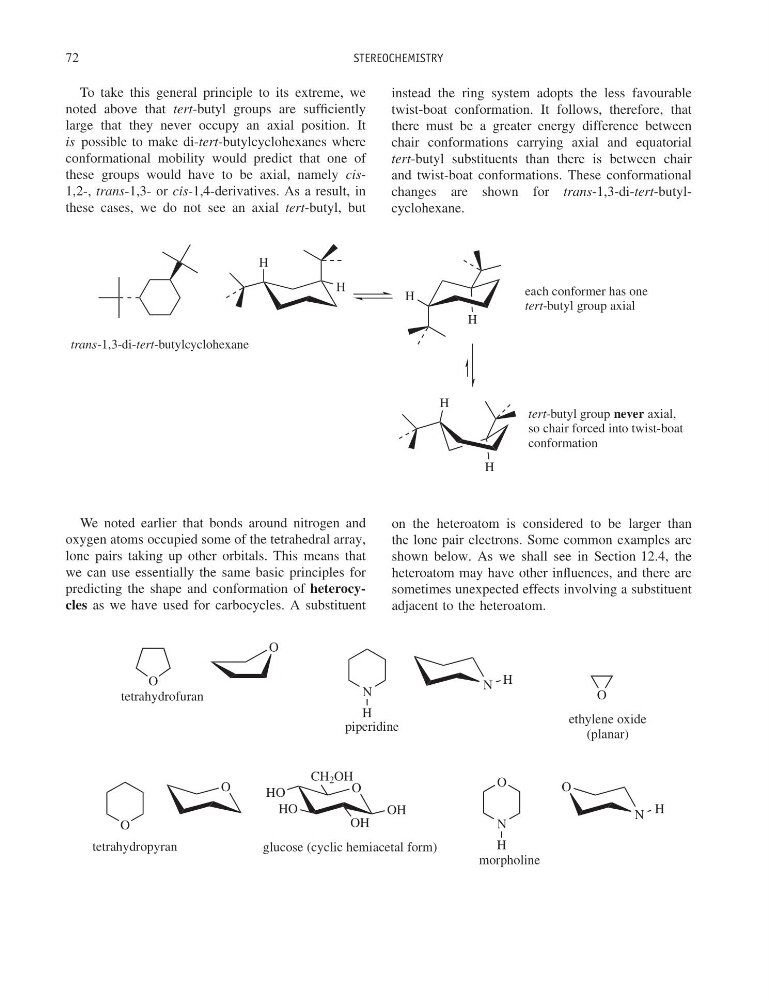
To take this general principle to its extreme, we
noted above that tert-butyl groups are sufficiently
large that they never occupy an axial position. It
is possible to make di-tert-butylcyclohexanes where
conformational mobility would predict that one of
these groups would have to be axial, namely cis1,2-, trans-1,3- or cis-1,4-derivatives. As a result, in
these cases, we do not see an axial tert-butyl, but
instead the ring system adopts the less favourable
twist-boat conformation. It follows, therefore, that
there must be a greater energy difference between
chair conformations carrying axial and equatorial
tert-butyl substituents than there is between chair
and twist-boat conformations. These conformational
changes are shown for trans-1,3-di-tert-butylcyclohexane.
H
H
tert-butyl group never axial,
so chair forced into twist-boat
conformation
trans-1,3-di-tert-butylcyclohexane
each conformer has one
tert-butyl group axial
H
H
H
H
We noted earlier that bonds around nitrogen and
oxygen atoms occupied some of the tetrahedral array,
lone pairs taking up other orbitals. This means that
we can use essentially the same basic principles for
predicting the shape and conformation of heterocycles as we have used for carbocycles. A substituent
on the heteroatom is considered to be larger than
the lone pair electrons. Some common examples are
shown below. As we shall see in Section 12.4, the
heteroatom may have other influences, and there are
sometimes unexpected effects involving a substituent
adjacent to the heteroatom.
O
N H
O
O
N
H
O
N
O
piperidine
H
tetrahydrofuran
tetrahydropyran
morpholine
O
ethylene oxide
(planar)
N
O
H
HO
O
HO
OH
CH 2 OH
OH
glucose (cyclic hemiacetal form)
STEREOCHEMISTRY
To take this general principle to its extreme, we
noted above that tert-butyl groups are sufficiently
large that they never occupy an axial position. It
is possible to make di-tert-butylcyclohexanes where
conformational mobility would predict that one of
these groups would have to be axial, namely cis1,2-, trans-1,3- or cis-1,4-derivatives. As a result, in
these cases, we do not see an axial tert-butyl, but
instead the ring system adopts the less favourable
twist-boat conformation. It follows, therefore, that
there must be a greater energy difference between
chair conformations carrying axial and equatorial
tert-butyl substituents than there is between chair
and twist-boat conformations. These conformational
changes are shown for trans-1,3-di-tert-butylcyclohexane.
H
H
tert-butyl group never axial,
so chair forced into twist-boat
conformation
trans-1,3-di-tert-butylcyclohexane
each conformer has one
tert-butyl group axial
H
H
H
H
We noted earlier that bonds around nitrogen and
oxygen atoms occupied some of the tetrahedral array,
lone pairs taking up other orbitals. This means that
we can use essentially the same basic principles for
predicting the shape and conformation of heterocycles as we have used for carbocycles. A substituent
on the heteroatom is considered to be larger than
the lone pair electrons. Some common examples are
shown below. As we shall see in Section 12.4, the
heteroatom may have other influences, and there are
sometimes unexpected effects involving a substituent
adjacent to the heteroatom.
O
N H
O
O
N
H
O
N
O
piperidine
H
tetrahydrofuran
tetrahydropyran
morpholine
O
ethylene oxide
(planar)
N
O
H
HO
O
HO
OH
CH 2 OH
OH
glucose (cyclic hemiacetal form)