

CONFORMATIONAL ISOMERS
71
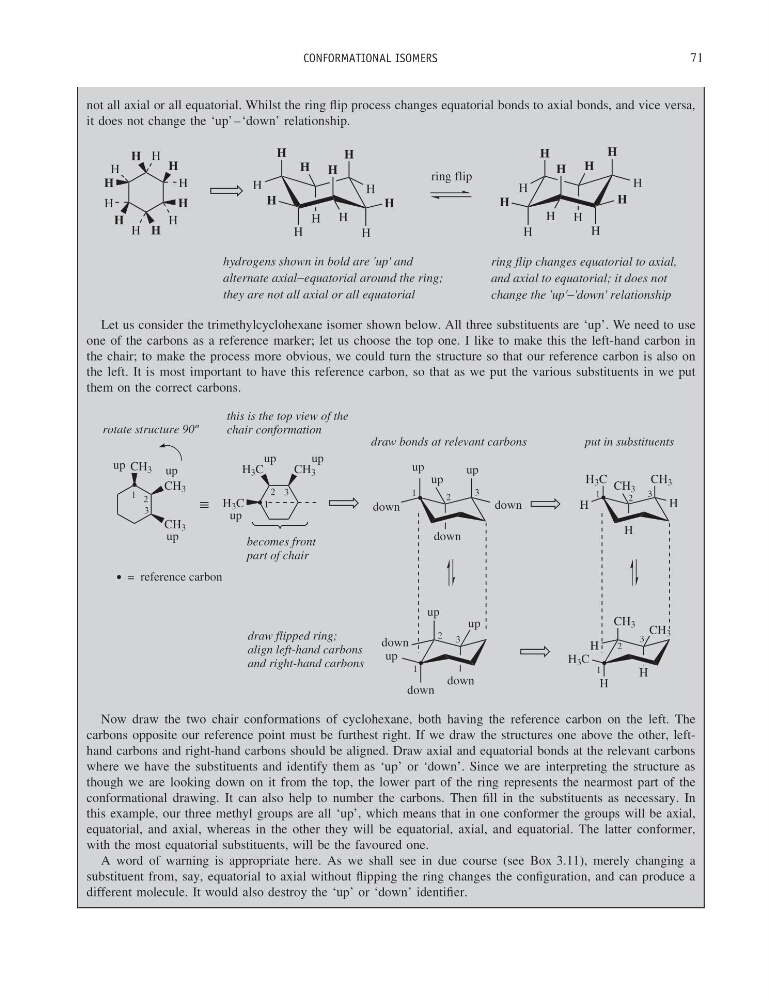
not all axial or all equatorial. Whilst the ring flip process changes equatorial bonds to axial bonds, and vice versa,
it does not change the ‘up’–‘down’ relationship.
H
H
H
H
H
H
H
H
H
H
H
H
H
H
H
H
H
H
H
H
H
H
H
H
hydrogens shown in bold are 'up' and
alternate axial−equatorial around the ring;
they are not all axial or all equatorial
H
H
H
H
H
H
H
H
H H
H
H
ring flip
ring flip changes equatorial to axial,
and axial to equatorial; it does not
change the 'up'−'down' relationship
Let us consider the trimethylcyclohexane isomer shown below. All three substituents are ‘up’. We need to use
one of the carbons as a reference marker; let us choose the top one. I like to make this the left-hand carbon in
the chair; to make the process more obvious, we could turn the structure so that our reference carbon is also on
the left. It is most important to have this reference carbon, so that as we put the various substituents in we put
them on the correct carbons.
H 3 C
H 3 C
CH 3
up
up
up
up
up
up
down
down
down
CH 3
CH 3
CH 3
up
up
up
≡
rotate structure 90º
up
up
up
down
down
down
draw bonds at relevant carbons
put in substituents
H 3 C CH 3
CH 3
H
H
H
H 3 C
CH 3 CH 3
H
H
H
draw flipped ring;
align left-hand carbons
and right-hand carbons
= reference carbon
this is the top view of the
chair conformation
becomes front
part of chair
1
2
3
1 2
3
1
2 3
1
2
3
1
2 3
1
2
3
Now draw the two chair conformations of cyclohexane, both having the reference carbon on the left. The
carbons opposite our reference point must be furthest right. If we draw the structures one above the other, lefthand carbons and right-hand carbons should be aligned. Draw axial and equatorial bonds at the relevant carbons
where we have the substituents and identify them as ‘up’ or ‘down’. Since we are interpreting the structure as
though we are looking down on it from the top, the lower part of the ring represents the nearmost part of the
conformational drawing. It can also help to number the carbons. Then fill in the substituents as necessary. In
this example, our three methyl groups are all ‘up’, which means that in one conformer the groups will be axial,
equatorial, and axial, whereas in the other they will be equatorial, axial, and equatorial. The latter conformer,
with the most equatorial substituents, will be the favoured one.
A word of warning is appropriate here. As we shall see in due course (see Box 3.11), merely changing a
substituent from, say, equatorial to axial without flipping the ring changes the configuration, and can produce a
different molecule. It would also destroy the ‘up’ or ‘down’ identifier.
71
not all axial or all equatorial. Whilst the ring flip process changes equatorial bonds to axial bonds, and vice versa,
it does not change the ‘up’–‘down’ relationship.
H
H
H
H
H
H
H
H
H
H
H
H
H
H
H
H
H
H
H
H
H
H
H
H
hydrogens shown in bold are 'up' and
alternate axial−equatorial around the ring;
they are not all axial or all equatorial
H
H
H
H
H
H
H
H
H H
H
H
ring flip
ring flip changes equatorial to axial,
and axial to equatorial; it does not
change the 'up'−'down' relationship
Let us consider the trimethylcyclohexane isomer shown below. All three substituents are ‘up’. We need to use
one of the carbons as a reference marker; let us choose the top one. I like to make this the left-hand carbon in
the chair; to make the process more obvious, we could turn the structure so that our reference carbon is also on
the left. It is most important to have this reference carbon, so that as we put the various substituents in we put
them on the correct carbons.
H 3 C
H 3 C
CH 3
up
up
up
up
up
up
down
down
down
CH 3
CH 3
CH 3
up
up
up
≡
rotate structure 90º
up
up
up
down
down
down
draw bonds at relevant carbons
put in substituents
H 3 C CH 3
CH 3
H
H
H
H 3 C
CH 3 CH 3
H
H
H
draw flipped ring;
align left-hand carbons
and right-hand carbons
= reference carbon
this is the top view of the
chair conformation
becomes front
part of chair
1
2
3
1 2
3
1
2 3
1
2
3
1
2 3
1
2
3
Now draw the two chair conformations of cyclohexane, both having the reference carbon on the left. The
carbons opposite our reference point must be furthest right. If we draw the structures one above the other, lefthand carbons and right-hand carbons should be aligned. Draw axial and equatorial bonds at the relevant carbons
where we have the substituents and identify them as ‘up’ or ‘down’. Since we are interpreting the structure as
though we are looking down on it from the top, the lower part of the ring represents the nearmost part of the
conformational drawing. It can also help to number the carbons. Then fill in the substituents as necessary. In
this example, our three methyl groups are all ‘up’, which means that in one conformer the groups will be axial,
equatorial, and axial, whereas in the other they will be equatorial, axial, and equatorial. The latter conformer,
with the most equatorial substituents, will be the favoured one.
A word of warning is appropriate here. As we shall see in due course (see Box 3.11), merely changing a
substituent from, say, equatorial to axial without flipping the ring changes the configuration, and can produce a
different molecule. It would also destroy the ‘up’ or ‘down’ identifier.