

70
STEREOCHEMISTRY
menthol
HO
HO
OH
HO
HO
HO
OH
CO 2 H
OH
CO 2 H
OH
HO
HO
quinic acid
OH
OH
HO
CO 2 H
OH
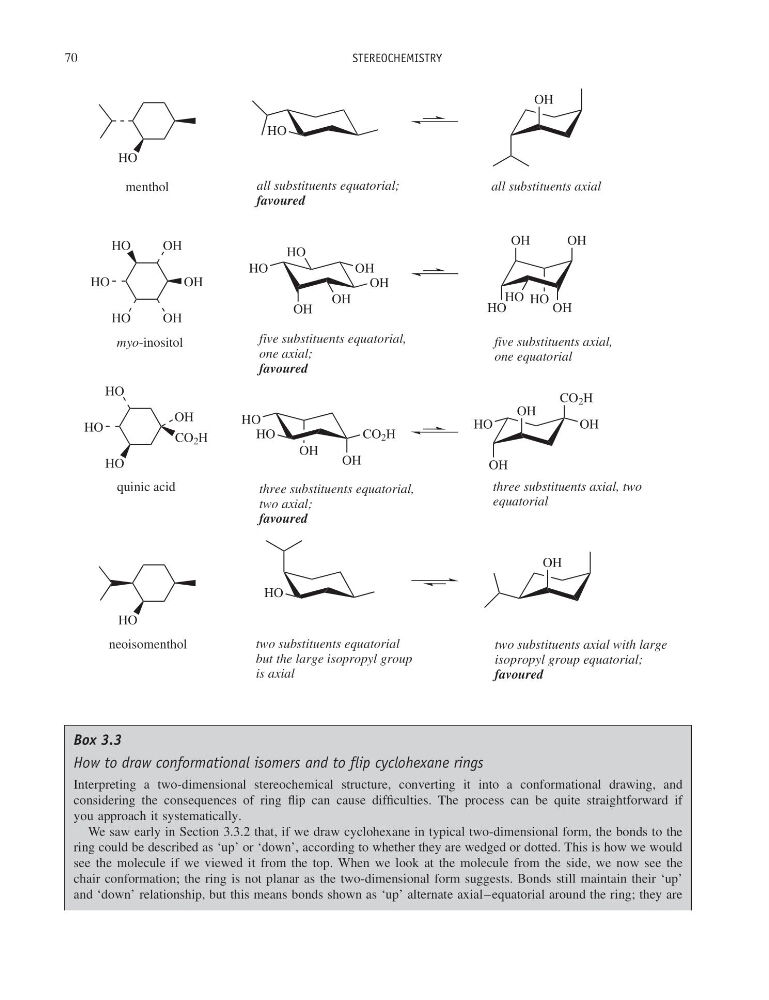
all substituents equatorial;
favoured
all substituents axial
three substituents equatorial,
two axial;
favoured
three substituents axial, two
equatorial
myo-inositol
HO
OH
OH
OH
OH
HO
HO
HO
OH
OH
HO
OH
five substituents equatorial,
one axial;
favoured
five substituents axial,
one equatorial
HO
OH
OH
OH
HO
HO
neoisomenthol
HO
HO
OH
two substituents equatorial
but the large isopropyl group
is axial
two substituents axial with large
isopropyl group equatorial;
favoured
Box 3.3
How to draw conformational isomers and to flip cyclohexane rings
Interpreting a two-dimensional stereochemical structure, converting it into a conformational drawing, and
considering the consequences of ring flip can cause difficulties. The process can be quite straightforward if
you approach it systematically.
We saw early in Section 3.3.2 that, if we draw cyclohexane in typical two-dimensional form, the bonds to the
ring could be described as ‘up’ or ‘down’, according to whether they are wedged or dotted. This is how we would
see the molecule if we viewed it from the top. When we look at the molecule from the side, we now see the
chair conformation; the ring is not planar as the two-dimensional form suggests. Bonds still maintain their ‘up’
and ‘down’ relationship, but this means bonds shown as ‘up’ alternate axial–equatorial around the ring; they are
STEREOCHEMISTRY
menthol
HO
HO
OH
HO
HO
HO
OH
CO 2 H
OH
CO 2 H
OH
HO
HO
quinic acid
OH
OH
HO
CO 2 H
OH
all substituents equatorial;
favoured
all substituents axial
three substituents equatorial,
two axial;
favoured
three substituents axial, two
equatorial
myo-inositol
HO
OH
OH
OH
OH
HO
HO
HO
OH
OH
HO
OH
five substituents equatorial,
one axial;
favoured
five substituents axial,
one equatorial
HO
OH
OH
OH
HO
HO
neoisomenthol
HO
HO
OH
two substituents equatorial
but the large isopropyl group
is axial
two substituents axial with large
isopropyl group equatorial;
favoured
Box 3.3
How to draw conformational isomers and to flip cyclohexane rings
Interpreting a two-dimensional stereochemical structure, converting it into a conformational drawing, and
considering the consequences of ring flip can cause difficulties. The process can be quite straightforward if
you approach it systematically.
We saw early in Section 3.3.2 that, if we draw cyclohexane in typical two-dimensional form, the bonds to the
ring could be described as ‘up’ or ‘down’, according to whether they are wedged or dotted. This is how we would
see the molecule if we viewed it from the top. When we look at the molecule from the side, we now see the
chair conformation; the ring is not planar as the two-dimensional form suggests. Bonds still maintain their ‘up’
and ‘down’ relationship, but this means bonds shown as ‘up’ alternate axial–equatorial around the ring; they are