

CONFORMATIONAL ISOMERS
69
H 3 C
CH 3
H
CH 3
H
CH 3
H
H
H
CH 3
H 3 C
CH 3
H
H
CH 3
H
1,4-dimethylcyclohexane
trans
cis
ax
eq
eq
ax
eq
ax
ax
lower energy − both methyl
substituents equatorial
higher energy − both methyl
substituents axial
both conformations have same energy −
one axial methyl and one equatorial methyl
eq
H
CH 3
CH 3
H
ax
eq
≡
180º
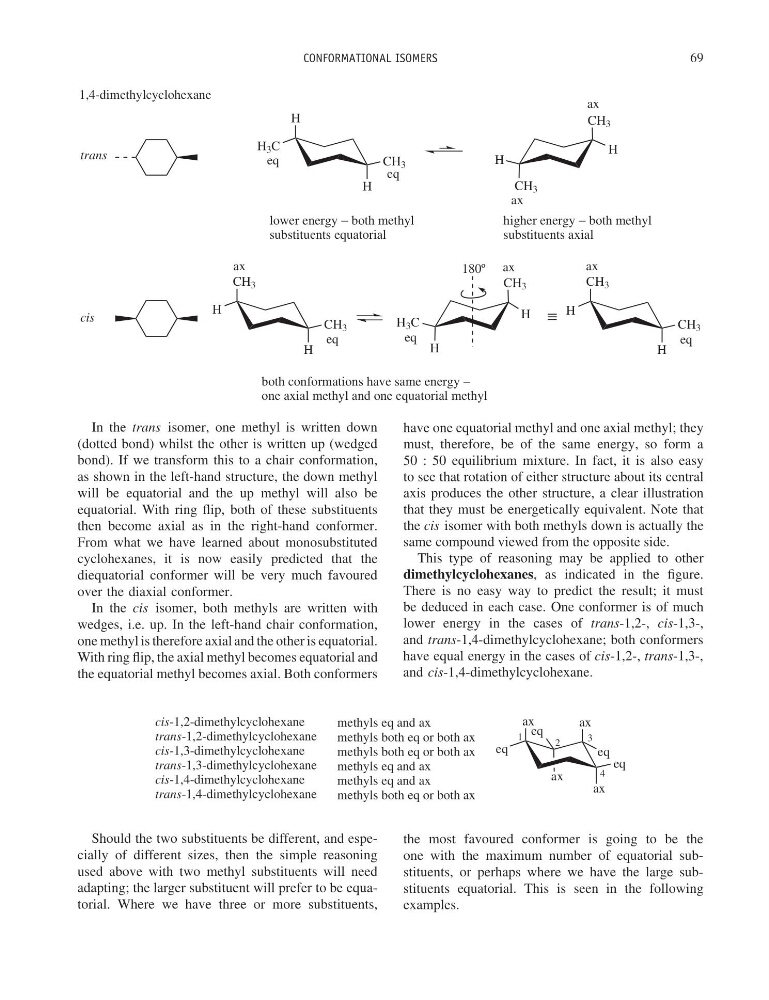
In the trans isomer, one methyl is written down
(dotted bond) whilst the other is written up (wedged
bond). If we transform this to a chair conformation,
as shown in the left-hand structure, the down methyl
will be equatorial and the up methyl will also be
equatorial. With ring flip, both of these substituents
then become axial as in the right-hand conformer.
From what we have learned about monosubstituted
cyclohexanes, it is now easily predicted that the
diequatorial conformer will be very much favoured
over the diaxial conformer.
In the cis isomer, both methyls are written with
wedges, i.e. up. In the left-hand chair conformation,
one methyl is therefore axial and the other is equatorial.
With ring flip, the axial methyl becomes equatorial and
the equatorial methyl becomes axial. Both conformers
have one equatorial methyl and one axial methyl; they
must, therefore, be of the same energy, so form a
50 : 50 equilibrium mixture. In fact, it is also easy
to see that rotation of either structure about its central
axis produces the other structure, a clear illustration
that they must be energetically equivalent. Note that
the cis isomer with both methyls down is actually the
same compound viewed from the opposite side.
This type of reasoning may be applied to other
dimethylcyclohexanes, as indicated in the figure.
There is no easy way to predict the result; it must
be deduced in each case. One conformer is of much
lower energy in the cases of trans-1,2-, cis-1,3-,
and trans-1,4-dimethylcyclohexane; both conformers
have equal energy in the cases of cis-1,2-, trans-1,3-,
and cis-1,4-dimethylcyclohexane.
eq
ax
ax
ax
eq
ax
eq
eq
cis-1,2-dimethylcyclohexane
trans-1,2-dimethylcyclohexane
cis-1,3-dimethylcyclohexane
trans-1,3-dimethylcyclohexane
cis-1,4-dimethylcyclohexane
trans-1,4-dimethylcyclohexane
methyls eq and ax
methyls both eq or both ax
methyls both eq or both ax
methyls eq and ax
methyls eq and ax
methyls both eq or both ax
2
3
4
1
Should the two substituents be different, and especially of different sizes, then the simple reasoning
used above with two methyl substituents will need
adapting; the larger substituent will prefer to be equatorial. Where we have three or more substituents,
the most favoured conformer is going to be the
one with the maximum number of equatorial substituents, or perhaps where we have the large substituents equatorial. This is seen in the following
examples.
69
H 3 C
CH 3
H
CH 3
H
CH 3
H
H
H
CH 3
H 3 C
CH 3
H
H
CH 3
H
1,4-dimethylcyclohexane
trans
cis
ax
eq
eq
ax
eq
ax
ax
lower energy − both methyl
substituents equatorial
higher energy − both methyl
substituents axial
both conformations have same energy −
one axial methyl and one equatorial methyl
eq
H
CH 3
CH 3
H
ax
eq
≡
180º
In the trans isomer, one methyl is written down
(dotted bond) whilst the other is written up (wedged
bond). If we transform this to a chair conformation,
as shown in the left-hand structure, the down methyl
will be equatorial and the up methyl will also be
equatorial. With ring flip, both of these substituents
then become axial as in the right-hand conformer.
From what we have learned about monosubstituted
cyclohexanes, it is now easily predicted that the
diequatorial conformer will be very much favoured
over the diaxial conformer.
In the cis isomer, both methyls are written with
wedges, i.e. up. In the left-hand chair conformation,
one methyl is therefore axial and the other is equatorial.
With ring flip, the axial methyl becomes equatorial and
the equatorial methyl becomes axial. Both conformers
have one equatorial methyl and one axial methyl; they
must, therefore, be of the same energy, so form a
50 : 50 equilibrium mixture. In fact, it is also easy
to see that rotation of either structure about its central
axis produces the other structure, a clear illustration
that they must be energetically equivalent. Note that
the cis isomer with both methyls down is actually the
same compound viewed from the opposite side.
This type of reasoning may be applied to other
dimethylcyclohexanes, as indicated in the figure.
There is no easy way to predict the result; it must
be deduced in each case. One conformer is of much
lower energy in the cases of trans-1,2-, cis-1,3-,
and trans-1,4-dimethylcyclohexane; both conformers
have equal energy in the cases of cis-1,2-, trans-1,3-,
and cis-1,4-dimethylcyclohexane.
eq
ax
ax
ax
eq
ax
eq
eq
cis-1,2-dimethylcyclohexane
trans-1,2-dimethylcyclohexane
cis-1,3-dimethylcyclohexane
trans-1,3-dimethylcyclohexane
cis-1,4-dimethylcyclohexane
trans-1,4-dimethylcyclohexane
methyls eq and ax
methyls both eq or both ax
methyls both eq or both ax
methyls eq and ax
methyls eq and ax
methyls both eq or both ax
2
3
4
1
Should the two substituents be different, and especially of different sizes, then the simple reasoning
used above with two methyl substituents will need
adapting; the larger substituent will prefer to be equatorial. Where we have three or more substituents,
the most favoured conformer is going to be the
one with the maximum number of equatorial substituents, or perhaps where we have the large substituents equatorial. This is seen in the following
examples.