

68
STEREOCHEMISTRY
this basis alone, we can predict that the equatorial
conformer is of lower energy and, thus, more
favoured. However, there is a further feature that
destabilizes the axial conformer, and that is the
spatial interaction between the axial methyl and the
axial hydrogens at positions 3 and 5, termed a
1,3-diaxial interaction. Together, they account for
the equilibrium mixture consisting mainly of the
equatorial conformer. We can indicate this by using
arrows of unequal size in the equilibrium equation.
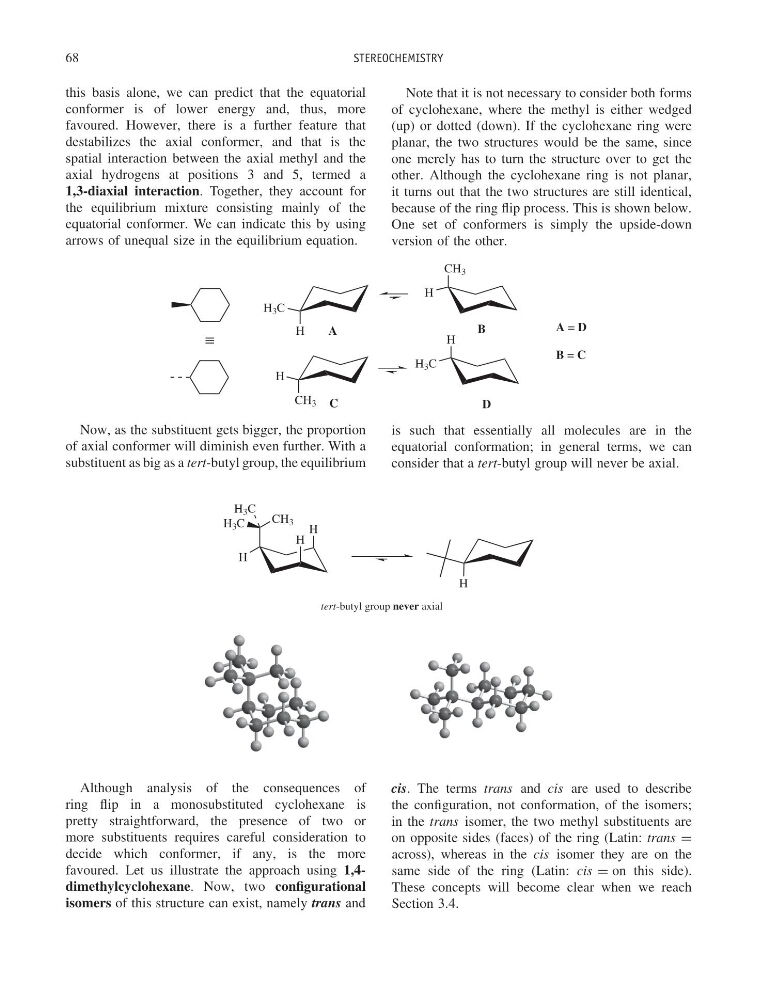
Note that it is not necessary to consider both forms
of cyclohexane, where the methyl is either wedged
(up) or dotted (down). If the cyclohexane ring were
planar, the two structures would be the same, since
one merely has to turn the structure over to get the
other. Although the cyclohexane ring is not planar,
it turns out that the two structures are still identical,
because of the ring flip process. This is shown below.
One set of conformers is simply the upside-down
version of the other.
H 3 C
H
H
CH 3
≡
H 3 C
H
H
CH 3
A
B
C
D
A = D
B = C
Now, as the substituent gets bigger, the proportion
of axial conformer will diminish even further. With a
substituent as big as a tert-butyl group, the equilibrium
is such that essentially all molecules are in the
equatorial conformation; in general terms, we can
consider that a tert-butyl group will never be axial.
H
H
H
H
CH 3
H 3 C
H 3 C
tert-butyl group never axial
Although analysis of the consequences of
ring flip in a monosubstituted cyclohexane is
pretty straightforward, the presence of two or
more substituents requires careful consideration to
decide which conformer, if any, is the more
favoured. Let us illustrate the approach using 1,4dimethylcyclohexane. Now, two configurational
isomers of this structure can exist, namely trans and
cis. The terms trans and cis are used to describe
the configuration, not conformation, of the isomers;
in the trans isomer, the two methyl substituents are
on opposite sides (faces) of the ring (Latin: trans =
across), whereas in the cis isomer they are on the
same side of the ring (Latin: cis = on this side).
These concepts will become clear when we reach
Section 3.4.
STEREOCHEMISTRY
this basis alone, we can predict that the equatorial
conformer is of lower energy and, thus, more
favoured. However, there is a further feature that
destabilizes the axial conformer, and that is the
spatial interaction between the axial methyl and the
axial hydrogens at positions 3 and 5, termed a
1,3-diaxial interaction. Together, they account for
the equilibrium mixture consisting mainly of the
equatorial conformer. We can indicate this by using
arrows of unequal size in the equilibrium equation.
Note that it is not necessary to consider both forms
of cyclohexane, where the methyl is either wedged
(up) or dotted (down). If the cyclohexane ring were
planar, the two structures would be the same, since
one merely has to turn the structure over to get the
other. Although the cyclohexane ring is not planar,
it turns out that the two structures are still identical,
because of the ring flip process. This is shown below.
One set of conformers is simply the upside-down
version of the other.
H 3 C
H
H
CH 3
≡
H 3 C
H
H
CH 3
A
B
C
D
A = D
B = C
Now, as the substituent gets bigger, the proportion
of axial conformer will diminish even further. With a
substituent as big as a tert-butyl group, the equilibrium
is such that essentially all molecules are in the
equatorial conformation; in general terms, we can
consider that a tert-butyl group will never be axial.
H
H
H
H
CH 3
H 3 C
H 3 C
tert-butyl group never axial
Although analysis of the consequences of
ring flip in a monosubstituted cyclohexane is
pretty straightforward, the presence of two or
more substituents requires careful consideration to
decide which conformer, if any, is the more
favoured. Let us illustrate the approach using 1,4dimethylcyclohexane. Now, two configurational
isomers of this structure can exist, namely trans and
cis. The terms trans and cis are used to describe
the configuration, not conformation, of the isomers;
in the trans isomer, the two methyl substituents are
on opposite sides (faces) of the ring (Latin: trans =
across), whereas in the cis isomer they are on the
same side of the ring (Latin: cis = on this side).
These concepts will become clear when we reach
Section 3.4.