

CONFIGURATIONAL ISOMERS
73
Box 3.4
Conformation of lindane
Chlorination of benzene gives an addition product that is a mixture of stereoisomers known collectively as
hexachlorocyclohexane (HCH). At one time, this was incorrectly termed benzene hexachloride. The mixture has
insecticidal activity, though activity was found to reside in only one isomer, the so-called gamma isomer, γ-HCH.
γ-HCH, sometimes under its generic name lindane, has been a mainstay insecticide for many years, and is about
the only example of the chlorinated hydrocarbons that has not been banned and is still available for general
use. Although chlorinated hydrocarbons have proved very effective insecticides, they are not readily degraded in
the environment, they accumulate and persist in animal tissues, and have proved toxic to many bird and animal
species.
Cl
Cl
Cl
Cl
Cl
Cl
Cl
Cl
Cl
Cl
Cl
Cl
Cl
Cl
Cl
Cl
Cl
Cl
lindane
γ-HCH
≡
Cl
Cl
Cl
Cl
Cl
Cl
180º
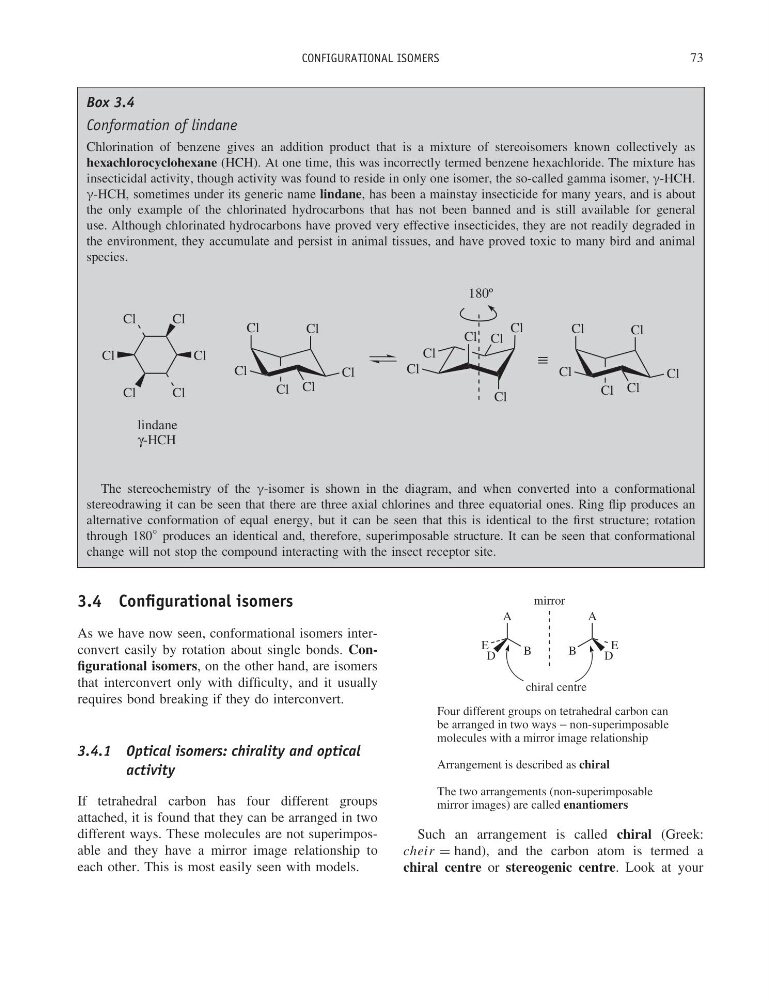
The stereochemistry of the γ-isomer is shown in the diagram, and when converted into a conformational
stereodrawing it can be seen that there are three axial chlorines and three equatorial ones. Ring flip produces an
alternative conformation of equal energy, but it can be seen that this is identical to the first structure; rotation
through 180
◦ produces an identical and, therefore, superimposable structure. It can be seen that conformational
change will not stop the compound interacting with the insect receptor site.
3.4 Configurational isomers
As we have now seen, conformational isomers interconvert easily by rotation about single bonds. Configurational isomers, on the other hand, are isomers
that interconvert only with difficulty, and it usually
requires bond breaking if they do interconvert.
3.4.1 Optical isomers: chirality and optical
activity
If tetrahedral carbon has four different groups
attached, it is found that they can be arranged in two
different ways. These molecules are not superimposable and they have a mirror image relationship to
each other. This is most easily seen with models.
A
B
D
E
A
B
D
E
Four different groups on tetrahedral carbon can
be arranged in two ways − non-superimposable
molecules with a mirror image relationship
Arrangement is described as chiral
The two arrangements (non-superimposable
mirror images) are called enantiomers
mirror
chiral centre
Such an arrangement is called chiral (Greek:
cheir = hand), and the carbon atom is termed a
chiral centre or stereogenic centre. Look at your
73
Box 3.4
Conformation of lindane
Chlorination of benzene gives an addition product that is a mixture of stereoisomers known collectively as
hexachlorocyclohexane (HCH). At one time, this was incorrectly termed benzene hexachloride. The mixture has
insecticidal activity, though activity was found to reside in only one isomer, the so-called gamma isomer, γ-HCH.
γ-HCH, sometimes under its generic name lindane, has been a mainstay insecticide for many years, and is about
the only example of the chlorinated hydrocarbons that has not been banned and is still available for general
use. Although chlorinated hydrocarbons have proved very effective insecticides, they are not readily degraded in
the environment, they accumulate and persist in animal tissues, and have proved toxic to many bird and animal
species.
Cl
Cl
Cl
Cl
Cl
Cl
Cl
Cl
Cl
Cl
Cl
Cl
Cl
Cl
Cl
Cl
Cl
Cl
lindane
γ-HCH
≡
Cl
Cl
Cl
Cl
Cl
Cl
180º
The stereochemistry of the γ-isomer is shown in the diagram, and when converted into a conformational
stereodrawing it can be seen that there are three axial chlorines and three equatorial ones. Ring flip produces an
alternative conformation of equal energy, but it can be seen that this is identical to the first structure; rotation
through 180
◦ produces an identical and, therefore, superimposable structure. It can be seen that conformational
change will not stop the compound interacting with the insect receptor site.
3.4 Configurational isomers
As we have now seen, conformational isomers interconvert easily by rotation about single bonds. Configurational isomers, on the other hand, are isomers
that interconvert only with difficulty, and it usually
requires bond breaking if they do interconvert.
3.4.1 Optical isomers: chirality and optical
activity
If tetrahedral carbon has four different groups
attached, it is found that they can be arranged in two
different ways. These molecules are not superimposable and they have a mirror image relationship to
each other. This is most easily seen with models.
A
B
D
E
A
B
D
E
Four different groups on tetrahedral carbon can
be arranged in two ways − non-superimposable
molecules with a mirror image relationship
Arrangement is described as chiral
The two arrangements (non-superimposable
mirror images) are called enantiomers
mirror
chiral centre
Such an arrangement is called chiral (Greek:
cheir = hand), and the carbon atom is termed a
chiral centre or stereogenic centre. Look at your