

CONFORMATIONAL ISOMERS
63
CH 2
H eq
H ax
H ax
H eq
H ax
H ax
H ax
H eq
H eq
H ax
H eq
H eq
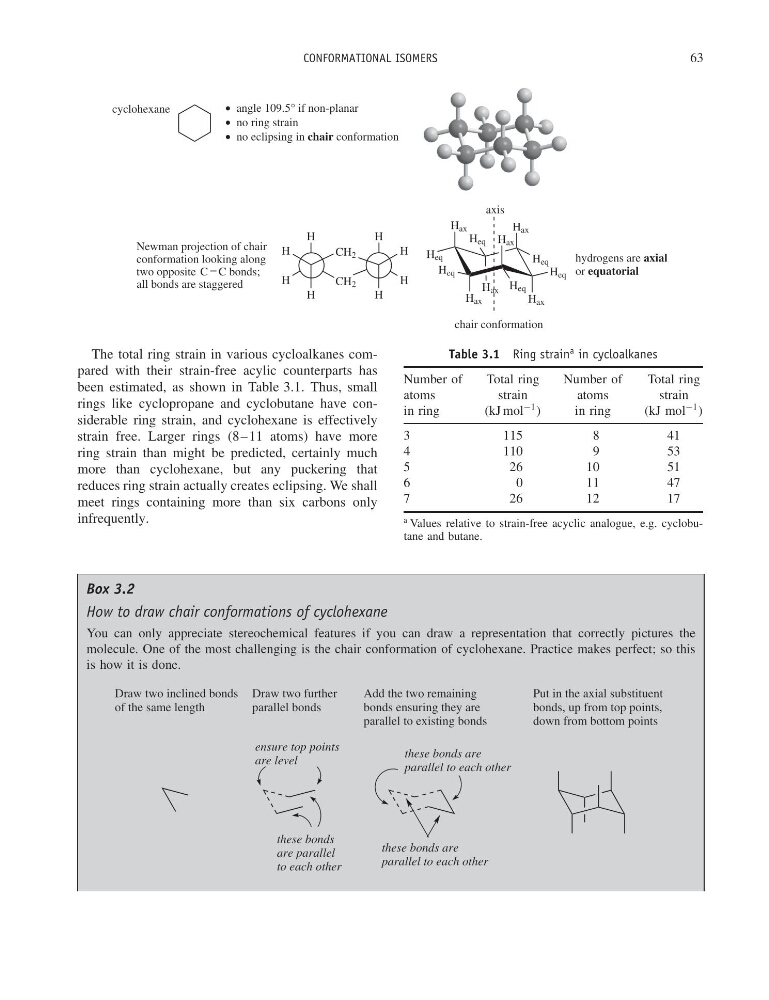
• angle 109.5° if non-planar
• no ring strain
• no eclipsing in chair conformation
cyclohexane
chair conformation
hydrogens are axial
or equatorial
Newman projection of chair
conformation looking along
two opposite
axis
H
H
H
H
H
H
H
H
CH 2
C C bonds;
all bonds are staggered
The total ring strain in various cycloalkanes compared with their strain-free acylic counterparts has
been estimated, as shown in Table 3.1. Thus, small
rings like cyclopropane and cyclobutane have considerable ring strain, and cyclohexane is effectively
strain free. Larger rings (8–11 atoms) have more
ring strain than might be predicted, certainly much
more than cyclohexane, but any puckering that
reduces ring strain actually creates eclipsing. We shall
meet rings containing more than six carbons only
infrequently.
Table 3.1 Ring strain
a in cycloalkanes
Number of
atoms
in ring
Total ring
strain
(kJ mol
−1 )
Number of
atoms
in ring
Total ring
strain
(kJ mol
−1 )
3
115
8
41
4
110
9
53
5
2 6
1 0
5 1
6
0
11
47
7
2 6
1 2
1 7
a Values relative to strain-free acyclic analogue, e.g. cyclobutane and butane.
Box 3.2
How to draw chair conformations of cyclohexane
You can only appreciate stereochemical features if you can draw a representation that correctly pictures the
molecule. One of the most challenging is the chair conformation of cyclohexane. Practice makes perfect; so this
is how it is done.
Draw two inclined bonds
of the same length
Draw two further
parallel bonds
these bonds
are parallel
to each other
Add the two remaining
bonds ensuring they are
parallel to existing bonds
these bonds are
parallel to each other
these bonds are
parallel to each other
Put in the axial substituent
bonds, up from top points,
down from bottom points
ensure top points
are level
63
CH 2
H eq
H ax
H ax
H eq
H ax
H ax
H ax
H eq
H eq
H ax
H eq
H eq
• angle 109.5° if non-planar
• no ring strain
• no eclipsing in chair conformation
cyclohexane
chair conformation
hydrogens are axial
or equatorial
Newman projection of chair
conformation looking along
two opposite
axis
H
H
H
H
H
H
H
H
CH 2
C C bonds;
all bonds are staggered
The total ring strain in various cycloalkanes compared with their strain-free acylic counterparts has
been estimated, as shown in Table 3.1. Thus, small
rings like cyclopropane and cyclobutane have considerable ring strain, and cyclohexane is effectively
strain free. Larger rings (8–11 atoms) have more
ring strain than might be predicted, certainly much
more than cyclohexane, but any puckering that
reduces ring strain actually creates eclipsing. We shall
meet rings containing more than six carbons only
infrequently.
Table 3.1 Ring strain
a in cycloalkanes
Number of
atoms
in ring
Total ring
strain
(kJ mol
−1 )
Number of
atoms
in ring
Total ring
strain
(kJ mol
−1 )
3
115
8
41
4
110
9
53
5
2 6
1 0
5 1
6
0
11
47
7
2 6
1 2
1 7
a Values relative to strain-free acyclic analogue, e.g. cyclobutane and butane.
Box 3.2
How to draw chair conformations of cyclohexane
You can only appreciate stereochemical features if you can draw a representation that correctly pictures the
molecule. One of the most challenging is the chair conformation of cyclohexane. Practice makes perfect; so this
is how it is done.
Draw two inclined bonds
of the same length
Draw two further
parallel bonds
these bonds
are parallel
to each other
Add the two remaining
bonds ensuring they are
parallel to existing bonds
these bonds are
parallel to each other
these bonds are
parallel to each other
Put in the axial substituent
bonds, up from top points,
down from bottom points
ensure top points
are level