

64
STEREOCHEMISTRY
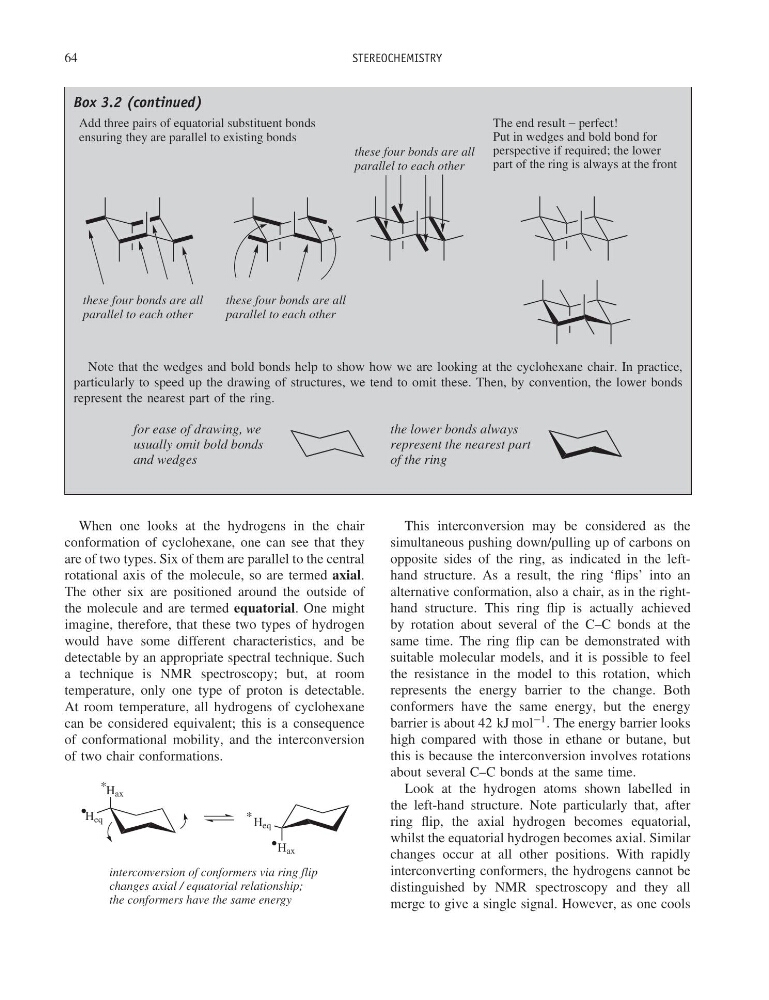
Box 3.2 (continued)
Add three pairs of equatorial substituent bonds
ensuring they are parallel to existing bonds
these four bonds are all
parallel to each other
these four bonds are all
parallel to each other
these four bonds are all
parallel to each other
The end result − perfect!
Put in wedges and bold bond for
perspective if required; the lower
part of the ring is always at the front
Note that the wedges and bold bonds help to show how we are looking at the cyclohexane chair. In practice,
particularly to speed up the drawing of structures, we tend to omit these. Then, by convention, the lower bonds
represent the nearest part of the ring.
for ease of drawing, we
usually omit bold bonds
and wedges
the lower bonds always
represent the nearest part
of the ring
When one looks at the hydrogens in the chair
conformation of cyclohexane, one can see that they
are of two types. Six of them are parallel to the central
rotational axis of the molecule, so are termed axial.
The other six are positioned around the outside of
the molecule and are termed equatorial. One might
imagine, therefore, that these two types of hydrogen
would have some different characteristics, and be
detectable by an appropriate spectral technique. Such
a technique is NMR spectroscopy; but, at room
temperature, only one type of proton is detectable.
At room temperature, all hydrogens of cyclohexane
can be considered equivalent; this is a consequence
of conformational mobility, and the interconversion
of two chair conformations.
H eq
H ax
H eq
H ax
interconversion of conformers via ring flip
changes axial / equatorial relationship;
the conformers have the same energy
•
*
*
•
This interconversion may be considered as the
simultaneous pushing down/pulling up of carbons on
opposite sides of the ring, as indicated in the lefthand structure. As a result, the ring ‘flips’ into an
alternative conformation, also a chair, as in the righthand structure. This ring flip is actually achieved
by rotation about several of the C–C bonds at the
same time. The ring flip can be demonstrated with
suitable molecular models, and it is possible to feel
the resistance in the model to this rotation, which
represents the energy barrier to the change. Both
conformers have the same energy, but the energy
barrier is about 42 kJ mol
−1 . The energy barrier looks
high compared with those in ethane or butane, but
this is because the interconversion involves rotations
about several C–C bonds at the same time.
Look at the hydrogen atoms shown labelled in
the left-hand structure. Note particularly that, after
ring flip, the axial hydrogen becomes equatorial,
whilst the equatorial hydrogen becomes axial. Similar
changes occur at all other positions. With rapidly
interconverting conformers, the hydrogens cannot be
distinguished by NMR spectroscopy and they all
merge to give a single signal. However, as one cools
STEREOCHEMISTRY
Box 3.2 (continued)
Add three pairs of equatorial substituent bonds
ensuring they are parallel to existing bonds
these four bonds are all
parallel to each other
these four bonds are all
parallel to each other
these four bonds are all
parallel to each other
The end result − perfect!
Put in wedges and bold bond for
perspective if required; the lower
part of the ring is always at the front
Note that the wedges and bold bonds help to show how we are looking at the cyclohexane chair. In practice,
particularly to speed up the drawing of structures, we tend to omit these. Then, by convention, the lower bonds
represent the nearest part of the ring.
for ease of drawing, we
usually omit bold bonds
and wedges
the lower bonds always
represent the nearest part
of the ring
When one looks at the hydrogens in the chair
conformation of cyclohexane, one can see that they
are of two types. Six of them are parallel to the central
rotational axis of the molecule, so are termed axial.
The other six are positioned around the outside of
the molecule and are termed equatorial. One might
imagine, therefore, that these two types of hydrogen
would have some different characteristics, and be
detectable by an appropriate spectral technique. Such
a technique is NMR spectroscopy; but, at room
temperature, only one type of proton is detectable.
At room temperature, all hydrogens of cyclohexane
can be considered equivalent; this is a consequence
of conformational mobility, and the interconversion
of two chair conformations.
H eq
H ax
H eq
H ax
interconversion of conformers via ring flip
changes axial / equatorial relationship;
the conformers have the same energy
•
*
*
•
This interconversion may be considered as the
simultaneous pushing down/pulling up of carbons on
opposite sides of the ring, as indicated in the lefthand structure. As a result, the ring ‘flips’ into an
alternative conformation, also a chair, as in the righthand structure. This ring flip is actually achieved
by rotation about several of the C–C bonds at the
same time. The ring flip can be demonstrated with
suitable molecular models, and it is possible to feel
the resistance in the model to this rotation, which
represents the energy barrier to the change. Both
conformers have the same energy, but the energy
barrier is about 42 kJ mol
−1 . The energy barrier looks
high compared with those in ethane or butane, but
this is because the interconversion involves rotations
about several C–C bonds at the same time.
Look at the hydrogen atoms shown labelled in
the left-hand structure. Note particularly that, after
ring flip, the axial hydrogen becomes equatorial,
whilst the equatorial hydrogen becomes axial. Similar
changes occur at all other positions. With rapidly
interconverting conformers, the hydrogens cannot be
distinguished by NMR spectroscopy and they all
merge to give a single signal. However, as one cools