

62
STEREOCHEMISTRY
Box 3.1 (continued)
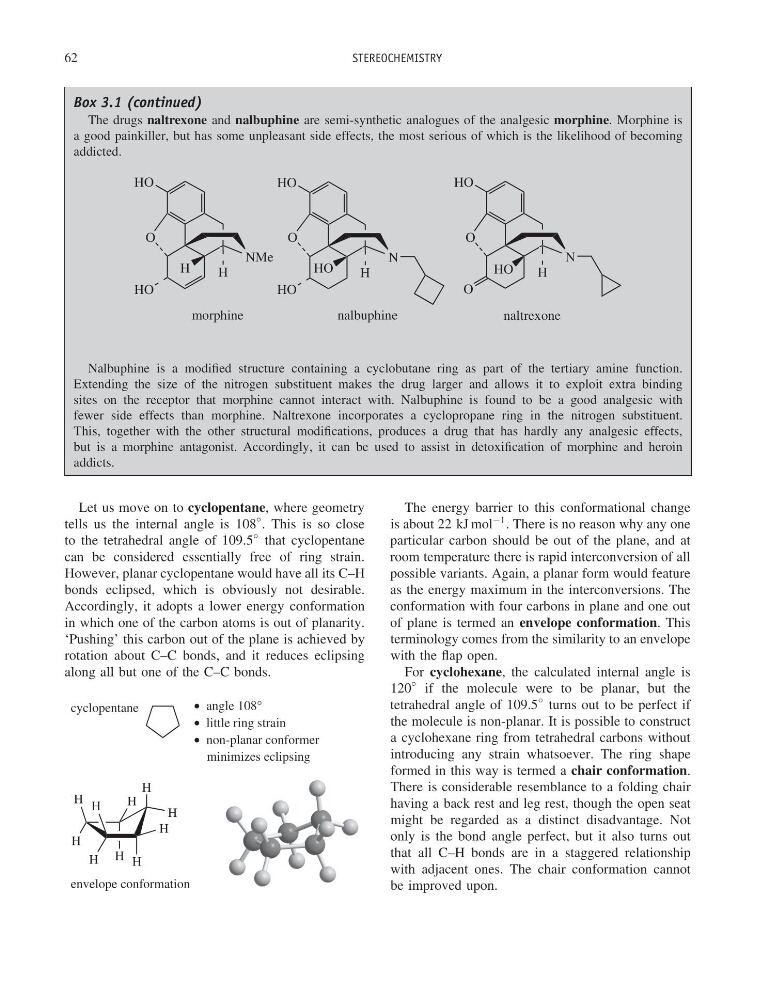
The drugs naltrexone and nalbuphine are semi-synthetic analogues of the analgesic morphine. Morphine is
a good painkiller, but has some unpleasant side effects, the most serious of which is the likelihood of becoming
addicted.
HO
O
HO
H
N
HO
HO
O
O
H
N
HO
naltrexone
nalbuphine
HO
O
HO
H
NMe
H
morphine
Nalbuphine is a modified structure containing a cyclobutane ring as part of the tertiary amine function.
Extending the size of the nitrogen substituent makes the drug larger and allows it to exploit extra binding
sites on the receptor that morphine cannot interact with. Nalbuphine is found to be a good analgesic with
fewer side effects than morphine. Naltrexone incorporates a cyclopropane ring in the nitrogen substituent.
This, together with the other structural modifications, produces a drug that has hardly any analgesic effects,
but is a morphine antagonist. Accordingly, it can be used to assist in detoxification of morphine and heroin
addicts.
Let us move on to cyclopentane, where geometry
tells us the internal angle is 108
◦ . This is so close
to the tetrahedral angle of 109.5
◦ that cyclopentane
can be considered essentially free of ring strain.
However, planar cyclopentane would have all its C–H
bonds eclipsed, which is obviously not desirable.
Accordingly, it adopts a lower energy conformation
in which one of the carbon atoms is out of planarity.
‘Pushing’ this carbon out of the plane is achieved by
rotation about C–C bonds, and it reduces eclipsing
along all but one of the C–C bonds.
cyclopentane
• angle 108°
• little ring strain
• non-planar conformer
minimizes eclipsing
H
H H
H
H
H
H
H H
H
envelope conformation
The energy barrier to this conformational change
is about 22 kJ mol
−1 . There is no reason why any one
particular carbon should be out of the plane, and at
room temperature there is rapid interconversion of all
possible variants. Again, a planar form would feature
as the energy maximum in the interconversions. The
conformation with four carbons in plane and one out
of plane is termed an envelope conformation. This
terminology comes from the similarity to an envelope
with the flap open.
For cyclohexane, the calculated internal angle is
120
◦ if the molecule were to be planar, but the
tetrahedral angle of 109.5
◦ turns out to be perfect if
the molecule is non-planar. It is possible to construct
a cyclohexane ring from tetrahedral carbons without
introducing any strain whatsoever. The ring shape
formed in this way is termed a chair conformation.
There is considerable resemblance to a folding chair
having a back rest and leg rest, though the open seat
might be regarded as a distinct disadvantage. Not
only is the bond angle perfect, but it also turns out
that all C–H bonds are in a staggered relationship
with adjacent ones. The chair conformation cannot
be improved upon.
STEREOCHEMISTRY
Box 3.1 (continued)
The drugs naltrexone and nalbuphine are semi-synthetic analogues of the analgesic morphine. Morphine is
a good painkiller, but has some unpleasant side effects, the most serious of which is the likelihood of becoming
addicted.
HO
O
HO
H
N
HO
HO
O
O
H
N
HO
naltrexone
nalbuphine
HO
O
HO
H
NMe
H
morphine
Nalbuphine is a modified structure containing a cyclobutane ring as part of the tertiary amine function.
Extending the size of the nitrogen substituent makes the drug larger and allows it to exploit extra binding
sites on the receptor that morphine cannot interact with. Nalbuphine is found to be a good analgesic with
fewer side effects than morphine. Naltrexone incorporates a cyclopropane ring in the nitrogen substituent.
This, together with the other structural modifications, produces a drug that has hardly any analgesic effects,
but is a morphine antagonist. Accordingly, it can be used to assist in detoxification of morphine and heroin
addicts.
Let us move on to cyclopentane, where geometry
tells us the internal angle is 108
◦ . This is so close
to the tetrahedral angle of 109.5
◦ that cyclopentane
can be considered essentially free of ring strain.
However, planar cyclopentane would have all its C–H
bonds eclipsed, which is obviously not desirable.
Accordingly, it adopts a lower energy conformation
in which one of the carbon atoms is out of planarity.
‘Pushing’ this carbon out of the plane is achieved by
rotation about C–C bonds, and it reduces eclipsing
along all but one of the C–C bonds.
cyclopentane
• angle 108°
• little ring strain
• non-planar conformer
minimizes eclipsing
H
H H
H
H
H
H
H H
H
envelope conformation
The energy barrier to this conformational change
is about 22 kJ mol
−1 . There is no reason why any one
particular carbon should be out of the plane, and at
room temperature there is rapid interconversion of all
possible variants. Again, a planar form would feature
as the energy maximum in the interconversions. The
conformation with four carbons in plane and one out
of plane is termed an envelope conformation. This
terminology comes from the similarity to an envelope
with the flap open.
For cyclohexane, the calculated internal angle is
120
◦ if the molecule were to be planar, but the
tetrahedral angle of 109.5
◦ turns out to be perfect if
the molecule is non-planar. It is possible to construct
a cyclohexane ring from tetrahedral carbons without
introducing any strain whatsoever. The ring shape
formed in this way is termed a chair conformation.
There is considerable resemblance to a folding chair
having a back rest and leg rest, though the open seat
might be regarded as a distinct disadvantage. Not
only is the bond angle perfect, but it also turns out
that all C–H bonds are in a staggered relationship
with adjacent ones. The chair conformation cannot
be improved upon.