

CONFORMATIONAL ISOMERS
61
more favourable conformation in which eclipsing is
reduced, and the ring appears puckered. This appears
to be achieved by pushing pairs of opposite carbons
in different directions; but, in reality, it is only a
combination of rotations about C–C bonds as we
have seen with the simpler acyclic compounds. It
is not possible to achieve the ideal 60
◦ staggered
arrangement, but it does produce a lower energy
conformer. Of course, there are two alternative ways
of doing this, depending on whether pairs of carbons
are ‘pushed’ or ‘pulled’. Both conformers will be
produced equally, and can interconvert at room
temperature because the energy barrier is fairly small
at about 5.8 kJ mol
−1 . The interconversion of the
two forms is depicted by the equilibrium arrow,
comprised of two half arrows. At equilibrium, both
conformers coexist, and in this case in equal amounts
since they have the same energy.
The planar form of cyclobutane will be the energy
maximum in the interconversion of conformers.
Box 3.1
Compounds with cyclopropane or cyclobutane rings
A cyclopropane ring has the highest level of ring strain in the carbocycles. This means that they are rather
susceptible to ring-opening reactions, but it does not mean that they are unstable and cannot exist. Indeed, there
are many examples of natural products that contain cyclopropane rings, and these are perfectly stable under
normal conditions.
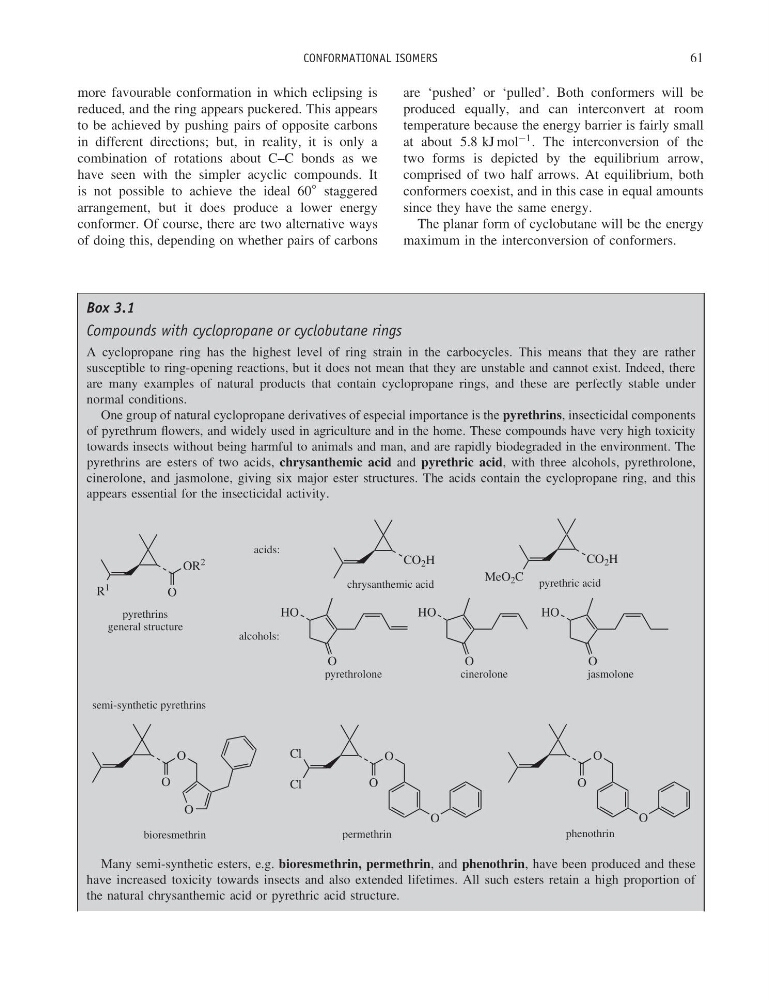
One group of natural cyclopropane derivatives of especial importance is the pyrethrins, insecticidal components
of pyrethrum flowers, and widely used in agriculture and in the home. These compounds have very high toxicity
towards insects without being harmful to animals and man, and are rapidly biodegraded in the environment. The
pyrethrins are esters of two acids, chrysanthemic acid and pyrethric acid, with three alcohols, pyrethrolone,
cinerolone, and jasmolone, giving six major ester structures. The acids contain the cyclopropane ring, and this
appears essential for the insecticidal activity.
R 1
O
OR 2
CO 2 H
CO 2 H
MeO 2 C
O
O
O
Cl
Cl
O
O
O
HO
O
HO
O
HO
O
jasmolone
cinerolone
pyrethric acid
chrysanthemic acid
bioresmethrin
permethrin
pyrethrolone
pyrethrins
general structure
O
O
O
phenothrin
semi-synthetic pyrethrins
acids:
alcohols:
Many semi-synthetic esters, e.g. bioresmethrin, permethrin, and phenothrin, have been produced and these
have increased toxicity towards insects and also extended lifetimes. All such esters retain a high proportion of
the natural chrysanthemic acid or pyrethric acid structure.
61
more favourable conformation in which eclipsing is
reduced, and the ring appears puckered. This appears
to be achieved by pushing pairs of opposite carbons
in different directions; but, in reality, it is only a
combination of rotations about C–C bonds as we
have seen with the simpler acyclic compounds. It
is not possible to achieve the ideal 60
◦ staggered
arrangement, but it does produce a lower energy
conformer. Of course, there are two alternative ways
of doing this, depending on whether pairs of carbons
are ‘pushed’ or ‘pulled’. Both conformers will be
produced equally, and can interconvert at room
temperature because the energy barrier is fairly small
at about 5.8 kJ mol
−1 . The interconversion of the
two forms is depicted by the equilibrium arrow,
comprised of two half arrows. At equilibrium, both
conformers coexist, and in this case in equal amounts
since they have the same energy.
The planar form of cyclobutane will be the energy
maximum in the interconversion of conformers.
Box 3.1
Compounds with cyclopropane or cyclobutane rings
A cyclopropane ring has the highest level of ring strain in the carbocycles. This means that they are rather
susceptible to ring-opening reactions, but it does not mean that they are unstable and cannot exist. Indeed, there
are many examples of natural products that contain cyclopropane rings, and these are perfectly stable under
normal conditions.
One group of natural cyclopropane derivatives of especial importance is the pyrethrins, insecticidal components
of pyrethrum flowers, and widely used in agriculture and in the home. These compounds have very high toxicity
towards insects without being harmful to animals and man, and are rapidly biodegraded in the environment. The
pyrethrins are esters of two acids, chrysanthemic acid and pyrethric acid, with three alcohols, pyrethrolone,
cinerolone, and jasmolone, giving six major ester structures. The acids contain the cyclopropane ring, and this
appears essential for the insecticidal activity.
R 1
O
OR 2
CO 2 H
CO 2 H
MeO 2 C
O
O
O
Cl
Cl
O
O
O
HO
O
HO
O
HO
O
jasmolone
cinerolone
pyrethric acid
chrysanthemic acid
bioresmethrin
permethrin
pyrethrolone
pyrethrins
general structure
O
O
O
phenothrin
semi-synthetic pyrethrins
acids:
alcohols:
Many semi-synthetic esters, e.g. bioresmethrin, permethrin, and phenothrin, have been produced and these
have increased toxicity towards insects and also extended lifetimes. All such esters retain a high proportion of
the natural chrysanthemic acid or pyrethric acid structure.