

WORKED PROBLEMS
673
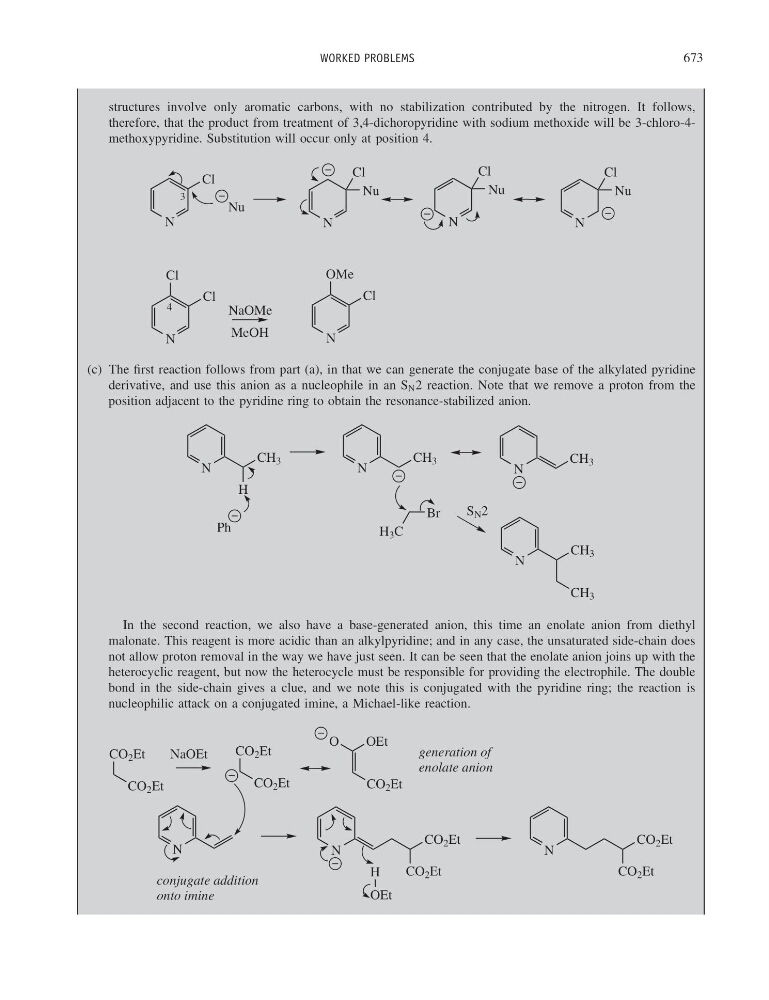
structures involve only aromatic carbons, with no stabilization contributed by the nitrogen. It follows,
therefore, that the product from treatment of 3,4-dichoropyridine with sodium methoxide will be 3-chloro-4methoxypyridine. Substitution will occur only at position 4.
N
Cl
NaOMe
MeOH
Cl
N
Nu
N
Nu
Cl
N
Nu
Cl
N
Nu
Cl
3
Cl
N
Cl
OMe
4
(c) The first reaction follows from part (a), in that we can generate the conjugate base of the alkylated pyridine
derivative, and use this anion as a nucleophile in an S N 2 reaction. Note that we remove a proton from the
position adjacent to the pyridine ring to obtain the resonance-stabilized anion.
N
CH 3
H
Ph
N
CH 3
N
CH 3
Br
H 3 C
N
CH 3
CH 3
S N 2
In the second reaction, we also have a base-generated anion, this time an enolate anion from diethyl
malonate. This reagent is more acidic than an alkylpyridine; and in any case, the unsaturated side-chain does
not allow proton removal in the way we have just seen. It can be seen that the enolate anion joins up with the
heterocyclic reagent, but now the heterocycle must be responsible for providing the electrophile. The double
bond in the side-chain gives a clue, and we note this is conjugated with the pyridine ring; the reaction is
nucleophilic attack on a conjugated imine, a Michael-like reaction.
CO 2 Et
CO 2 Et
N
CO 2 Et
CO 2 Et
CO 2 Et
CO 2 Et
CO 2 Et
O
OEt
N
NaOEt
N
CO 2 Et
CO 2 Et
H
OEt
generation of
enolate anion
conjugate addition
onto imine