

672
HOW TO APPROACH EXAMINATION QUESTIONS: SELECTED PROBLEMS AND ANSWERS
Answer 16.24
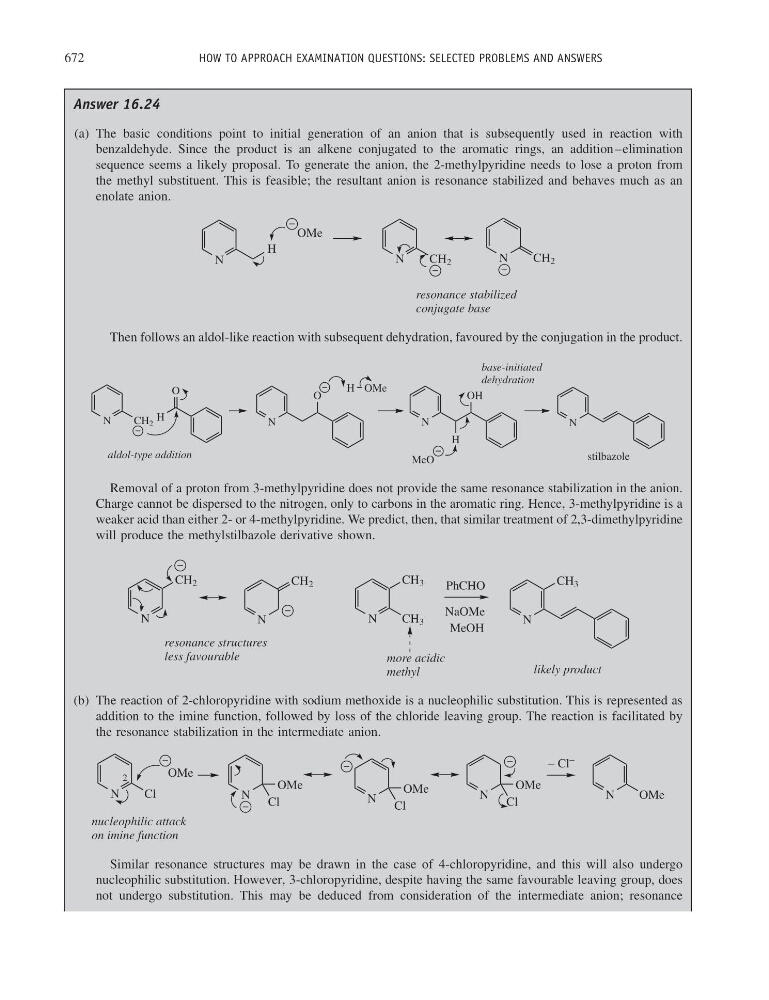
(a) The basic conditions point to initial generation of an anion that is subsequently used in reaction with
benzaldehyde. Since the product is an alkene conjugated to the aromatic rings, an addition–elimination
sequence seems a likely proposal. To generate the anion, the 2-methylpyridine needs to lose a proton from
the methyl substituent. This is feasible; the resultant anion is resonance stabilized and behaves much as an
enolate anion.
N
N
CH 2
N
CH 2
H
OMe
resonance stabilized
conjugate base
Then follows an aldol-like reaction with subsequent dehydration, favoured by the conjugation in the product.
N
CH 2
H
O
N
O
H OMe
N
OH
H
MeO
N
aldol-type addition
base-initiated
dehydration
stilbazole
Removal of a proton from 3-methylpyridine does not provide the same resonance stabilization in the anion.
Charge cannot be dispersed to the nitrogen, only to carbons in the aromatic ring. Hence, 3-methylpyridine is a
weaker acid than either 2- or 4-methylpyridine. We predict, then, that similar treatment of 2,3-dimethylpyridine
will produce the methylstilbazole derivative shown.
N
CH 3
CH 3
PhCHO
NaOMe
MeOH
N
CH 2
N
CH 2
resonance structures
less favourable
N
CH 3
more acidic
methyl
likely product
(b) The reaction of 2-chloropyridine with sodium methoxide is a nucleophilic substitution. This is represented as
addition to the imine function, followed by loss of the chloride leaving group. The reaction is facilitated by
the resonance stabilization in the intermediate anion.
N
N
OMe
Cl
N
OMe
Cl
N
OMe
Cl
− Cl
−
N
OMe
2
Cl
OMe
nucleophilic attack
on imine function
Similar resonance structures may be drawn in the case of 4-chloropyridine, and this will also undergo
nucleophilic substitution. However, 3-chloropyridine, despite having the same favourable leaving group, does
not undergo substitution. This may be deduced from consideration of the intermediate anion; resonance