

674
HOW TO APPROACH EXAMINATION QUESTIONS: SELECTED PROBLEMS AND ANSWERS
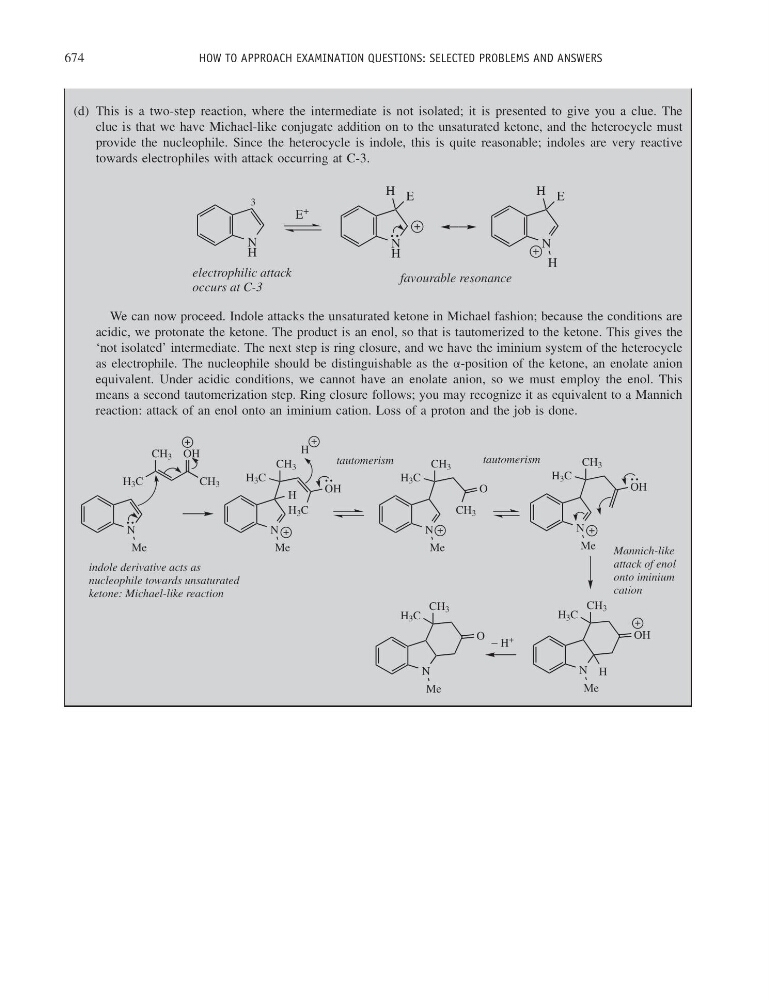
(d) This is a two-step reaction, where the intermediate is not isolated; it is presented to give you a clue. The
clue is that we have Michael-like conjugate addition on to the unsaturated ketone, and the heterocycle must
provide the nucleophile. Since the heterocycle is indole, this is quite reasonable; indoles are very reactive
towards electrophiles with attack occurring at C-3.
N
H
N
H
E +
E
H
N
E
H
H
favourable resonance
electrophilic attack
occurs at C-3
3
We can now proceed. Indole attacks the unsaturated ketone in Michael fashion; because the conditions are
acidic, we protonate the ketone. The product is an enol, so that is tautomerized to the ketone. This gives the
‘not isolated’ intermediate. The next step is ring closure, and we have the iminium system of the heterocycle
as electrophile. The nucleophile should be distinguishable as the α-position of the ketone, an enolate anion
equivalent. Under acidic conditions, we cannot have an enolate anion, so we must employ the enol. This
means a second tautomerization step. Ring closure follows; you may recognize it as equivalent to a Mannich
reaction: attack of an enol onto an iminium cation. Loss of a proton and the job is done.
N
Me
CH 3
H 3 C
OH
N
Me
H 3 C
CH 3
CH 3 OH
N
OH
H 3 C
CH 3
H 3 C
Me
H
H
N
O
CH 3
CH 3
H 3 C
Me
N
OH
CH 3
H 3 C
Me
N
Me
CH 3
H 3 C
O
H
− H
+
indole derivative acts as
nucleophile towards unsaturated
ketone: Michael-like reaction
tautomerism
tautomerism
Mannich-like
attack of enol
onto iminium
cation