

WORKED PROBLEMS
669
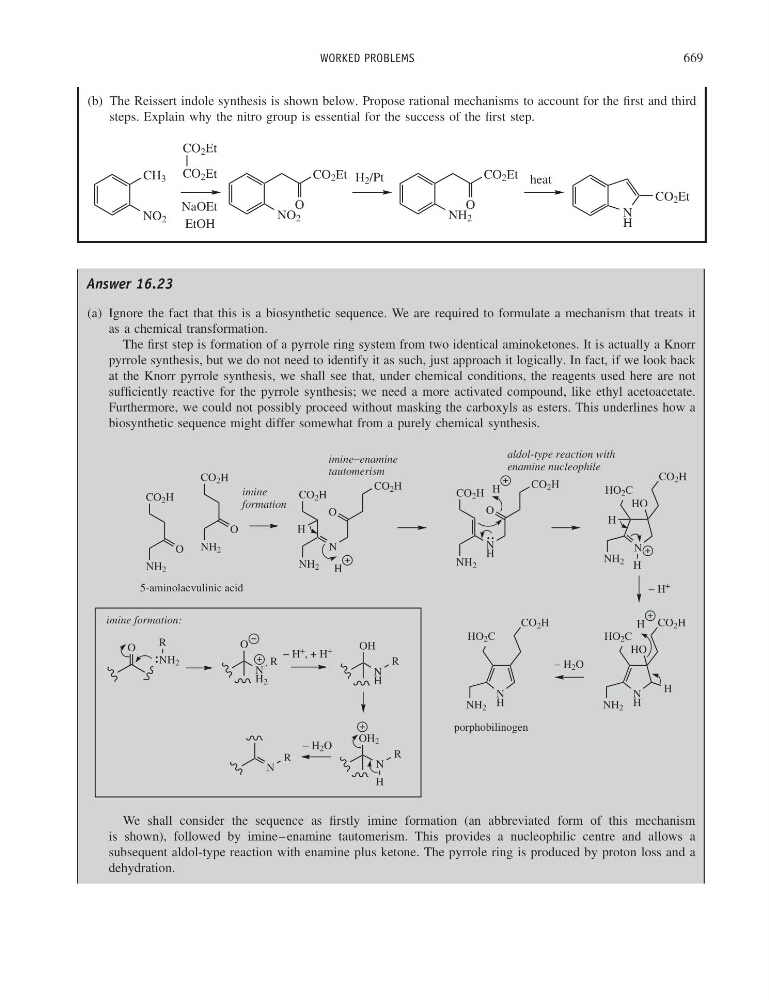
(b) The Reissert indole synthesis is shown below. Propose rational mechanisms to account for the first and third
steps. Explain why the nitro group is essential for the success of the first step.
CH 3
NO 2
NaOEt
EtOH
CO 2 Et
CO 2 Et
NO 2
CO 2 Et
O
H 2 /Pt
NH 2
CO 2 Et
O
N
H
CO 2 Et
heat
Answer 16.23
(a) Ignore the fact that this is a biosynthetic sequence. We are required to formulate a mechanism that treats it
as a chemical transformation.
The first step is formation of a pyrrole ring system from two identical aminoketones. It is actually a Knorr
pyrrole synthesis, but we do not need to identify it as such, just approach it logically. In fact, if we look back
at the Knorr pyrrole synthesis, we shall see that, under chemical conditions, the reagents used here are not
sufficiently reactive for the pyrrole synthesis; we need a more activated compound, like ethyl acetoacetate.
Furthermore, we could not possibly proceed without masking the carboxyls as esters. This underlines how a
biosynthetic sequence might differ somewhat from a purely chemical synthesis.
aldol-type reaction with
enamine nucleophile
CO 2 H
O
NH 2
5-aminolaevulinic acid
CO 2 H
O
NH 2
porphobilinogen
N
NH 2
CO 2 H
CO 2 H
O
imine
formation
H
H
N
H
NH 2
CO 2 H
CO 2 H
O
imine−enamine
tautomerism
H
N
NH 2
HO 2 C
CO 2 H
H
HO
N
H
NH 2
HO 2 C
CO 2 H
HO
H
H
H
N
H
NH 2
HO 2 C
CO 2 H
− H +
− H 2 O
O
N
H 2
O
N
H
OH
N
− H + , + H +
N
OH 2
− H 2 O
H
NH 2
R
R
R
R
R
imine formation:
We shall consider the sequence as firstly imine formation (an abbreviated form of this mechanism
is shown), followed by imine–enamine tautomerism. This provides a nucleophilic centre and allows a
subsequent aldol-type reaction with enamine plus ketone. The pyrrole ring is produced by proton loss and a
dehydration.