

668
HOW TO APPROACH EXAMINATION QUESTIONS: SELECTED PROBLEMS AND ANSWERS
4-amino substituent. We do not need to consider any further resonance structures. Effects involving the 2-amino
substituent will be the same whether N-1 or N-3 is protonated. We can predict that protonation occurs on
N-1.
Quinine has two potentially basic centres, a cyclic tertiary amine at a ring junction, and one in a
quinoline ring system. pK a 8.5 is reasonably basic, and this is most likely from the aliphatic tertiary
amine. We need to convince ourselves that the quinoline nitrogen is less basic. This is true. As far
as reactivity is concerned, a quinoline ring system behaves as two separate parts, either pyridine or
benzene, depending upon the reagent. Thus, quinoline has pK a very similar to that of pyridine, i.e.
around 5.
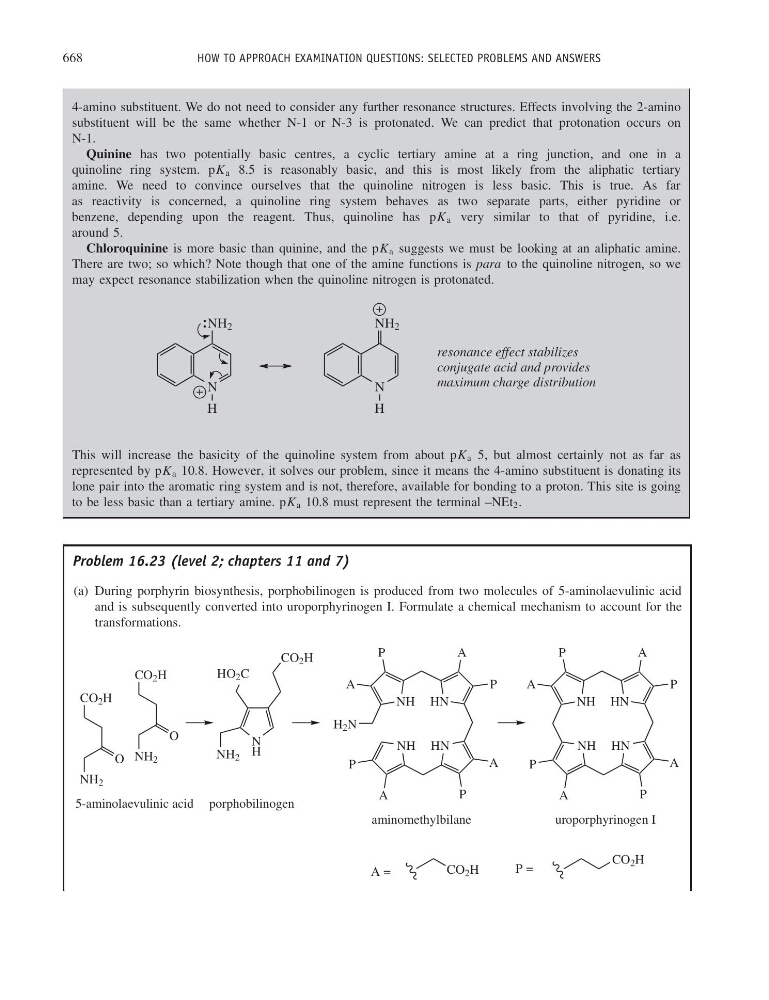
Chloroquinine is more basic than quinine, and the pK a suggests we must be looking at an aliphatic amine.
There are two; so which? Note though that one of the amine functions is para to the quinoline nitrogen, so we
may expect resonance stabilization when the quinoline nitrogen is protonated.
N
NH 2
H
N
NH 2
H
resonance effect stabilizes
conjugate acid and provides
maximum charge distribution
This will increase the basicity of the quinoline system from about pK a 5, but almost certainly not as far as
represented by pK a 10.8. However, it solves our problem, since it means the 4-amino substituent is donating its
lone pair into the aromatic ring system and is not, therefore, available for bonding to a proton. This site is going
to be less basic than a tertiary amine. pK a 10.8 must represent the terminal –NEt 2 .
Problem 16.23 (level 2; chapters 11 and 7)
(a) During porphyrin biosynthesis, porphobilinogen is produced from two molecules of 5-aminolaevulinic acid
and is subsequently converted into uroporphyrinogen I. Formulate a chemical mechanism to account for the
transformations.
CO 2 H
O
NH 2
5-aminolaevulinic acid
CO 2 H
O
NH 2
N
H
NH 2
HO 2 C
CO 2 H
porphobilinogen
NH
NH HN
HN
H 2 N
A
P
A
P
A
P
A
P
NH
NH HN
HN
A
P
A
P
A
P
A
P
aminomethylbilane
uroporphyrinogen I
A =
P =
CO 2 H
CO 2 H