

WORKED PROBLEMS
667
Nicotine has two nitrogen atoms, one as a cyclic tertiary amine and one in a pyridine ring. The basicities
are easily distinguished, in that a pyridine system is much less basic than a simple amine. This is essentially
a hybridization effect, the nitrogen lone pair in pyridine being held in an sp
2 orbital. This means the lone pair
electrons are held closer to the nitrogen, and are consequently less available for protonation than in an sp
3 -
hybridized aliphatic amine. Hence, as mentioned above, pyridine has pK a approximately 5. It follows that pK a
8.1 is more appropriate for the pyrrolidine nitrogen.
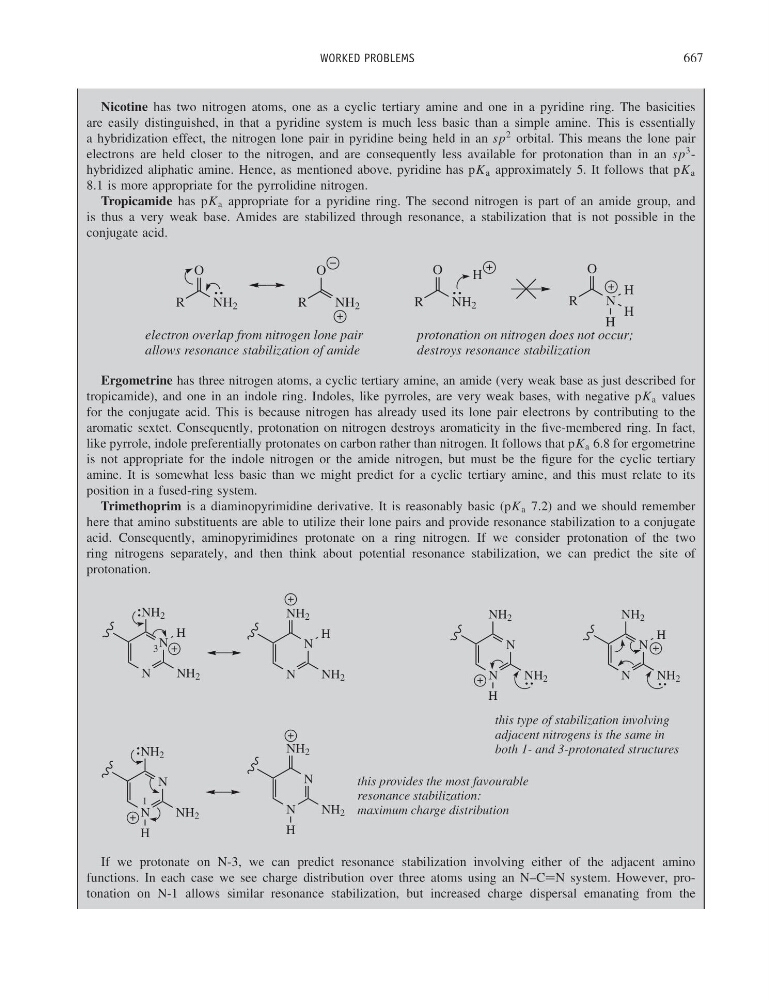
Tropicamide has pK a appropriate for a pyridine ring. The second nitrogen is part of an amide group, and
is thus a very weak base. Amides are stabilized through resonance, a stabilization that is not possible in the
conjugate acid.
O
R
NH 2
O
R
NH 2
O
R
NH 2
O
R
N
H
H
H
protonation on nitrogen does not occur;
destroys resonance stabilization
electron overlap from nitrogen lone pair
allows resonance stabilization of amide
H
Ergometrine has three nitrogen atoms, a cyclic tertiary amine, an amide (very weak base as just described for
tropicamide), and one in an indole ring. Indoles, like pyrroles, are very weak bases, with negative pK a values
for the conjugate acid. This is because nitrogen has already used its lone pair electrons by contributing to the
aromatic sextet. Consequently, protonation on nitrogen destroys aromaticity in the five-membered ring. In fact,
like pyrrole, indole preferentially protonates on carbon rather than nitrogen. It follows that pK a 6.8 for ergometrine
is not appropriate for the indole nitrogen or the amide nitrogen, but must be the figure for the cyclic tertiary
amine. It is somewhat less basic than we might predict for a cyclic tertiary amine, and this must relate to its
position in a fused-ring system.
Trimethoprim is a diaminopyrimidine derivative. It is reasonably basic (pK a 7.2) and we should remember
here that amino substituents are able to utilize their lone pairs and provide resonance stabilization to a conjugate
acid. Consequently, aminopyrimidines protonate on a ring nitrogen. If we consider protonation of the two
ring nitrogens separately, and then think about potential resonance stabilization, we can predict the site of
protonation.
N
N
NH 2
NH 2
N
N
NH 2
NH 2
H
H
N
N
NH 2
NH 2
H
N
N
NH 2
NH 2
H
N
N
NH 2
H
NH 2
this provides the most favourable
resonance stabilization:
maximum charge distribution
1
3
N
N
NH 2
NH 2
H
this type of stabilization involving
adjacent nitrogens is the same in
both 1- and 3-protonated structures
If we protonate on N-3, we can predict resonance stabilization involving either of the adjacent amino
functions. In each case we see charge distribution over three atoms using an N–C=N system. However, protonation on N-1 allows similar resonance stabilization, but increased charge dispersal emanating from the