

666
HOW TO APPROACH EXAMINATION QUESTIONS: SELECTED PROBLEMS AND ANSWERS
The next step is not immediately obvious. The generation of an ethyl ester from a lactone can be accommodated
by transesterification (we might alternatively consider esterification of the free hydroxyacid). The incorporation
of chlorine where we effectively had the alcohol part of the lactone leads us to nucleophilic substitution. That it
can be S N 1 is a consequence of the tertiary site. Cyclopropane ring formation from an S N 2 reaction in which an
enolate anion displaces a halide should be deducible from the structural relationships and basic conditions.
Problem 16.22 (level 2; chapters 4 and 11)
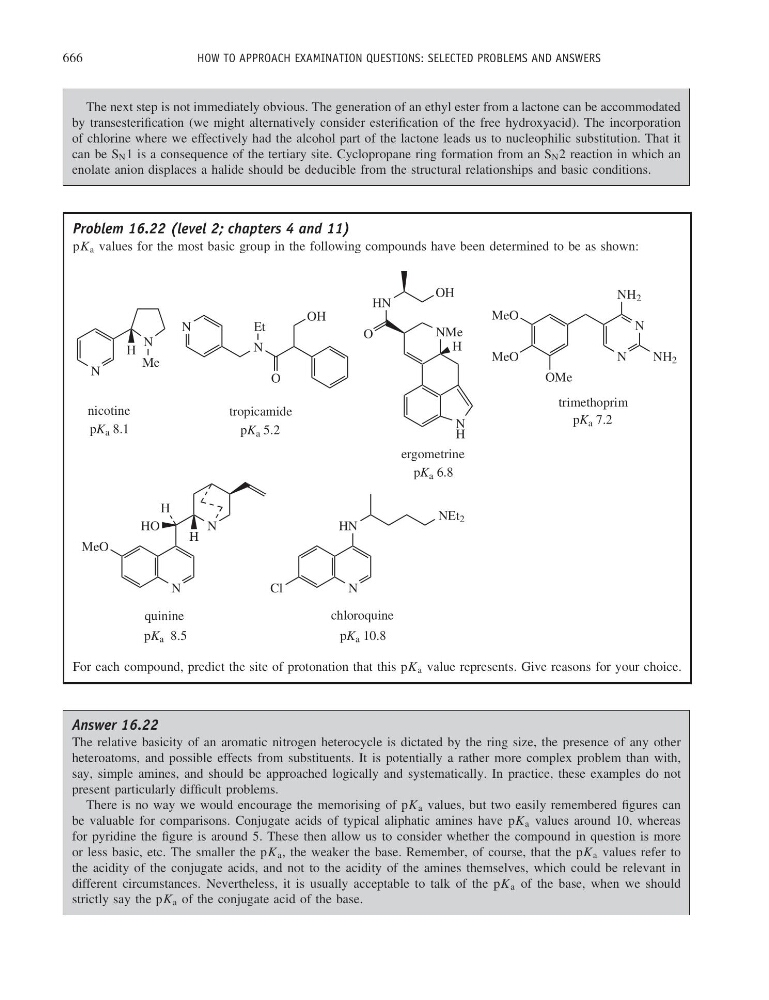
pK a values for the most basic group in the following compounds have been determined to be as shown:
N
N
O
Et
OH
tropicamide
N
N
MeO
MeO
OMe
NH 2
NH 2
trimethoprim
pK a 7.2
N
N
Me
nicotine
pK a 8.1
H
N
H
NMe
H
O
HN
OH
ergometrine
pK a 6.8
N
Cl
HN
NEt 2
chloroquine
pK a 10.8
N
N
H
H
HO
MeO
quinine
pK a 8.5
pK a 5.2
For each compound, predict the site of protonation that this pK a value represents. Give reasons for your choice.
Answer 16.22
The relative basicity of an aromatic nitrogen heterocycle is dictated by the ring size, the presence of any other
heteroatoms, and possible effects from substituents. It is potentially a rather more complex problem than with,
say, simple amines, and should be approached logically and systematically. In practice, these examples do not
present particularly difficult problems.
There is no way we would encourage the memorising of pK a values, but two easily remembered figures can
be valuable for comparisons. Conjugate acids of typical aliphatic amines have pK a values around 10, whereas
for pyridine the figure is around 5. These then allow us to consider whether the compound in question is more
or less basic, etc. The smaller the pK a , the weaker the base. Remember, of course, that the pK a values refer to
the acidity of the conjugate acids, and not to the acidity of the amines themselves, which could be relevant in
different circumstances. Nevertheless, it is usually acceptable to talk of the pK a of the base, when we should
strictly say the pK a of the conjugate acid of the base.