

WORKED PROBLEMS
665
Answer 16.21
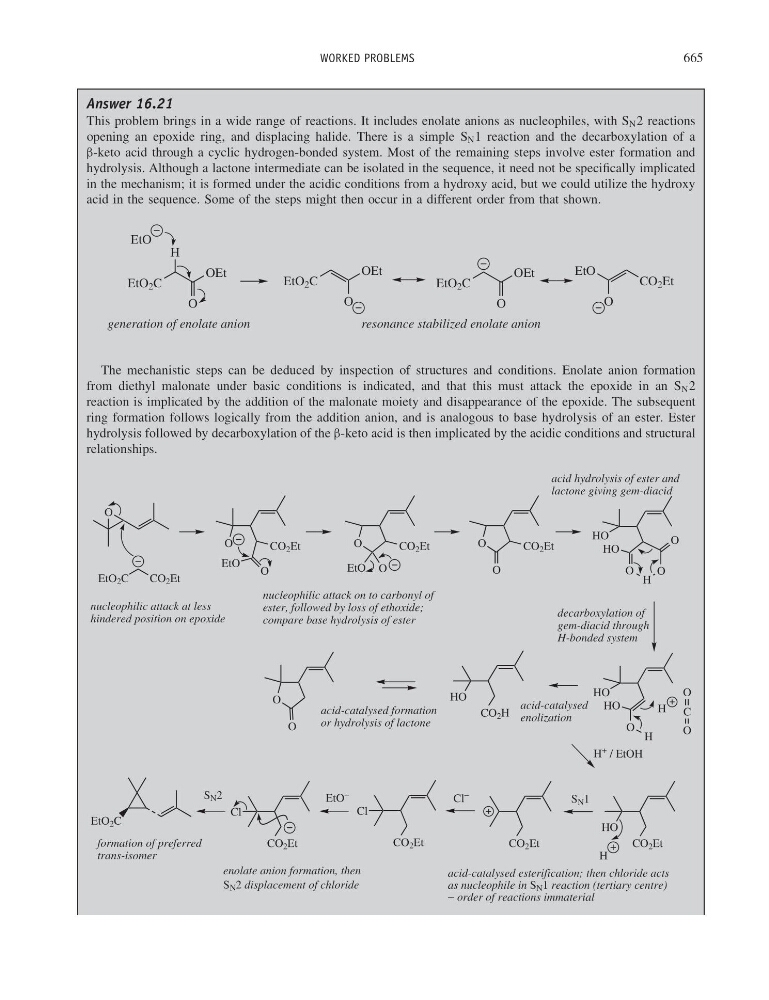
This problem brings in a wide range of reactions. It includes enolate anions as nucleophiles, with S N 2 reactions
opening an epoxide ring, and displacing halide. There is a simple S N 1 reaction and the decarboxylation of a
β-keto acid through a cyclic hydrogen-bonded system. Most of the remaining steps involve ester formation and
hydrolysis. Although a lactone intermediate can be isolated in the sequence, it need not be specifically implicated
in the mechanism; it is formed under the acidic conditions from a hydroxy acid, but we could utilize the hydroxy
acid in the sequence. Some of the steps might then occur in a different order from that shown.
H
EtO 2 C
OEt
O
EtO
EtO 2 C
OEt
O
EtO 2 C
OEt
O
CO 2 Et
EtO
O
resonance stabilized enolate anion
generation of enolate anion
The mechanistic steps can be deduced by inspection of structures and conditions. Enolate anion formation
from diethyl malonate under basic conditions is indicated, and that this must attack the epoxide in an S N 2
reaction is implicated by the addition of the malonate moiety and disappearance of the epoxide. The subsequent
ring formation follows logically from the addition anion, and is analogous to base hydrolysis of an ester. Ester
hydrolysis followed by decarboxylation of the β-keto acid is then implicated by the acidic conditions and structural
relationships.
O
CO 2 Et
Cl
EtO 2 C
EtO 2 C
CO 2 Et
O
O
CO 2 Et
O
CO 2 Et
O
EtO
O
O
HO
O
O
O
H
CO 2 Et
Cl
formation of preferred
trans-isomer
nucleophilic attack at less
hindered position on epoxide
nucleophilic attack on to carbonyl of
ester, followed by loss of ethoxide;
compare base hydrolysis of ester
acid hydrolysis of ester and
lactone giving gem-diacid
decarboxylation of
gem-diacid through
H-bonded system
CO 2 H
HO
HO
CO 2 Et
HO
acid-catalysed formation
or hydrolysis of lactone
acid-catalysed esterification; then chloride acts
as nucleophile in S N 1 reaction (tertiary centre)
− order of reactions immaterial
S N 2
S N 1
O
O
CO 2 Et
EtO
HO
O
C
O
O
H
HO
H
acid-catalysed
enolization
H
+ / EtOH
Cl
−
CO 2 Et
enolate anion formation, then
S N 2 displacement of chloride
EtO −
H