

670
HOW TO APPROACH EXAMINATION QUESTIONS: SELECTED PROBLEMS AND ANSWERS
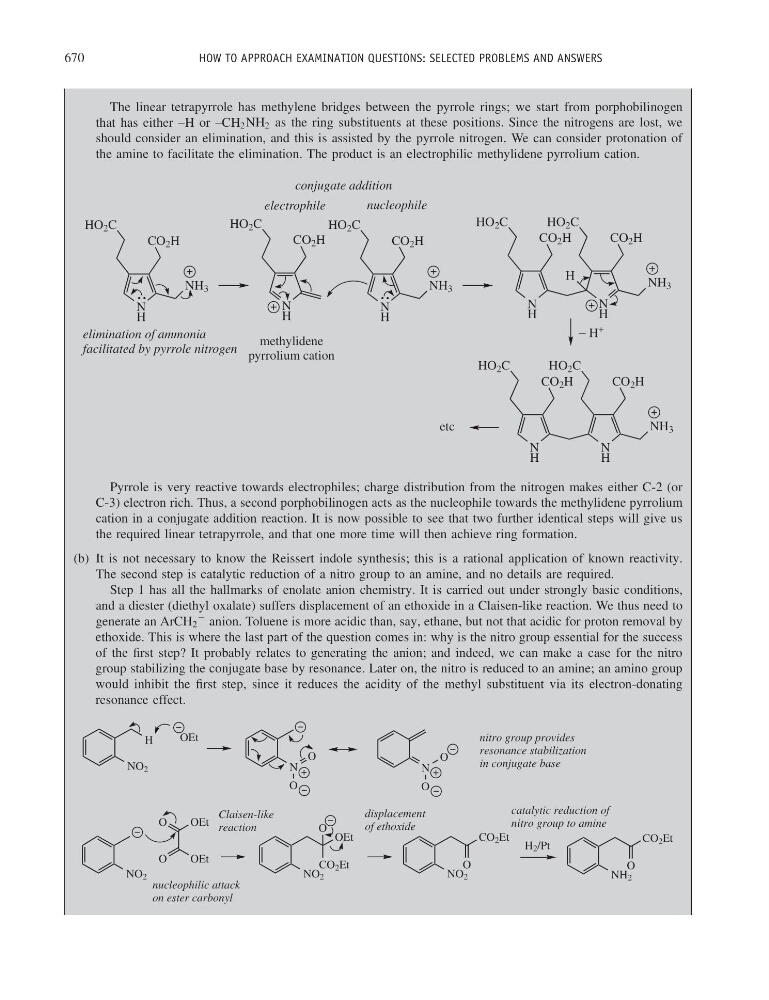
The linear tetrapyrrole has methylene bridges between the pyrrole rings; we start from porphobilinogen
that has either –H or –CH 2 NH 2 as the ring substituents at these positions. Since the nitrogens are lost, we
should consider an elimination, and this is assisted by the pyrrole nitrogen. We can consider protonation of
the amine to facilitate the elimination. The product is an electrophilic methylidene pyrrolium cation.
N
H
NH 3
HO 2 C
CO 2 H
N
H
HO 2 C
CO 2 H
N
H
NH 3
HO 2 C
CO 2 H
etc
elimination of ammonia
facilitated by pyrrole nitrogen
methylidene
pyrrolium cation
N
H
HO 2 C
CO 2 H
N
H
NH 3
HO 2 C
CO 2 H
H
N
H
HO 2 C
CO 2 H
N
H
NH 3
HO 2 C
CO 2 H
electrophile
nucleophile
conjugate addition
− H
+
Pyrrole is very reactive towards electrophiles; charge distribution from the nitrogen makes either C-2 (or
C-3) electron rich. Thus, a second porphobilinogen acts as the nucleophile towards the methylidene pyrrolium
cation in a conjugate addition reaction. It is now possible to see that two further identical steps will give us
the required linear tetrapyrrole, and that one more time will then achieve ring formation.
(b) It is not necessary to know the Reissert indole synthesis; this is a rational application of known reactivity.
The second step is catalytic reduction of a nitro group to an amine, and no details are required.
Step 1 has all the hallmarks of enolate anion chemistry. It is carried out under strongly basic conditions,
and a diester (diethyl oxalate) suffers displacement of an ethoxide in a Claisen-like reaction. We thus need to
generate an ArCH 2
− anion. Toluene is more acidic than, say, ethane, but not that acidic for proton removal by
ethoxide. This is where the last part of the question comes in: why is the nitro group essential for the success
of the first step? It probably relates to generating the anion; and indeed, we can make a case for the nitro
group stabilizing the conjugate base by resonance. Later on, the nitro is reduced to an amine; an amino group
would inhibit the first step, since it reduces the acidity of the methyl substituent via its electron-donating
resonance effect.
NO 2
H
OEt
N
O
O
N
O
O
nitro group provides
resonance stabilization
in conjugate base
NO 2
O
OEt
O
OEt
NO 2
OEt
CO 2 Et
O
NO 2
CO 2 Et
O
nucleophilic attack
on ester carbonyl
displacement
of ethoxide
H 2 /Pt
NH 2
CO 2 Et
O
Claisen-like
reaction
catalytic reduction of
nitro group to amine