

WORKED PROBLEMS
659
reverse Claisen reaction
CO 2 Et
O
HO
O
HO
CO 2 Et
O
OH
CO 2 Et
OEt
O
HO H
OEt
O
OH
OEt
O
OH
CO 2 H
nucleophile
attacks carbonyl
loss of enolate anion
as leaving group
resonance stabilized
enolate anion
protonation of enolate
anion
basic hydrolysis of ester
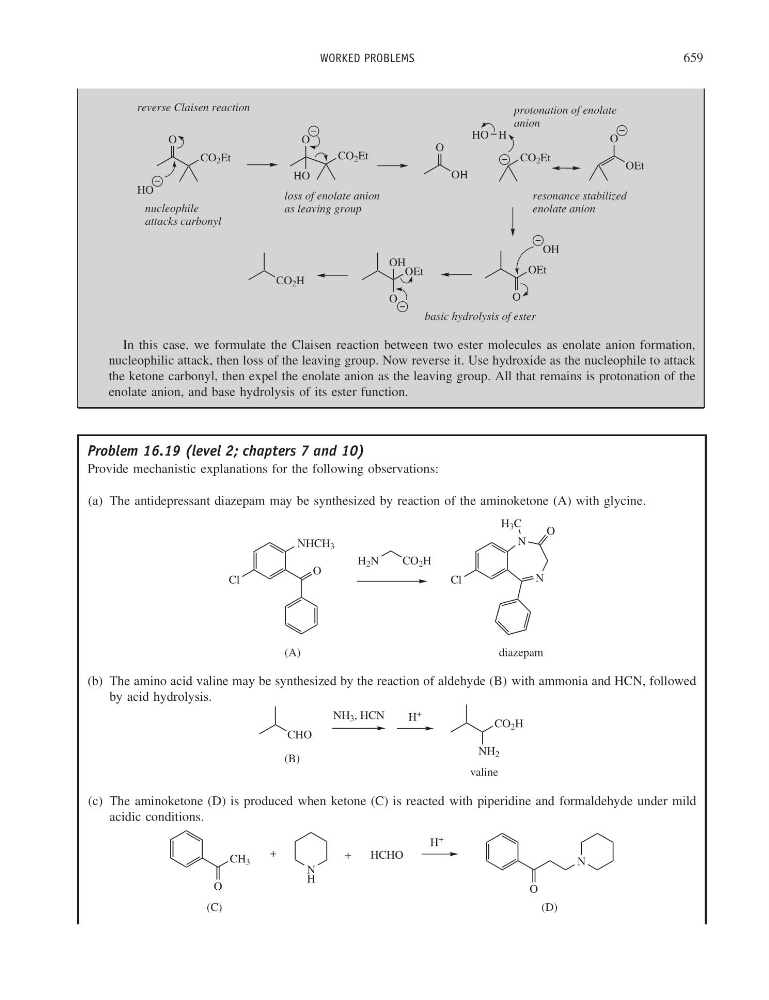
In this case, we formulate the Claisen reaction between two ester molecules as enolate anion formation,
nucleophilic attack, then loss of the leaving group. Now reverse it. Use hydroxide as the nucleophile to attack
the ketone carbonyl, then expel the enolate anion as the leaving group. All that remains is protonation of the
enolate anion, and base hydrolysis of its ester function.
Problem 16.19 (level 2; chapters 7 and 10)
Provide mechanistic explanations for the following observations:
(a) The antidepressant diazepam may be synthesized by reaction of the aminoketone (A) with glycine.
NHCH 3
O
Cl
H 2 N
CO 2 H
Cl
N
N
H 3 C
O
diazepam
(A)
(b) The amino acid valine may be synthesized by the reaction of aldehyde (B) with ammonia and HCN, followed
by acid hydrolysis.
CHO
NH 3 , HCN
CO 2 H
NH 2
valine
H
+
(B)
(c) The aminoketone (D) is produced when ketone (C) is reacted with piperidine and formaldehyde under mild
acidic conditions.
CH 3
O
N
H
+
+
HCHO
H +
O
N
(C)
(D)