

658
HOW TO APPROACH EXAMINATION QUESTIONS: SELECTED PROBLEMS AND ANSWERS
Base removes a proton from adjacent to a carbonyl group. We can use a general B
− to represent the base;
however, we could use hydroxide, since that is released upon dissolving sodium carbonate in water. It does
not matter which α-position we choose; they are actually all equivalent in this symmetrical substrate. The
nucleophilic attack of the enolate anion onto the second carbonyl is followed by base-initiated dehydration, so
that a favourable conjugated ketone is the product. As you can see, the size of the ring systems is automatically
defined by the reaction.
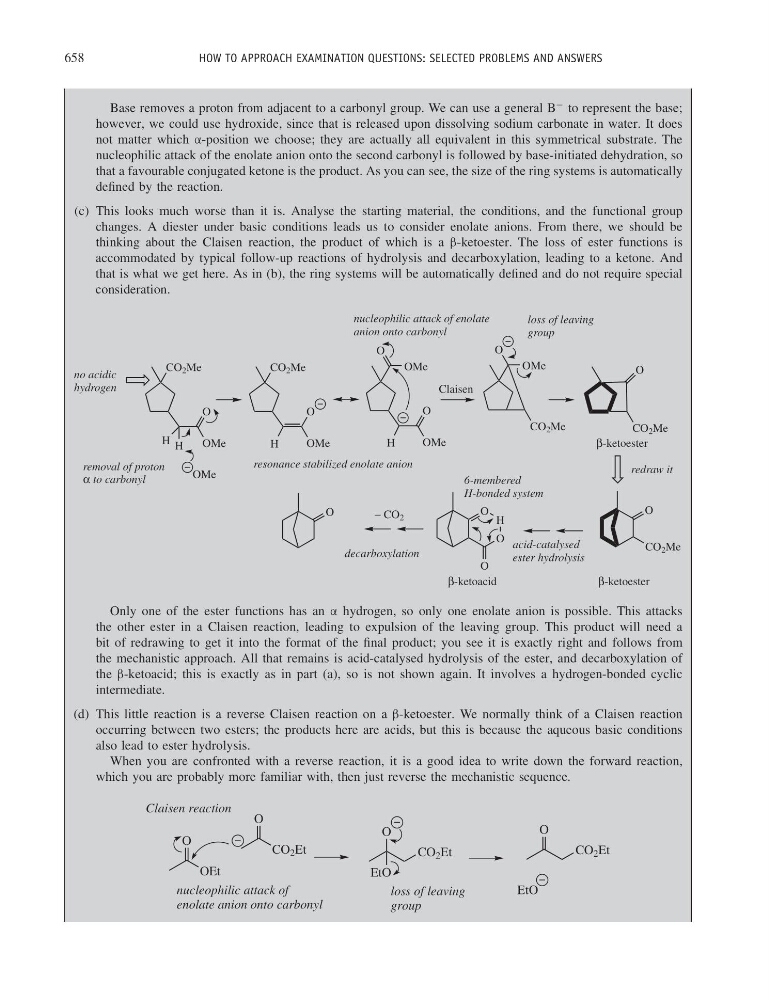
(c) This looks much worse than it is. Analyse the starting material, the conditions, and the functional group
changes. A diester under basic conditions leads us to consider enolate anions. From there, we should be
thinking about the Claisen reaction, the product of which is a β-ketoester. The loss of ester functions is
accommodated by typical follow-up reactions of hydrolysis and decarboxylation, leading to a ketone. And
that is what we get here. As in (b), the ring systems will be automatically defined and do not require special
consideration.
CO 2 Me
H
H
OMe
O
OMe
CO 2 Me
OMe
O
H
OMe
O
H
O
OMe
OMe
O
CO 2 Me
CO 2 Me
O
O
CO 2 Me
O
O
O
H
O
no acidic
hydrogen
removal of proton
α to carbonyl
resonance stabilized enolate anion
nucleophilic attack of enolate
anion onto carbonyl
loss of leaving
group
β-ketoacid
β-ketoester
redraw it
β-ketoester
6-membered
H-bonded system
− CO 2
decarboxylation
acid-catalysed
ester hydrolysis
Claisen
Only one of the ester functions has an α hydrogen, so only one enolate anion is possible. This attacks
the other ester in a Claisen reaction, leading to expulsion of the leaving group. This product will need a
bit of redrawing to get it into the format of the final product; you see it is exactly right and follows from
the mechanistic approach. All that remains is acid-catalysed hydrolysis of the ester, and decarboxylation of
the β-ketoacid; this is exactly as in part (a), so is not shown again. It involves a hydrogen-bonded cyclic
intermediate.
(d) This little reaction is a reverse Claisen reaction on a β-ketoester. We normally think of a Claisen reaction
occurring between two esters; the products here are acids, but this is because the aqueous basic conditions
also lead to ester hydrolysis.
When you are confronted with a reverse reaction, it is a good idea to write down the forward reaction,
which you are probably more familiar with, then just reverse the mechanistic sequence.
O
OEt
O
CO 2 Et
O
EtO
CO 2 Et
O
EtO
Claisen reaction
CO 2 Et
nucleophilic attack of
enolate anion onto carbonyl
loss of leaving
group