

WORKED PROBLEMS
657
O
H 3 C
OEt
O
H
OEt
O
H 3 C
OEt
O
H
O
H 3 C
OEt
O
H
H
O
H 3 C
OEt
O
H
O
H 3 C
OEt
O
H
O
H 3 C
OEt
O
Br
Br
Br
O
H 3 C
OEt
O
Br
base removes acidic proton;
hydrogens between the two
carbonyls are the most acidic
resonance stabilized enolate anion
S N 2
enolate anion
nucleophile
displaces halide
hydrogen between
carbonyls still acidic
EtO
−
enolate anion
formation
S N 2
second S N 2 reaction
β-ketoester
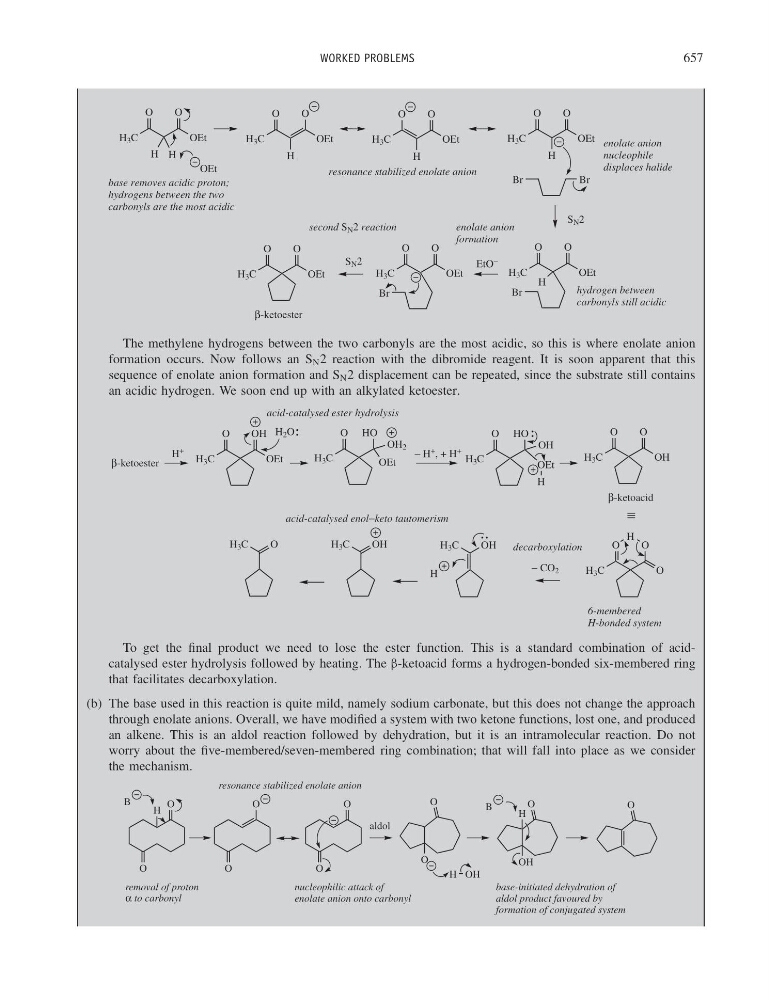
The methylene hydrogens between the two carbonyls are the most acidic, so this is where enolate anion
formation occurs. Now follows an S N 2 reaction with the dibromide reagent. It is soon apparent that this
sequence of enolate anion formation and S N 2 displacement can be repeated, since the substrate still contains
an acidic hydrogen. We soon end up with an alkylated ketoester.
O
H 3 C
OEt
OH H 2 O
O
H 3 C
OEt
HO
OH 2
O
H 3 C
OEt
HO
OH
H
O
H 3 C
OH
O
O
H 3 C
O
O
H
H 3 C
OH
H
H 3 C
OH
H 3 C
O
H
+
acid-catalysed ester hydrolysis
− H + , + H +
β-ketoacid
β-ketoester
≡
6-membered
H-bonded system
− CO 2
decarboxylation
acid-catalysed enol−keto tautomerism
To get the final product we need to lose the ester function. This is a standard combination of acidcatalysed ester hydrolysis followed by heating. The β-ketoacid forms a hydrogen-bonded six-membered ring
that facilitates decarboxylation.
(b) The base used in this reaction is quite mild, namely sodium carbonate, but this does not change the approach
through enolate anions. Overall, we have modified a system with two ketone functions, lost one, and produced
an alkene. This is an aldol reaction followed by dehydration, but it is an intramolecular reaction. Do not
worry about the five-membered/seven-membered ring combination; that will fall into place as we consider
the mechanism.
O
O
H
B
O
O
O
O
O
O
H OH
O
OH
H
B
O
removal of proton
α to carbonyl
resonance stabilized enolate anion
nucleophilic attack of
enolate anion onto carbonyl
base-initiated dehydration of
aldol product favoured by
formation of conjugated system
aldol