

656
HOW TO APPROACH EXAMINATION QUESTIONS: SELECTED PROBLEMS AND ANSWERS
Problem 16.18 (level 2; chapters 7 and 10)
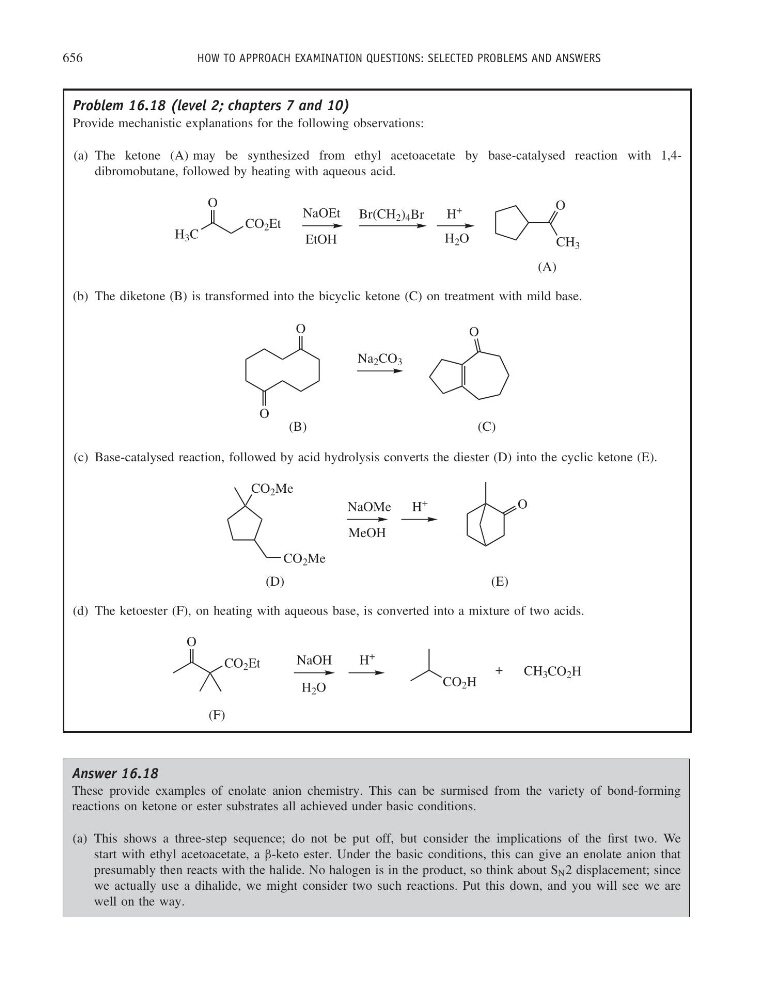
Provide mechanistic explanations for the following observations:
(a) The ketone (A) may be synthesized from ethyl acetoacetate by base-catalysed reaction with 1,4dibromobutane, followed by heating with aqueous acid.
O
CH 3
O
H 3 C
CO 2 Et
NaOEt
EtOH
H +
H 2 O
Br(CH 2 ) 4 Br
(A)
(b) The diketone (B) is transformed into the bicyclic ketone (C) on treatment with mild base.
O
O
O
Na 2 CO 3
(B)
(C)
(c) Base-catalysed reaction, followed by acid hydrolysis converts the diester (D) into the cyclic ketone (E).
O
CO 2 Me
CO 2 Me
H +
NaOMe
MeOH
(D)
(E)
(d) The ketoester (F), on heating with aqueous base, is converted into a mixture of two acids.
CO 2 Et
O
CO 2 H
+
H
+
NaOH
H 2 O
(F)
CH 3 CO 2 H
Answer 16.18
These provide examples of enolate anion chemistry. This can be surmised from the variety of bond-forming
reactions on ketone or ester substrates all achieved under basic conditions.
(a) This shows a three-step sequence; do not be put off, but consider the implications of the first two. We
start with ethyl acetoacetate, a β-keto ester. Under the basic conditions, this can give an enolate anion that
presumably then reacts with the halide. No halogen is in the product, so think about S N 2 displacement; since
we actually use a dihalide, we might consider two such reactions. Put this down, and you will see we are
well on the way.