

WORKED PROBLEMS
655
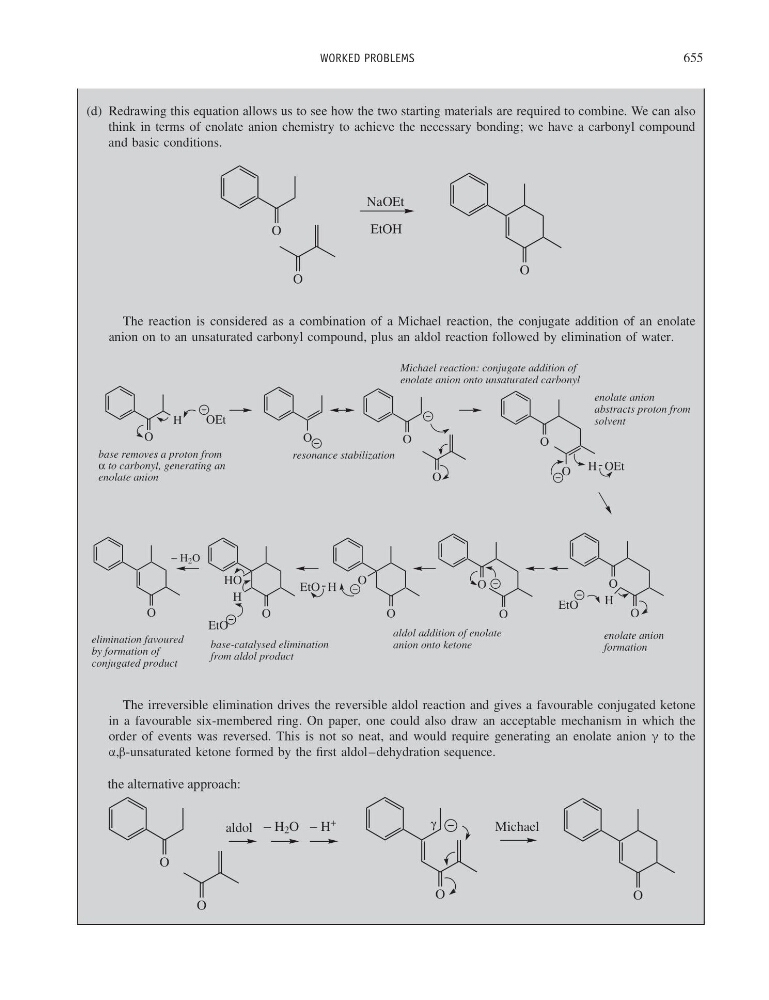
(d) Redrawing this equation allows us to see how the two starting materials are required to combine. We can also
think in terms of enolate anion chemistry to achieve the necessary bonding; we have a carbonyl compound
and basic conditions.
O
O
NaOEt
EtOH
O
The reaction is considered as a combination of a Michael reaction, the conjugate addition of an enolate
anion on to an unsaturated carbonyl compound, plus an aldol reaction followed by elimination of water.
O
H
OEt
O
O
O
O
O H OEt
O
O
H
EtO
O
O
O
O
H
EtO
O
HO
H
EtO
O
base removes a proton from
α to carbonyl, generating an
enolate anion
resonance stabilization
Michael reaction: conjugate addition of
enolate anion onto unsaturated carbonyl
enolate anion
abstracts proton from
solvent
enolate anion
formation
aldol addition of enolate
anion onto ketone
base-catalysed elimination
from aldol product
elimination favoured
by formation of
conjugated product
− H 2 O
The irreversible elimination drives the reversible aldol reaction and gives a favourable conjugated ketone
in a favourable six-membered ring. On paper, one could also draw an acceptable mechanism in which the
order of events was reversed. This is not so neat, and would require generating an enolate anion γ to the
α,β-unsaturated ketone formed by the first aldol–dehydration sequence.
O
O
O
γ
the alternative approach:
aldol − H 2 O
Michael
− H
+
O