

660
HOW TO APPROACH EXAMINATION QUESTIONS: SELECTED PROBLEMS AND ANSWERS
(d) Dopamine reacts readily with acetaldehyde to produce the cyclic amine salsolinol.
NH 2
HO
HO
NH
HO
HO
CH 3
dopamine
salsolinol
CH 3 CHO
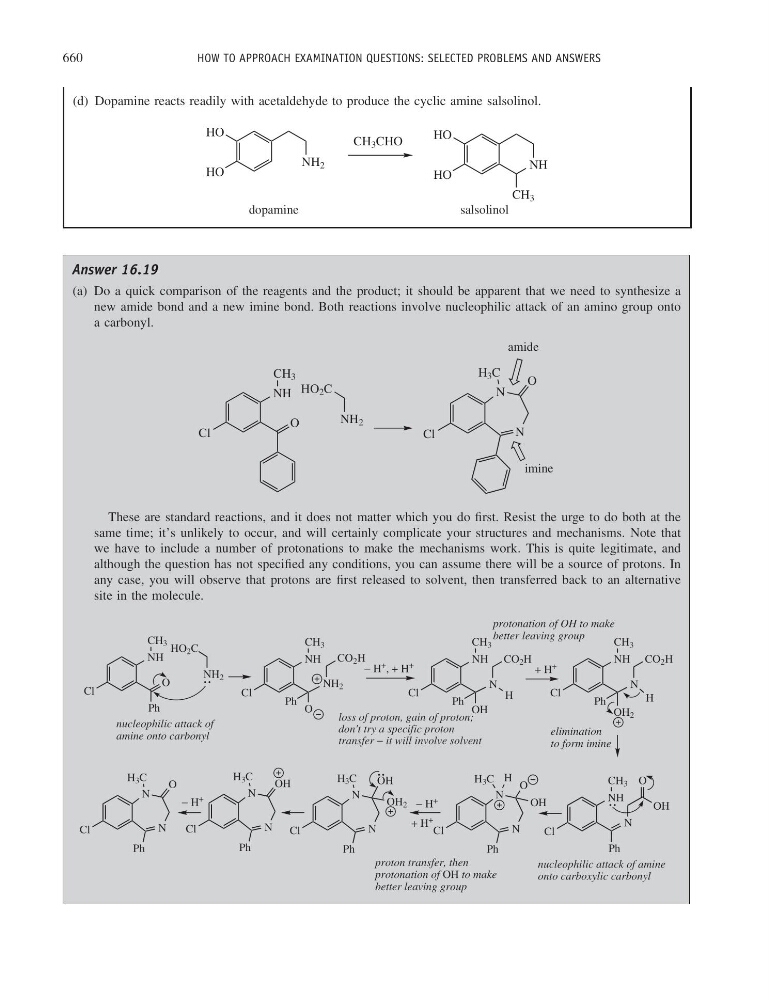
Answer 16.19
(a) Do a quick comparison of the reagents and the product; it should be apparent that we need to synthesize a
new amide bond and a new imine bond. Both reactions involve nucleophilic attack of an amino group onto
a carbonyl.
NH
O
Cl
Cl
N
N
H 3 C
O
CH 3
NH 2
HO 2 C
amide
imine
These are standard reactions, and it does not matter which you do first. Resist the urge to do both at the
same time; it’s unlikely to occur, and will certainly complicate your structures and mechanisms. Note that
we have to include a number of protonations to make the mechanisms work. This is quite legitimate, and
although the question has not specified any conditions, you can assume there will be a source of protons. In
any case, you will observe that protons are first released to solvent, then transferred back to an alternative
site in the molecule.
NH
O
Ph
Cl
CH 3
NH 2
HO 2 C
NH
NH 2
O
Cl
CH 3
CO 2 H
NH
N
OH
Cl
CH 3
CO 2 H
H
NH
N
OH 2
Cl
CH 3
CO 2 H
H
Ph
Ph
Ph
NH
N
Cl
CH 3
Ph
O
OH
Cl
N
N
H 3 C
Ph
O
Cl
N
N
H 3 C
Ph
O
OH
Cl
N
N
H 3 C
Ph
OH
OH 2
Cl
N
N
H 3 C
Ph
OH
nucleophilic attack of
amine onto carbonyl
− H
+
, + H
+
loss of proton, gain of proton;
don't try a specific proton
transfer − it will involve solvent
protonation of OH to make
better leaving group
+ H
+
nucleophilic attack of amine
onto carboxylic carbonyl
+ H
+
proton transfer, then
protonation of OH to make
better leaving group
elimination
to form imine
− H
+
− H +
H