

646
HOW TO APPROACH EXAMINATION QUESTIONS: SELECTED PROBLEMS AND ANSWERS
Now do the same for the second compound, and keep thinking about rearrangements. We can formulate
this in the same way once we see that a hydride migration would achieve the secondary to tertiary carbocation
change.
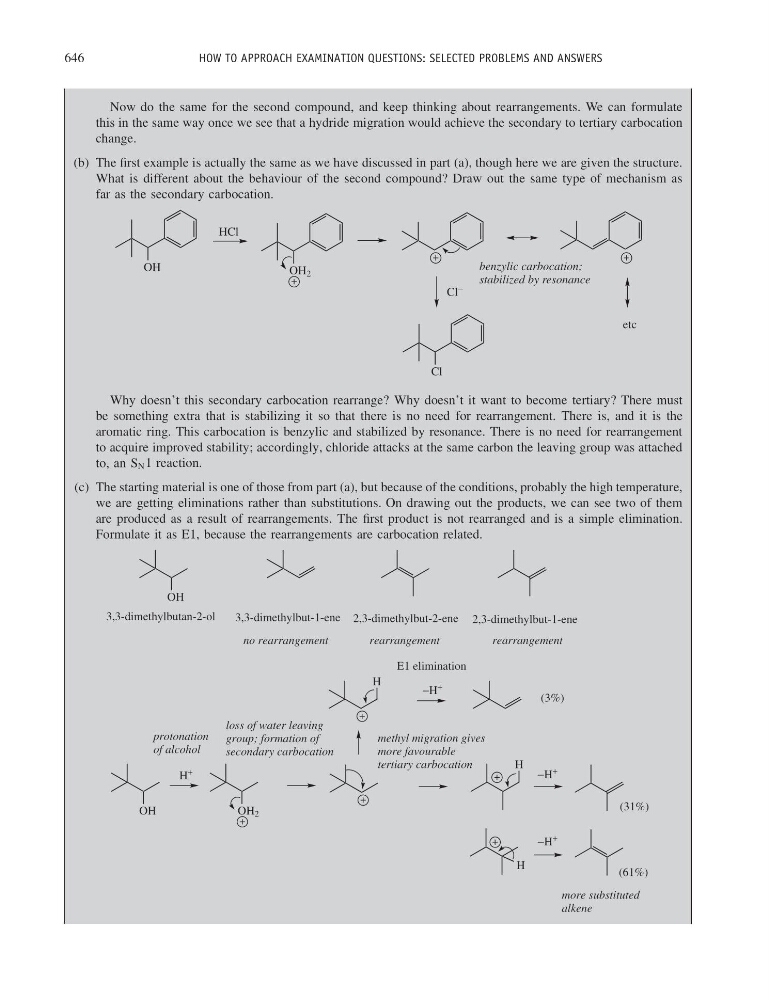
(b) The first example is actually the same as we have discussed in part (a), though here we are given the structure.
What is different about the behaviour of the second compound? Draw out the same type of mechanism as
far as the secondary carbocation.
OH
Cl
HCl
OH 2
etc
Cl −
benzylic carbocation;
stabilized by resonance
Why doesn’t this secondary carbocation rearrange? Why doesn’t it want to become tertiary? There must
be something extra that is stabilizing it so that there is no need for rearrangement. There is, and it is the
aromatic ring. This carbocation is benzylic and stabilized by resonance. There is no need for rearrangement
to acquire improved stability; accordingly, chloride attacks at the same carbon the leaving group was attached
to, an S N 1 reaction.
(c) The starting material is one of those from part (a), but because of the conditions, probably the high temperature,
we are getting eliminations rather than substitutions. On drawing out the products, we can see two of them
are produced as a result of rearrangements. The first product is not rearranged and is a simple elimination.
Formulate it as E1, because the rearrangements are carbocation related.
OH
3,3-dimethylbutan-2-ol
3,3-dimethylbut-1-ene 2,3-dimethylbut-2-ene 2,3-dimethylbut-1-ene
no rearrangement
rearrangement
rearrangement
OH
OH 2
H
+
protonation
of alcohol
loss of water leaving
group; formation of
secondary carbocation
methyl migration gives
more favourable
tertiary carbocation
H
E1 elimination
−H +
H −H
+
H
−H
+
more substituted
alkene
(3%)
(31%)
(61%)