

WORKED PROBLEMS
647
Methyl migration as in part (a) converts the first-formed secondary carbocation into a more favourable
tertiary carbocation, and we see proton loss from this to give the other two products. These are unexceptional;
there are two possible sites for proton loss.
Now for the relative proportions of products. Only 3% of the unrearranged product shows just how
unfavourable the secondary carbocation is compared with the rearranged tertiary carbocation. The relative
proportions of the other two alkenes are explained by the increased thermodynamic stability of the moresubstituted alkene, though this is not sufficient to produce just the single product.
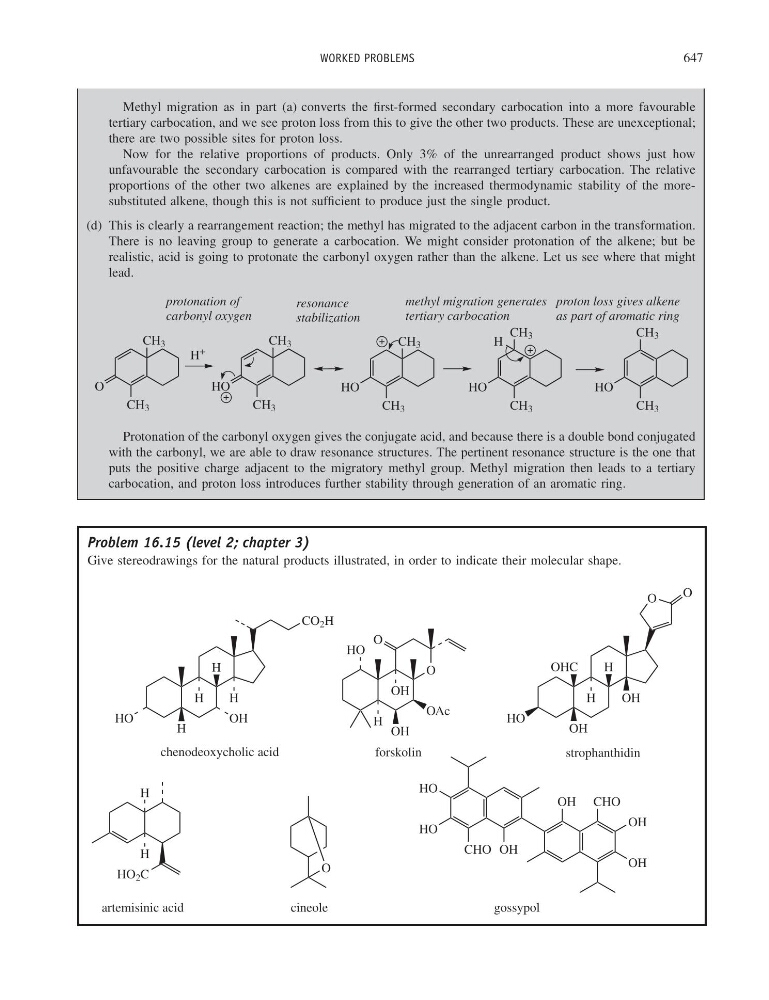
(d) This is clearly a rearrangement reaction; the methyl has migrated to the adjacent carbon in the transformation.
There is no leaving group to generate a carbocation. We might consider protonation of the alkene; but be
realistic, acid is going to protonate the carbonyl oxygen rather than the alkene. Let us see where that might
lead.
CH 3
O
CH 3
H
+
HO
CH 3
CH 3
CH 3
HO
CH 3
CH 3
HO
CH 3
HO
CH 3
CH 3
H
protonation of
carbonyl oxygen
resonance
stabilization
methyl migration generates
tertiary carbocation
proton loss gives alkene
as part of aromatic ring
Protonation of the carbonyl oxygen gives the conjugate acid, and because there is a double bond conjugated
with the carbonyl, we are able to draw resonance structures. The pertinent resonance structure is the one that
puts the positive charge adjacent to the migratory methyl group. Methyl migration then leads to a tertiary
carbocation, and proton loss introduces further stability through generation of an aromatic ring.
Problem 16.15 (level 2; chapter 3)
Give stereodrawings for the natural products illustrated, in order to indicate their molecular shape.
H
H
HO 2 C
artemisinic acid
H
H
H
HO
H
OH
CO 2 H
chenodeoxycholic acid
H
OH
O
O
HO
OH
OAc
forskolin
O
cineole
OHC
OH
OH
O
O
HO
H
H
strophanthidin
CHO
OH
OH
OH
CHO
HO
HO
OH
gossypol